
For SaaS and tech companies with English sites.
:quality(80))
10 Best Surfer SEO Alternatives in 2026, Tested, Reviewed, and Compared
:quality(80)) Georg Richard Aare
Georg Richard Aare For SaaS and tech companies with English sites.
I've lost count of how many times I've watched a content score turn green and the article still go nowhere.
You stuff in the NLP terms, hit the word count target, and the score turns green. But the content reads like a SERP digest — no brand voice, no original insight, nothing a competitor couldn't publish tomorrow.
I tested all 10 tools on this list while building RankUp, an agentic SEO content platform. That meant running them against real production workflows, not demo keywords, and asking which ones actually moved the needle on content quality, workflow coverage, and brand voice.
Those three checks separate tools that improve the finished article from tools that only produce a score. Each entry shows what the tool completes, where manual work remains, who it fits, and what it costs.
What to look for in a Surfer SEO alternative
The five checks below show how much work each alternative completes and how useful its output is.
How these alternatives were selected
The ten tools were selected for workflow coverage and relevance to SaaS content teams.
I evaluated them using:
1. How much of the workflow does the tool actually cover?
Some tools cover research and briefing but stop before the writing phase. Others focus on optimization only, with no content generation at scale. The coverage varies widely, and the gaps add up.
If you're replacing Surfer to simplify your stack, make sure the replacement doesn't just shift the manual work elsewhere.
2. Optimization quality: scoring depth vs. score-chasing
Real-time SERP-driven scoring and semantic keyword suggestions are the baseline for any Surfer replacement. The differentiator is whether the tool grounds its suggestions in search intent or just keyword frequency targets.
Score-chasing is a real trap. You hit the keyword density target, the score turns green, and the content still doesn't match what the searcher actually wants. Tools that surface intent classification and competitor structure data alongside scores give you a much better signal than raw NLP term lists.
3. Research and briefing depth
If SERP analysis and brief generation is your primary use case, a keyword list alone isn't enough. Look for tools that include competitor heading analysis, search intent mapping, and People Also Ask extraction.
The depth of intent data and brief quality varies significantly across tools. Some provide rich SERP structure analysis and PAA extraction. Others just surface keyword lists and call it a brief.
4. How much context carries into the next session?
Tools that reset for every keyword make teams reload their positioning, product details, audience, and previous decisions each time.
That rebuild time compounds across a content calendar. Include those repeated setup hours when you compare the actual cost of each tool.
5. Is AI-search readiness built into the workflow?
AI-search-ready content needs clear answers, precise entities, and first-hand product context. Keyword counts alone do not provide those signals.
Look for a workflow that can:
Put a direct answer near the start of a section
Name products, people, and concepts precisely
Carry brand evidence and voice into the final draft
Generic output weakens the expertise signals that make a page useful to readers and citable in ChatGPT, Perplexity, Gemini, and Google AI Overviews.
Our complete guide to SEO content explains these signals in more detail.
These five criteria make the tradeoffs easier to compare across the ten alternatives.
1. RankUp
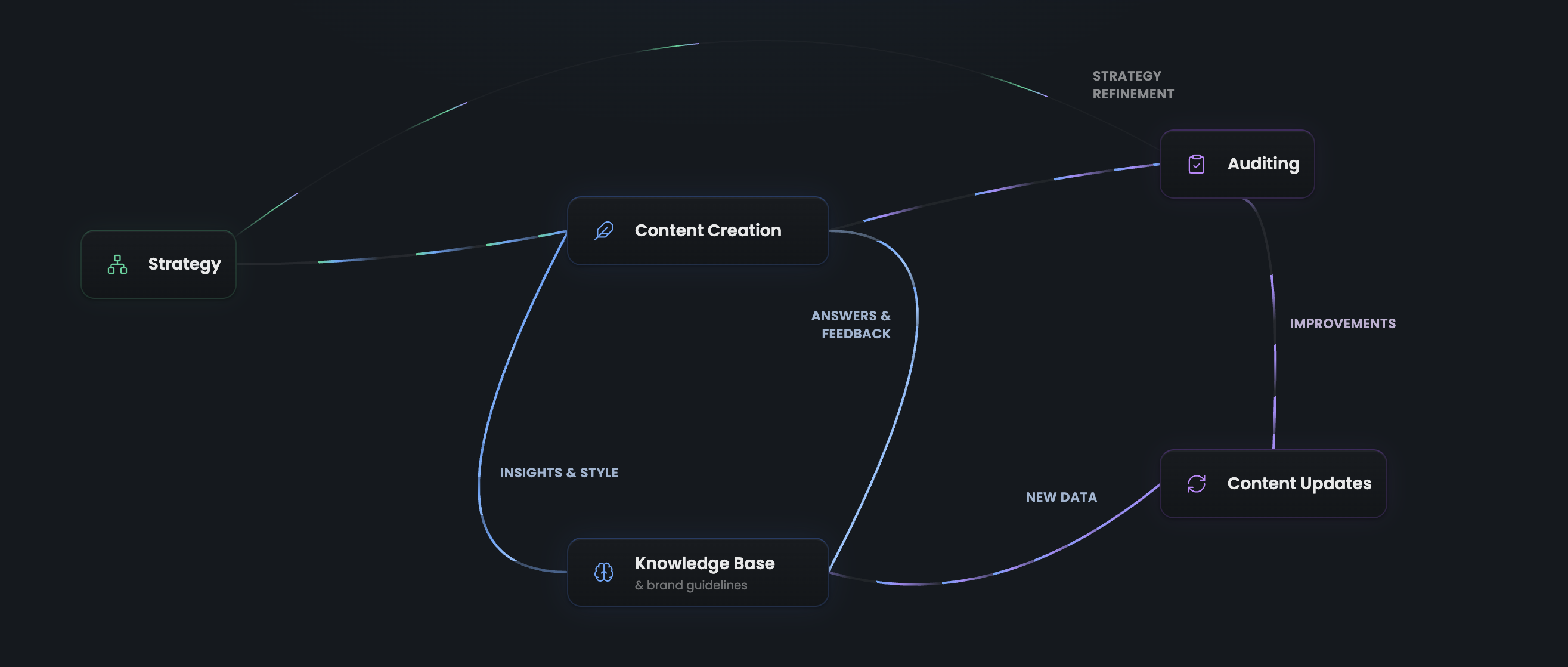
RankUp carries your product, buyers, positioning, and content history from one session to the next.
That context shapes the strategy, articles, and updates RankUp completes, helping relevant buyers find your SaaS in Google and AI answers.
A prioritized plan becomes publish-ready articles with ongoing updates from the RankUp agent team.
Magnus plans the work. Cedric creates articles, while Lyra manages updates and performance.
RankUp's four-step agentic workflow: from keyword research to published, brand-specific content
Where it wins
RankUp builds output from a persistent knowledge system. Creative briefs and style guides load automatically for each article type.
Surfer offers Brand Knowledge and Custom Voice. RankUp carries company context through an autonomous research-to-draft workflow.
That context compounds as work is completed:
Writing context: Cedric starts with the creative brief and style guide for the article type, including the right voice and positioning.
Knowledge reuse: Cedric asks only about missing points. New facts are grouped by meaning for future use and in-editor claim checks.
The three agents have fixed roles:
RankUp also brings Google Search Console and PostHog data into update decisions, including search, behavior, conversion, and AI-referral signals.
The system tracks visibility and recommendation gains as measured outcomes. RankUp does not guarantee rankings or AI mentions.
Magnus, AI SEO strategist: Researches demand and builds the prioritized content plan.
Cedric, AI content writer: Runs the writing flow from SERP research through the CMS-ready draft.
Lyra, AI content manager: Reviews performance, prioritizes updates, and coordinates changes across the site.
Magnus handles keyword research and strategy from start to finish. Drop in your domain and it runs:
Competitor identification - finds who you're competing with in search
Keyword discovery - surfaces relevant keywords across your topic space
Automatic filtering - removes low-value terms without manual review
Topical clustering - groups keywords into content themes
Prioritized publishing plan - puts high-intent clusters first so you write what moves the needle earliest
Magnus turns manual keyword research into a ready-to-execute publishing plan.
Cedric runs the autonomous content flow from live SERP research to a publish-ready draft.
The workflow builds the outline and blueprint before checking RankUp's knowledge base for gaps.
Focused interview questions appear only when missing expertise would improve the article.
Lyra manages the existing content library. She uses performance data to find pages that need attention.
From there, Lyra decides what should change and routes writing work to Cedric. Approved edits can move into internal linking and site-wide updates.
Content auditing
Once your content library grows, Lyra runs monthly audits to find what's underperforming and why. Each audit flags:
Stale pages - content that has dropped in impressions or clicks since last month
Cannibalizing content - articles targeting the same keyword that are splitting traffic
Internal linking gaps - pages with no inbound links from related content
Title alignment issues - headlines that don't match the search intent the page is actually ranking for
GSC keyword movement - queries gaining traction that the page isn't fully addressing yet
Lyra prioritizes the audit findings and coordinates the rollout. Cedric writes substantive section updates and new copy for review.
Lyra then manages approved implementation, internal links, and the monthly audit cycle so the update backlog keeps moving.
Where it falls short
Not a lightweight content scorer. If you need a quick on-page grade before hitting publish, RankUp is overkill. Tools like Clearscope or NeuronWriter handle that faster.
Not suited for bulk low-effort content. RankUp asks for your brand knowledge as input. If the goal is 50 generic articles with no brand voice, that's not what the system is built for.
Less suited for granular data specialists. SEO professionals who need deep backlink databases, technical audit depth, or raw keyword exports at scale will find Ahrefs (for link research and keyword gap analysis) or Semrush better fits.
Pricing
RankUp's public entry point is a 7-day free trial. The trial includes:
A brand voice, knowledge base, and topical map built from your site
After the trial, you can build a custom ongoing plan in the app. An optional strategy call is available if you want help choosing that plan.
Start your 7-day free trial and write and refine an article with your own site and product context. The trial is only available to SaaS and technology companies with English-language websites.
RankUp vs. Surfer SEO
Dimension | Surfer SEO | RankUp |
|---|---|---|
Knowledge base / Brand context | Brand Knowledge (single doc) + Custom Voice on Pro+ | Persistent knowledge base, creative brief, and style guides loaded for the work |
Content source | Built from top-ranking SERP results | Built from live SERP research, company knowledge, and product expertise |
Monthly content auditing | Content Audit tool via GSC; manual implementation | Monthly audits use GSC data; Lyra prioritizes the rollout and Cedric writes substantive changes |
LLM visibility | AI Tracker: ChatGPT, Perplexity, Google AI Overviews, AI Mode | PostHog AI-referral data and GSC performance signals; AI-answer monitoring is not yet live |
Best for | End-to-end workflow: keyword research, AI drafting, optimization, auditing | SaaS teams that want strategy, writing, and managed updates built around company context |
Surfer covers keyword research, topical mapping, AI drafting, on-page optimization, auditing, Brand Knowledge, and Custom Voice.
RankUp loads company knowledge, the creative brief, and the relevant style guide into content work, so product facts, positioning, and voice shape the output.
That context carries through live research, outlining, the blueprint, focused interviews, writing, and review. The result is content that gives relevant buyers clearer material for finding, understanding, and evaluating your product in Google and AI search.
Dimension | RankUp | Surfer SEO |
|---|---|---|
Brand context | Persistent knowledge base, briefs, style guides per article type | Brand Knowledge and Custom Voice on eligible plans |
Content source | Company knowledge plus live research | SERP analysis plus supplied brand context |
Content score / NLP depth | No standalone page score | SERP-based content score with NLP terms |
Content updates | Lyra prioritizes, Cedric writes the changes | Content Audit surfaces opportunities for manual follow-up |
AI/GEO visibility | Content built from product knowledge, PostHog AI-referral data | AI Tracker: ChatGPT, Perplexity, AI Overviews, AI Mode |
Workflow | Strategy, writing, auditing, managed updates | Research, drafting, scoring, auditing, AI visibility |
Best fit | SaaS teams wanting the work completed with persistent context | Teams wanting an end-to-end optimization workspace |
Pricing | 7-day free trial | Tiered monthly plans, Custom Voice on Pro+ |
Surfer suits teams that want SERP-based optimization, AI drafting, audits, and brand-context features in one workspace.
RankUp suits SaaS teams that want strategy, writing, and updates completed with company knowledge carried through the workflow.
2. Clearscope
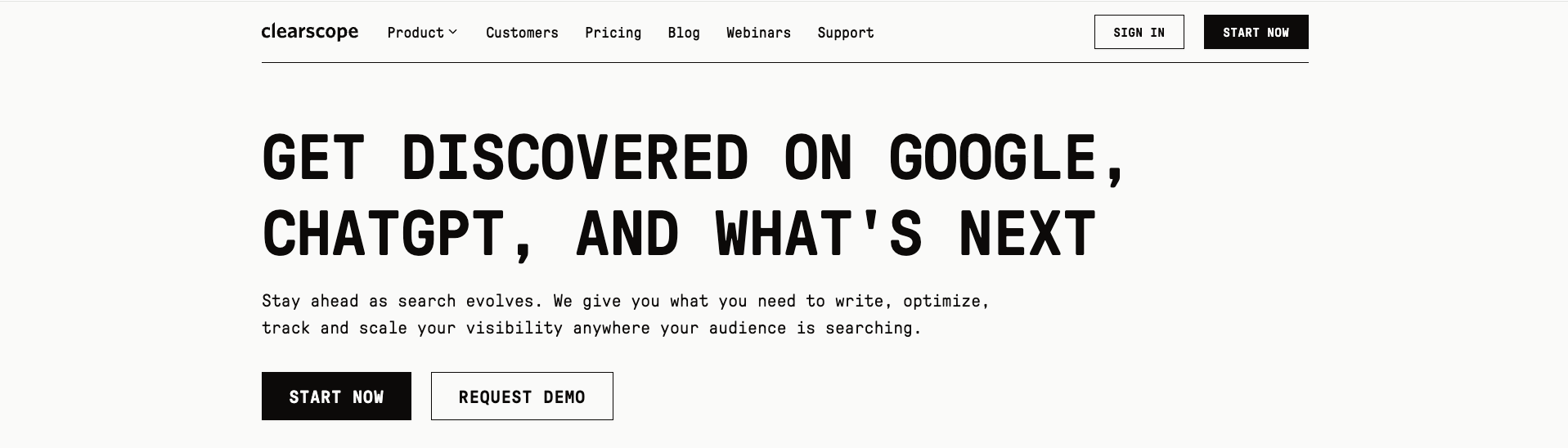
Clearscope fits enterprise editorial teams that need deeper content planning, topical coverage, and portfolio monitoring.
Clearscope grades content from A to F using term and relevance signals drawn from top-ranking pages.
Its workflow centers on optimization, content inventory, and team collaboration. Keyword strategy and full first-draft production sit outside its core scope.
Unlimited seats make the collaboration model easier to budget for teams with writers, editors, and client reviewers.
The pricing-fit observation comes from G2 reviews, where larger companies rate the cost more favorably than smaller teams.
Why agencies keep renewing
Four parts of the workflow support agency use:
Letter-grade scoring that non-SEOs actually understand. Clearscope assigns A through F grades based on NLP keyword match quality against top-ranking pages. Writers without SEO backgrounds can act on a grade without interpreting a numeric score.
Unlimited seats, no per-user fees. Agencies can add writers, editors, and clients without touching pricing. On a 10-person team, that changes the cost calculus entirely.
Customer support that actually responds. Clearscope holds a 9.9/10 customer support rating on G2, against Surfer SEO's 9.4. In practice, this means issues get resolved, not routed through a ticket queue.
Content inventory for portfolio-wide monitoring. The inventory layer tracks published pages over time and flags content drifting out of optimization range as competitor content evolves. This is the feature that keeps larger teams renewing — most other tools stop at draft creation.
Run the first Content Inventory audit after enough history exists to show which pages are slipping.
Where it gets complicated
Minimal AI content generation. The $399/month Business plan caps AI Drafts at 20 per month, shared across all users. Teams that need AI drafting at scale should look at Writesonic or Scalenut instead.
AI visibility is monitoring-only. Clearscope now includes AI visibility features through its Tracked Topics and Expand products, which monitor citations across Google, ChatGPT, and Gemini. It stops at tracking — Clearscope does not help you write or optimize content for LLM citations the way dedicated GEO tools do.
High cost for small teams. At $129/month minimum, Clearscope is hard to justify for solo operators or small teams with tight budgets. Frase (from $49/month) and Thruuu (from ~$19/month) offer optimization workflows at a fraction of the price.
No readability metrics. G2 users flag the absence of readability scoring as a gap. You'll need a separate tool like Hemingway App or Readable to check reading level before publishing.
Pricing
Clearscope's official pricing page lists Essentials at $129/month and Business at $399/month.
The comparable pricing fields are:
Billing basis: Monthly plan price
Included users: Unlimited seats on both plans
Primary allowance: 20 AI Drafts per month on Business
Plan names and allowances can change. Verify the official page before purchase rather than converting AI Drafts into an article quota.
Clearscope vs. Surfer SEO
Dimension | Clearscope | Surfer SEO |
|---|---|---|
Core focus | Content optimization and portfolio monitoring | Research, writing, and optimization |
Seats | Unlimited users on all plans | Per-user pricing |
Content scoring / NLP | A to F letter grades via NLP | 0 to 100 content score |
AI drafting limit | 20 AI Drafts/month on Business | AI writing in the core workflow |
AI / GEO visibility | Citation monitoring for Google, ChatGPT, and Gemini | AI Tracker for ChatGPT, Perplexity, Google AI Overviews, and AI Mode |
G2 customer support | 9.9/10 | 9.4/10 |
Entry price | $129/month, Essentials | $49/month, Discovery |
Clearscope uses letter grades, unlimited seats, and portfolio monitoring for editorial workflows.
Surfer SEO covers a broader workflow with research, AI drafting, content scoring, audits, and AI visibility tracking.
Both products monitor AI citations. Their writing and optimization workflows differ, so compare the included signals and editable SERP set during a trial.
Dimension | Clearscope | Surfer SEO |
|---|---|---|
Core focus | Optimization and portfolio monitoring | Research, drafting, optimization, audits, and AI visibility |
Users | Unlimited seats | Plan-dependent seat limits |
AI drafting allowance | 20 AI Drafts per month on Business | Plan-dependent AI writing allowance |
AI visibility | Citation monitoring | AI visibility tracking across supported platforms |
Support rating | 9.9/10 on G2 | 9.4/10 on G2 |
Content grading | A to F letter grade | 0 to 100 content score |
Pricing basis | Published monthly plans; verify official page | Dynamic plan details; verify official page |
Unlimited seats change Clearscope's cost profile as more writers and editors join the workspace.
Solo users still carry the full base plan cost, while larger editorial teams can spread that cost across every contributor.
Want the full picture? See our top Clearscope alternatives ranked for LLM-optimized content.
3. Scalenut
Scalenut fits teams that need fast first drafts and can handle editorial cleanup before publishing.
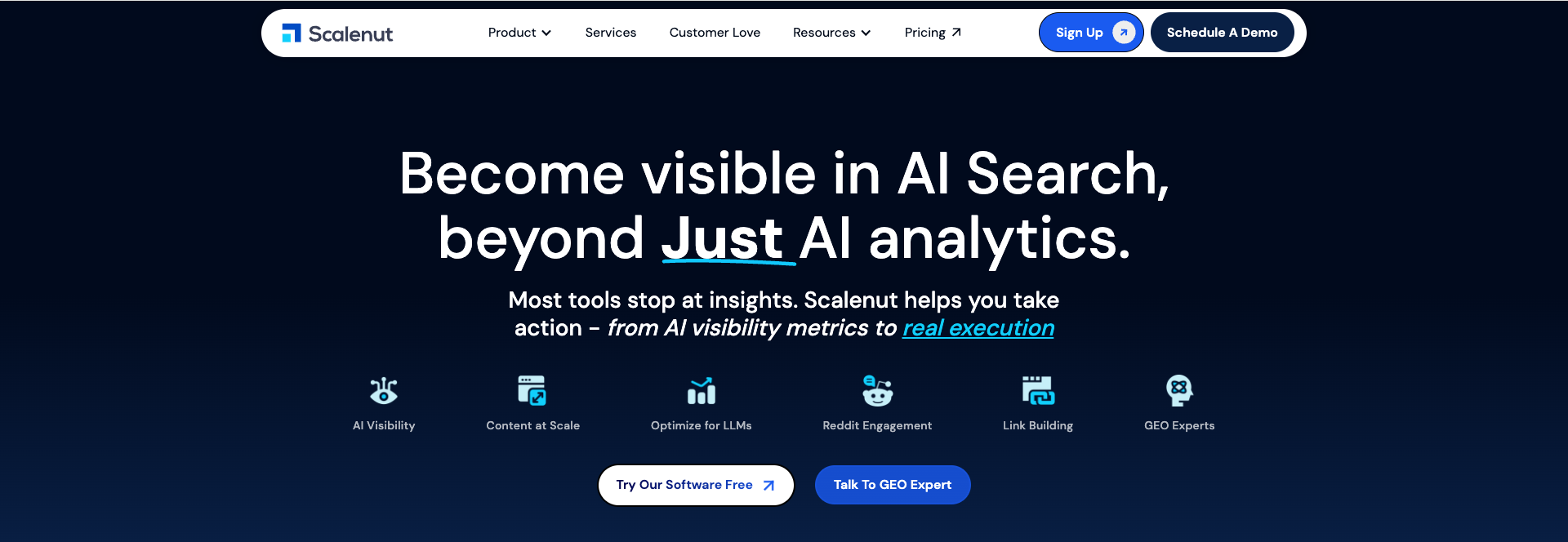
The entry price sits at $59/month — above Frase's $49/month but well below Clearscope's $129/month. Unlike Clearscope, which skips drafting entirely, Scalenut generates full articles from a keyword input.
Teams moving away from Jasper tend to land here. Jasper is a brand-voice writing tool that starts at $49/month and has no meaningful SERP analysis built in. Teams that need content to rank, not just sound on-brand, need something with keyword intelligence underneath it — which is where Scalenut fits.
Where it wins
Start with a keyword. Cruise Mode builds the research and article structure.
Speed — From keyword input to a 1,500-word structured draft, Cruise Mode ran in roughly 4-6 minutes in testing. That's faster than manually building the same structure in Frase or Clearscope.
All-in-one workflow — Keyword planning, writing, content optimization, and basic monitoring live in one interface. Teams can run the full workflow without toggling between a keyword tool, a brief builder, and a writing environment.
Where it falls short
Scalenut averages 3.2 out of 5 stars on Capterra based on 160 reviews, with a substantial share of low ratings.
Shallow keyword clustering — The keyword clustering felt shallow in testing and the strategy intelligence lagged behind more focused tools. Teams building topical authority at scale would find SE Ranking's 2 billion keyword database or Semrush's competitive data more capable.
Rigid automated structure — The platform inserts FAQs, tables, and summaries by default. Teams with a strict house style typically strip out these auto-inserted blocks before the draft is usable.
Key features start at $89/month — On-page Pro and the Backlinks Marketplace unlock on the Plus plan. Professional includes both features with higher usage limits (Scalenut pricing page).
Recurring bugs and content inaccuracies — User reviews on Capterra cite recurring technical bugs and content inaccuracies as a direct reason for cancellations. For teams with active publishing schedules, these errors add a manual verification layer on top of the editing already required.
Verify names, factual claims, and source links before sending a Scalenut draft to a client.
If these limitations are dealbreakers for your team, our Scalenut alternatives for SEO content covers 10 tested options across different workflow needs and budgets.
Pricing
The $199/month Scalenut Professional tier also provides those features at higher usage limits, along with unlimited team seats.
Scalenut vs. Surfer SEO
Surfer SEO covers keyword research, AI drafting, and optimization scoring. Scalenut prioritizes Cruise Mode drafting, with keyword planning and optimization in the same workspace.
Test both editors with the same query. Check which SERP pages they include, whether you can edit that set, and whether intent, headings, and term guidance appear separately.
Dimension | Scalenut | Surfer SEO |
|---|---|---|
Primary focus | AI-guided drafting and all-in-one workflow | Keyword research, AI drafting, and optimization |
Content generation | Cruise Mode produces 1,500-2,000 word drafts | Surfer AI full articles and Surfy editing |
Keyword research | Built-in clustering with shallow depth | Dedicated tool with intent analysis on all plans |
Content score / NLP depth | Real-time on-page suggestions | Content score with NLP terms |
Optimization feedback | Real-time on-page suggestions | Content score with NLP terms |
Entry price | $59/month (Starter) | $49/month (Discovery) |
Higher-tier access | Plus: On-page Pro and Backlinks Marketplace | Not covered in this section |
Best for | Teams prioritizing fast first drafts | Keyword research, drafting, and optimization in one platform |
Scalenut suits teams that value a fast first draft and can budget for editorial cleanup. Cruise Mode produces structure quickly, but its default FAQs, tables, and summaries can create extra formatting work.
Frase centers its workflow on SERP research and brief building, which matters when a team needs more control before drafting begins.
4. Frase
Frase fits writers and small agencies that need deeper SERP research and more control before drafting.
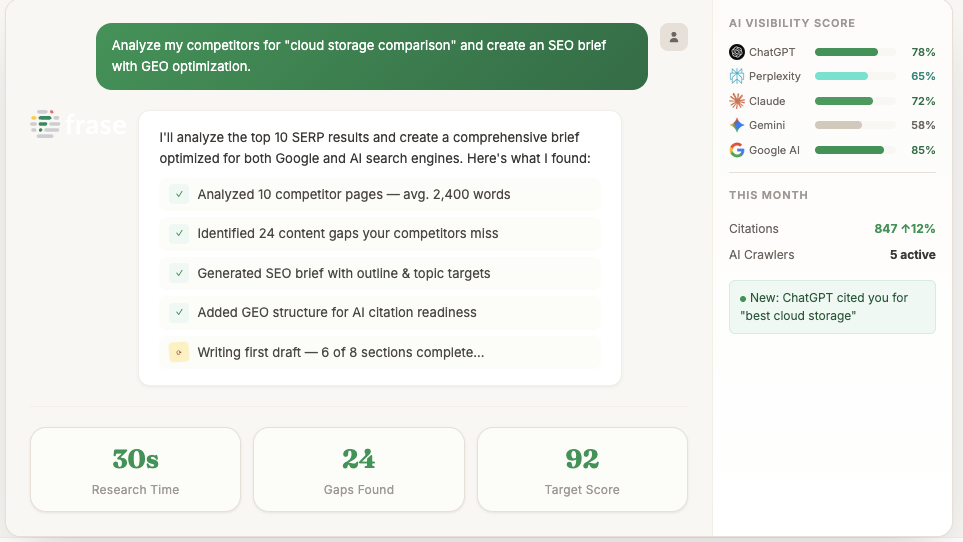
Plans start at $49/month, which sits well below Clearscope ($129/month) and NeuronWriter's Diamond tier ($97/month). Frase doesn't try to cover the full content lifecycle; it owns the research and brief-building phase and does that one thing well.
Freelance writers and small agencies are its natural home. Reddit SEO communities consistently flag it as the go-to alternative for teams that find Surfer SEO's pricing out of reach.
Where it wins
Brief generation speed — Frase pulls competitor word count, domain rating, and heading count from the SERP to produce a complete content brief in seconds. It's the fastest brief-generation workflow in this list.
Drag-and-drop outline builder — The outline builder lets you drag competitor headings directly into your own structure, removing most of the manual research time that normally goes into the structuring phase.
GEO features — Frase is one of three tools in this article with explicit Generative Engine Optimization features, alongside Thruuu and Writesonic. Its AI Agent tracks how AI search engines cite your content, useful for teams building toward LLM visibility alongside traditional rankings.
Content refresh support — You can import an existing page URL and have Frase re-analyze and re-optimize it against current SERP data. That makes it viable for refresh workflows, not just net-new creation.
Strong user ratings — Frase holds a 4.8-star rating from 298 reviews on G2, with users consistently citing functionality, feature depth, and content quality as highlights.
Where Frase hands the work back to you
Keyword research is the weakest point — Reviewers on G2 say it "leaves much to be desired." In testing I consistently paired Frase with SE Ranking before building any brief.
Integrations are thin too — alternatives to Frase like Semrush Writing Assistant and Search Atlas offer meaningfully better toolchain connectivity.
Drafts need significant editing — The speed Frase markets is in the research and brief phase, not the final output. Across three SaaS keywords tested, a 1,500-word Frase draft required rewriting roughly 60-70% of the prose. The drafts read as SERP summaries stitched together; they're a starting skeleton, not a publishable piece.
Use Frase for the research and brief stage, then plan an editorial pass or a separate writing workflow for the draft.
Pricing
Frase currently offers three plans: Starter at $49/month, Professional at $129/month, and Scale at $299/month.
At $49/month, Frase's Starter plan sits well below Clearscope at $129/month or NeuronWriter's Diamond tier at $97/month for teams working with a tight toolset budget. Thruuu (~$19/month) remains the most affordable entry point for pure SERP data.
Frase vs. Surfer SEO
Frase centers on SERP research and brief creation. Surfer SEO includes keyword data and real-time optimization scoring during drafting.
Run the same query through both tools before deciding. Check the included SERP pages, competitor-set controls, and whether intent, heading coverage, and term guidance are shown separately.
Dimension | Frase | Surfer SEO |
|---|---|---|
Entry price | $49/month (Starter) | $49/month (Discovery) |
Core strength | SERP research and brief generation | Content optimization scoring and NLP suggestions |
User rating | 4.8 stars from 298 G2 reviews | Not covered in this section |
Keyword research | Weak, requires a supplemental tool | Stronger built-in keyword data |
Content score / NLP depth | Research and brief-led workflow | Content score with NLP suggestions |
GEO / AI search | Explicit GEO features and AI citation tracking | AI Tracker for ChatGPT, Perplexity, AI Overviews, and AI Mode |
Collaboration | Professional and Scale plans | Yes |
Existing page refresh | Yes, via URL import | Yes |
Frase concentrates its value in the research and brief layer. Teams that already have keyword data and a writing process can use that narrower workflow without adding another full content suite.
Its $49/month entry price keeps the first step accessible, but the draft still needs a defined editing stage before publication.
Search Atlas is next, and it approaches the problem from a different angle entirely: link-building inside the SEO platform.
5. Search Atlas
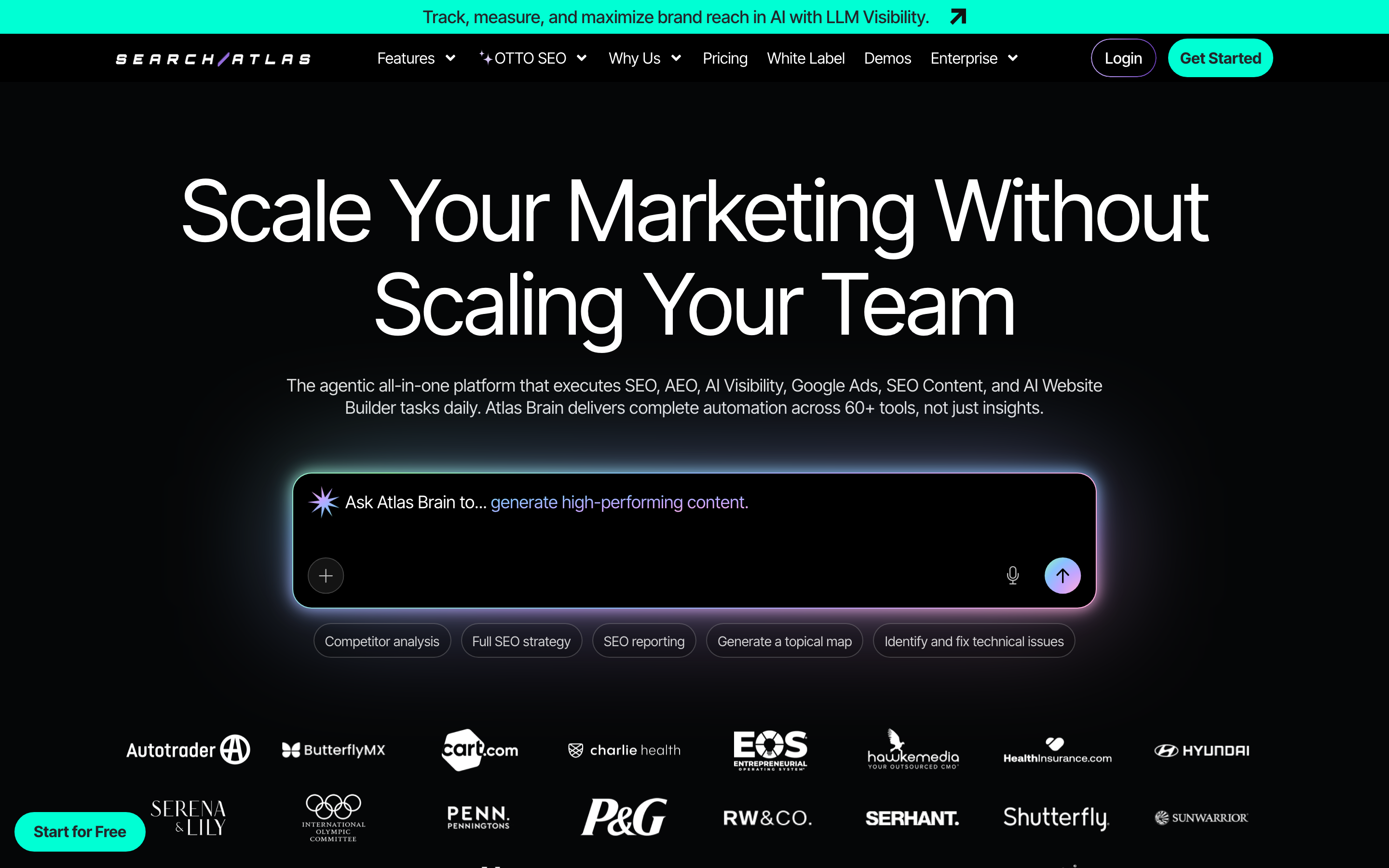
Search Atlas is aimed at teams consolidating SEO and digital PR work in one platform.
Search Atlas combines content optimization, technical audits, and HARO outreach in one platform.
Its data scope is narrower than SE Ranking's 2B+ multi-source database — Search Atlas pulls exclusively from Google. But for teams that operate within Google and want content optimization and link-building managed in one place, that trade-off is often acceptable.
What makes it worth considering
Search Atlas makes its case through workflow consolidation.
HARO integration — Inside the platform, you browse journalist queries by topic, match them to your domain's expertise, and submit pitches without switching to Cision or BuzzStream. A campaign that used to require two platforms and a handoff between writer and PR manager can run from a single dashboard.
Crawl capacity: Monthly crawl capacity ranges from 50,000 pages on Starter to 100 million pages on enterprise tiers. The Pro plan includes 10 million pages per month.
Keyword lookup volume — Limits scale from 500 to 100,000 per month depending on plan, so research volume grows with your subscription rather than hitting a fixed ceiling.
Check how Search Atlas selects SERP pages, separates intent from heading coverage, and lets you adjust the comparison set before treating any content score as a writing target.
Agency features — The $399/month Pro plan adds API access and white-label reporting, making it a workable option for agencies delivering SEO services under their own brand.
Where the cracks show
Google-only data — Search Atlas pulls SEO data exclusively from Google with no support for Bing, Yahoo, or DuckDuckGo. SE Ranking's 2B+ keyword database covers multiple data sources, making it a stronger fit if multi-engine visibility matters.
Disorganized interface — Users on Reddit describe it as clunky and hard to navigate. The Starter plan's 500 keyword lookup ceiling compounds this — it's a tight cap for any campaign exploring multiple topic clusters.
OTTO automation is unreliable — Persistent bugs are documented on G2, some unresolved for over five months. For a feature positioned as the platform's core automation layer, that level of instability is a real risk.
Pricing
Search Atlas pricing starts at $99/month (Starter), with Growth at $199/month and Pro at $399/month.
Plan | Billing basis | Included users | Primary allowance |
|---|---|---|---|
Starter | $99/month | Not stated | 50,000 crawled pages/month |
Growth | $199/month | Not stated | Higher crawl capacity |
Pro | $399/month | Not stated | 10M crawled pages/month |
At $99/month, Search Atlas Starter costs more than NeuronWriter's $19/month Bronze plan, but covers a much broader feature set: technical auditing and HARO link-building versus NeuronWriter's 25-analysis content limit. Clearscope Essentials starts at $129/month for content monitoring only, making Search Atlas's $99 Starter more cost-effective for teams that also need technical SEO and link-building tools.
Search Atlas vs. Surfer SEO
Search Atlas covers link-building and technical auditing that Surfer SEO lacks; Surfer SEO has stronger content optimization depth for writing workflows.
Dimension | Search Atlas | Surfer SEO |
|---|---|---|
Core focus | Technical SEO, keyword research, and HARO link-building | Content optimization and on-page scoring |
Link-building tools | Built-in HARO integration | None |
Technical site auditing | Up to 100M pages/month on enterprise tiers | Not a core feature |
Data sources | Google only | Google-based SERP data |
Content optimization depth | Included, but not the primary differentiator | Core workflow with real-time NLP scoring |
Entry price | $99/month for Starter | $49/month for Discovery |
Agency features | White-label reporting and API on Pro at $399/month | Available on higher tiers |
Search Atlas suits teams that need technical audits and journalist outreach in the same workspace. Its value falls when content optimization is the only workflow your team needs.
Semrush is a different kind of consolidation: the full marketing suite, with content optimization as one feature among many rather than the core product.
6. Semrush
Semrush Writing Assistant fits teams that already rely on the wider Semrush toolkit for SEO and marketing work.
The Writing Assistant is a secondary feature within a much broader platform, not the main event. That framing matters: if you're buying Semrush for its content editor alone, you're paying for a lot of platform you won't use.
It is best suited to full-service agencies and experienced marketers who already use Semrush for keyword research, rank tracking, or PPC. G2 reviewers note that freelancers and SMBs often find the price and complexity hard to justify.
What it does well
SEO Writing Assistant — Scores content in real time across four dimensions: readability, word count, tone of voice, and originality. It works inside Google Docs, WordPress, and Microsoft Office 365, and pulls live competitor data so writers can benchmark against top-ranking pages before they start.
During a trial, check which ranking pages inform the score, whether intent and heading coverage appear separately, and whether you can change the competitor set.
Competitive intelligence — Before you write a word, Semrush shows organic and paid traffic for any competitor domain, PPC spend data, and keyword gaps you wouldn't catch from a standard SERP scan. No other tool in this article, including Clearscope, Scalenut, or Frase, surfaces paid search data alongside content optimization.
Site audit — The site audit tool crawls domains to detect broken links, crawl errors, missing metadata, and slow page speeds, then generates a health score to prioritize fixes.
Position tracking: Monitors rankings by device and location. Semrush lists tracking limits from 500 keywords on Pro to 5,000 on Business.
Plan | Billing basis | Included users | Primary allowance |
|---|---|---|---|
Pro | $139.95/month | Not stated | 500 tracked keywords/day |
Guru | $249.95/month | Not stated | Content toolkit access |
Business | $499.95/month | Not stated | 5,000 tracked keywords/day |
Current plan structure
Within Semrush One, content optimization is listed on Pro+, not Starter. Teams that only need briefs and optimization can also compare dedicated tools such as Scalenut or Frase.
Use the free Writing Assistant tier first if your team already has Semrush Pro. That trial run shows whether the Pro+ upgrade changes the writing workflow enough to justify its cost.
Price and learning curve drive most departures. Among 2,709 G2 reviews at 4.5/5 stars, these are the two most common reasons users look for alternatives.
Semrush is a data platform rather than an end-to-end content creation workflow. Teams needing AI drafting from brief to finished draft can compare Scalenut or Writesonic.
Reddit users report that Semrush's site audit health scores do not consistently match findings from Ahrefs and other tools. That discrepancy can complicate technical prioritization.
Pricing
Semrush sells two plan structures:
SEO Toolkit: Pro, Guru, and Business, with content optimization on Guru and above
Semrush One: Starter, Pro+, and Advanced, combining the SEO Toolkit with AI Visibility; content optimization starts on Pro+
Check which product line a quoted price covers before comparing Semrush with Frase or Scalenut.
Semrush vs. Surfer SEO
Surfer SEO specializes in content optimization with a focused NLP editor; Semrush is a full marketing suite where content writing is one module among dozens.
Dimension | Semrush | Surfer SEO |
|---|---|---|
Primary focus | All-in-one marketing suite | Content optimization and SEO writing |
Content optimization depth | SEO Writing Assistant scores readability, word count, tone, and originality | NLP editor with SERP-driven recommendations |
Backlink analysis | Included | Not included |
Technical site audit | Included | Not included |
PPC and paid search data | Included | Not included |
Keyword tracking | 500 daily on Starter to 5,000 daily on Advanced | Dedicated tool on all plans |
Content optimization access | Included on Pro+ | Included in product plans |
Plan structure | SEO Toolkit and Semrush One | Check current plan options |
Semrush earns its place when rank tracking, backlink monitoring, PPC research, and content scoring need one shared workspace.
7. Writesonic
Writesonic fits SMB marketing teams that need drafting, SEO research, and visibility tools in one workspace.
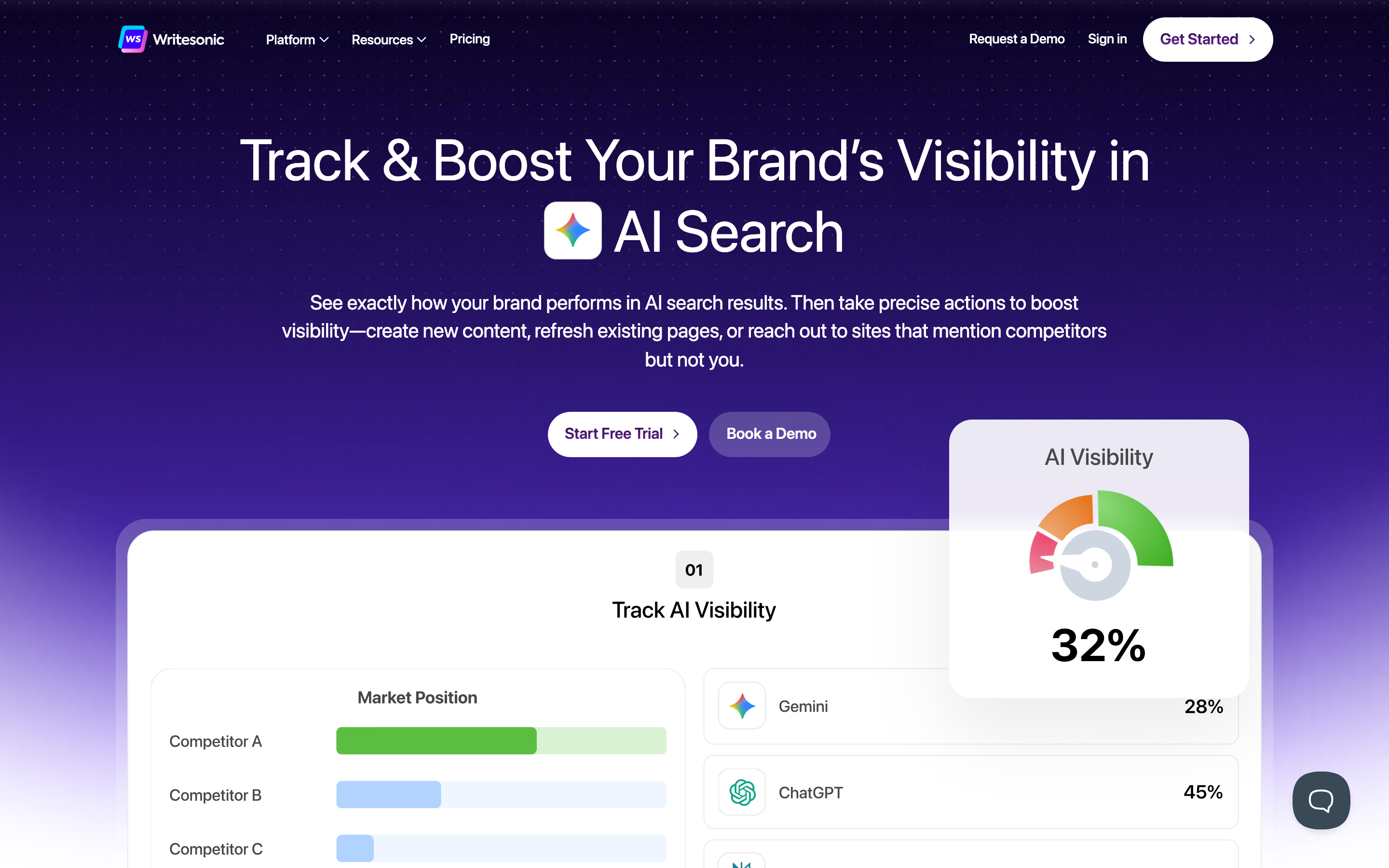
Writesonic combines keyword research, site audits, visibility tracking, AI drafting, and GEO tools in one platform.
That breadth suits teams replacing separate tools. Writers who only need a precise SERP editor may find Surfer SEO or Clearscope easier to use.
Where it pulls ahead
Full-platform SEO coverage. Writesonic covers keyword research, competitor analysis, site audits, visibility tracking, and AI content creation in a single platform. That footprint puts it closer to Semrush than to lightweight editors like Thruuu or Clearscope, which don't include site audit capabilities as a core offering.
Dedicated GEO prompt tiers. Writesonic is the only tool in this list with dedicated GEO prompt tiers for localized SEO content. The Standard plan includes 100 GEO prompts, Professional includes 200, and Advanced includes 300, giving teams a structured way to produce geographically targeted content at scale without a separate tool.
First-draft engine from a blank page. Writesonic works well when you're starting from nothing. The GEO prompts are genuinely useful — I ran a few localized drafts through them and the geographic specificity held up better than I expected. The drafts still needed rewrites before they were publishable, but the structural scaffolding saved time.
Here's the typical workflow:
Enter your target keyword
Generate an AI draft via Article Writer
Run the built-in SEO audit against the SERP
Apply GEO prompts if targeting a local market
From blank page to first draft typically takes under 10 minutes.
Treat the audit score as a review prompt, not a publishing target. In a trial, check which SERP pages are included, whether you can change them, and whether intent, headings, and term guidance are shown separately.
Limitations worth knowing
Robotic, repetitive output — Capterra reviewers consistently flag that Writesonic's AI output requires substantial editing before it reads as natural. Reviews also cite formulaic structure, redundant sentences, and occasional factual inaccuracies that make thorough human review non-negotiable before publishing.
Watch out for: Run a plagiarism check on any AI-generated content before publishing. The SEO community has flagged this as a documented precaution.
Plagiarism risk — SEO community discussions on Reddit flag that GPT-generated segments can mirror existing online content too closely. Running a secondary plagiarism check before publication is a documented precaution for teams using the platform.
Slow generation on bulk workflows — The platform delivers structured output but wait times create friction for teams running high-volume content pipelines. Scalenut's pipeline or Frase's brief generation are better fits on speed alone.
User and project caps at every tier — Projects and users are capped even at premium tiers, which limits agencies managing multiple client sites. SE Ranking's broader multi-site support or Search Atlas's agency-oriented workflow are better fits for uncapped multi-client operations.
Pricing
Writesonic starts at $49/month (Lite) and scales to $499/month (Advanced), with a 20% discount for annual billing and custom Enterprise pricing.
Plan | Billing basis | Included users | Primary allowance | Check before purchase |
|---|---|---|---|---|
Lite | $49/mo | Confirm at checkout | 15 articles/month | Plan limits |
Standard | $99/mo | Confirm at checkout | 30 articles, 100 GEO prompts | Plan limits |
Professional | $249/mo | Confirm at checkout | 50 articles, 200 GEO prompts | Plan limits |
Advanced | $499/mo | Confirm at checkout | 200 articles, 300 GEO prompts | Plan limits |
Enterprise | Custom | Confirm at checkout | Custom allowance | Plan limits |
At $49/month, Writesonic costs more than Thruuu ($19/month) and matches Frase's $49/month entry price. Capterra reviewers frequently describe the pricing as overpriced relative to output quality, particularly when compared to simpler AI writing tools at lower price points.
Writesonic vs. Surfer SEO
Surfer SEO focuses on page-level SERP optimization, while Writesonic prioritizes AI-driven drafting and full-platform SEO consolidation at the cost of simplicity.
Dimension | Writesonic | Surfer SEO |
|---|---|---|
Primary focus | AI drafting, research, and audits in one platform | Page-level content optimization via SERP data |
Content score / NLP depth | Built-in SERP audit, secondary to drafting | Core NLP scoring and keyword-density analysis |
Content generation | High-volume AI drafts and GEO prompts | Optimization-first with basic AI assistance |
Site audits | Yes, across plans | Not a primary feature |
Workflow complexity | Broader platform with more setup | Lighter editorial workflow |
Best for | Teams consolidating the SEO lifecycle | Writers optimizing individual pages |
Entry price | $49/month for Lite | $49/month for Discovery |
Writesonic covers more ground than Surfer SEO, but Surfer SEO does its one job better. If you need keyword research, drafting, auditing, and GEO content in a single login, Writesonic is the more practical choice — provided you budget time for post-editing.
If optimization depth and SERP precision matter more than platform breadth, Surfer SEO is the cleaner tool. And if budget is the constraint, NeuronWriter covers SERP-based optimization and AI drafting at a fraction of Writesonic's cost — without the full-platform overhead.
P.S. Teams moving away from a broad drafting platform may want to compare Writesonic alternatives by editing workload, local-content needs, and plan limits.
8. NeuronWriter
NeuronWriter suits independent writers and small agencies that need budget-friendly optimization and AI drafting.
It starts at $19/month billed annually. Frase and Surfer SEO each start at $49/month (vendor pricing pages).
Unlike Clearscope, which stops at the optimization layer, NeuronWriter includes generative writing tools and real-time scoring inside the same interface.
Less suited for teams that need deep keyword research, rank tracking, or backlink analysis as primary features. SE Ranking or Semrush are more appropriate for those workflows.
What it does well
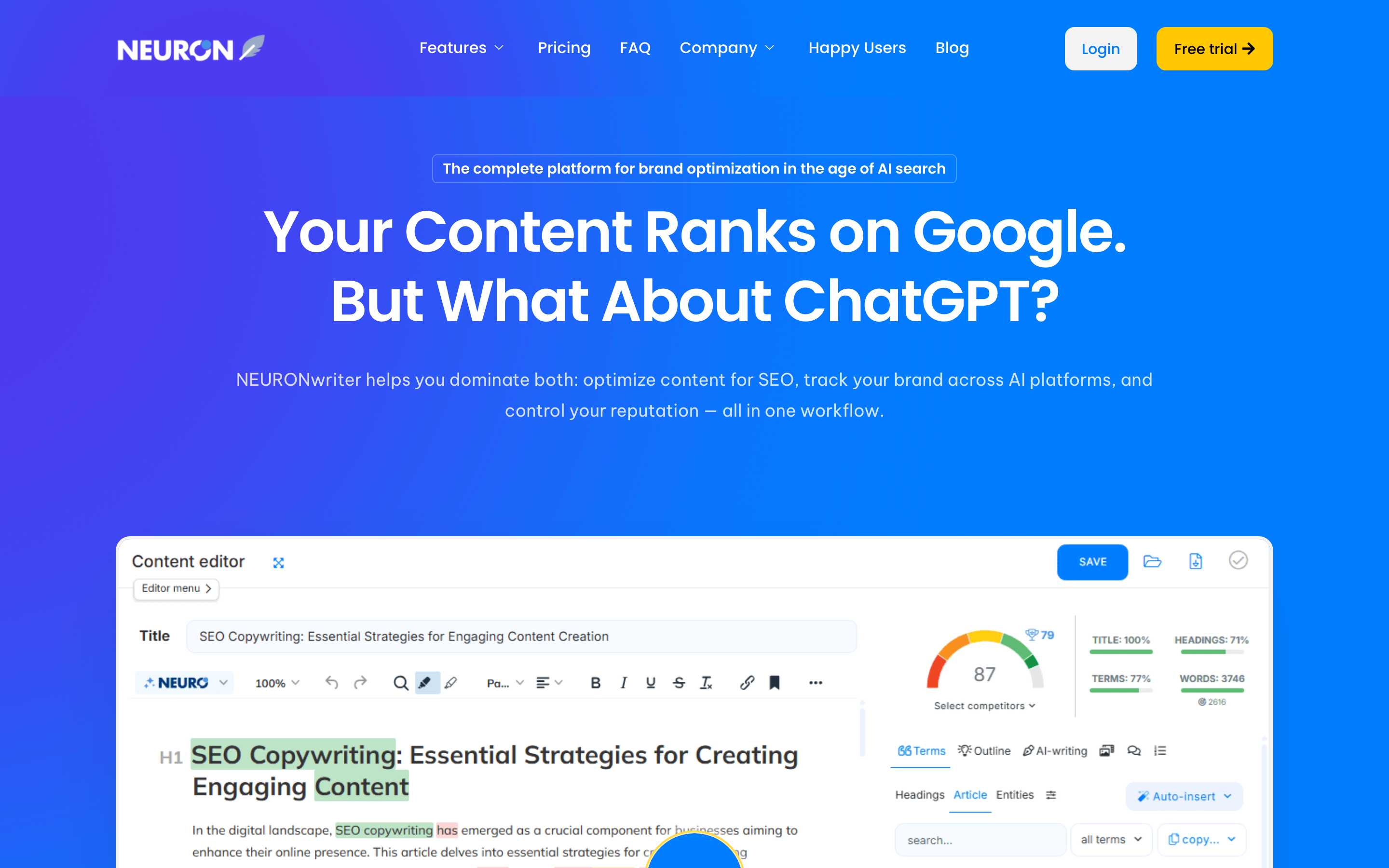
Real-time NLP Terms scoring from top 30+ SERP results. NeuronWriter analyzes the top 30+ ranking pages for your target keyword and generates a categorized list of semantically related terms (basic, supplementary, contextual) with importance scores. Your content score updates in real time as you write, showing coverage gaps without requiring you to leave the editor.
AI Score for AI search compatibility. Beyond keyword matching, NeuronWriter's AI Score (0-100) rates content on three dimensions used to evaluate pages for AI-driven search: Topic Coverage, Structure, and Clarity. It gives specific suggestions like breaking up dense paragraphs or adding comparison sections, rather than just flagging missing terms.
In testing, a 1,200-word draft scored 61/100 on the AI Score. The main flags were low structural variety (no comparison tables, no numbered lists) and thin topic coverage in the middle sections — exactly the kind of specific feedback that a keyword-density score alone won't surface.
A score should guide review, not decide publication. During a trial, inspect the selected SERP pages, term categories, separate intent and heading guidance, and competitor-set controls.
The 61/100 result is one draft example, not a cross-tool performance test. Review evidence and vendor documentation are used elsewhere where hands-on records are not available.
Chrome extension for in-editor optimization. A Chrome extension lets you run NeuronWriter's optimization scoring directly inside Google Docs, WordPress, and Shopify. No copy-pasting into a separate tab. The extension brings the content score into your existing writing environment.
Five pricing tiers with competitive AI credit limits. Plans scale from Bronze ($19/mo annually, 25 analyses, 15,000 AI credits) to Diamond ($97/mo annually, 150 analyses, 75,000 AI credits). All tiers include the full content editor and AI writing tools. WordPress and Google Search Console integrations unlock at Gold ($57/mo annually).
Where it gets complicated
Learning curve. The full feature set takes time to navigate. G2 and Capterra reviewers regularly flag onboarding difficulty for writers who only need a score and word-count target.
Draft quality. Generated copy still needs human editing before publication.
Originality checks. Capterra users describe the built-in plagiarism checker as limited beside dedicated tools such as Copyscape.
Integration gate. WordPress publishing and Google Search Console require the Gold plan at $57/month on annual billing.
Start with Gold when WordPress publishing is part of the workflow. Bronze and Silver do not include the WordPress or Google Search Console integrations.
Pricing
NeuronWriter offers five plans from $19/month to $97/month (billed annually), with monthly billing also available. All plans include a 14-day money-back guarantee.
Plan | Billing basis | Included users | Primary allowance | Check before purchase |
|---|---|---|---|---|
Bronze | $19/mo annual | Read-only content sharing | 25 analyses, 15,000 credits | Plan limits |
Silver | $37/mo annual | Read-only content sharing | 50 analyses, 30,000 credits | Plan limits |
Gold | $57/mo annual | Unlimited members with Create, Edit, and Read access | 75 analyses, 45,000 credits | Plan limits |
Platinum | $77/mo annual | Unlimited members with Create, Edit, and Read access | 100 analyses, 60,000 credits | Plan limits |
Diamond | $97/mo annual | Unlimited members with Create, Edit, and Read access | 150 analyses, 75,000 credits | Plan limits |
WordPress publishing and Google Search Console integrations start at Gold. Confirm current limits, plan names, and billing terms on NeuronWriter's pricing page before purchasing.
WordPress publishing and Google Search Console integrations start at Gold. Confirm current limits, plan names, and billing terms on NeuronWriter's pricing page before purchasing.
NeuronWriter vs. Surfer SEO: the trade-offs
NeuronWriter's lower entry price and AI-credit allowance make budget the central trade-off. Surfer SEO adds a broader optimization ecosystem, while NeuronWriter keeps scoring and drafting in one lower-cost editor.
Dimension | NeuronWriter | Surfer SEO |
|---|---|---|
Primary focus | NLP scoring and AI drafting in one editor | End-to-end content optimization with SERP-driven NLP |
Content score / NLP depth | Top 30+ results with categorized NLP terms | Top 50 results with detailed content scoring |
AI / GEO support | AI Score for coverage, structure, and clarity | AI Tracker for ChatGPT, Perplexity, Google AI Overviews, and AI Mode |
Chrome extension | Google Docs, WordPress, and Shopify | Google Docs, ChatGPT, and Keyword Surfer |
WordPress and GSC integration | Gold plan and above at $57/month annually | Available on core plans |
AI credits per month | 15,000 on Bronze to 75,000 on Diamond | Limited AI writing included |
Entry price | $19/month for Bronze, billed annually | $49/month for Discovery |
Best for | Budget-conscious optimizers wanting scoring and drafting | Teams wanting a mature editorial workflow |
NeuronWriter is a content scoring tool with a price advantage. It does not touch rank tracking or site audits. If those belong on the same invoice as your content editor, SE Ranking is the next tool worth looking at.
9. SE Ranking
SE Ranking is a full SEO suite for teams that need rank tracking, audits, backlink analysis, and content optimization in one workspace.
Its Content Marketing module adds SERP analysis and content scoring, while the wider platform handles the operational SEO work around the editor.
Why teams consolidate here
Teams that switch to SE Ranking typically arrive from three separate subscriptions: a content optimizer, a rank tracker, and a keyword tool. SE Ranking consolidates all three.
Keyword database — Over 2 billion keywords (per SE Ranking's published product specs). That sits below Ahrefs' roughly 8 billion keyword index, but covers most use cases for content-focused teams at roughly half the price.
Full technical SEO suite — Built-in rank tracking, site audits, and backlink analysis. Content-only tools like Surfer or Frase do not replicate this.
AI Visibility Tracker — Monitors appearances across Google AI Overviews, ChatGPT, Gemini, and Perplexity. It costs $71.20/month annually or $89/month monthly and reports appearances rather than optimization guidance (SE Ranking subscription page).
Value for money — The most consistent reason users cite for choosing SE Ranking. A single subscription covers what would otherwise require Surfer, a rank tracker, and a keyword research tool.
Content Marketing module — SERP analysis and content scoring for optimization, functioning as a built-in Surfer-like layer. Covers keyword research through content creation in one workspace.
Build the keyword cluster first, then send the priority keyword into Content Marketing for the brief and optimization work. The workflow stays in SE Ranking instead of moving between tools.
The catch
SE Ranking's content suite supports optimization, but rank tracking and audits remain its primary workflow.
Test the Content Marketing module with a live topic. Check which SERP pages it includes, whether you can edit that set, and whether intent, headings, and term guidance appear separately.
Where SE Ranking falls short: Content-first teams may need more detailed writing guidance than a bundled module provides. Its best use case is consolidation, where rank tracking and audits matter alongside the editor.
Price the AI Search add-on separately before committing.
Add-on pricing can push costs up quickly:
Core plan — $103.20/month (annual)
Growth plan — $223.20/month (annual)
Agency Pack add-on — +$69/month annually
AI Search add-on — +$89/month annually
Stacking Agency Pack and annual-billing AI Search on top of Core brings you close to Semrush Guru territory. The tracker reports answer-engine visibility but does not provide optimization recommendations or GEO writing guidance.
Pricing
SE Ranking starts at $103.20/month for Core on annual billing and includes a 14-day free trial.
Plan | Billing basis | Included users | Primary allowance |
|---|---|---|---|
Core | $103.20/month annual | Not stated | Up to 10 projects |
Growth | $223.20/month annual | 3 seats | Extended limits |
Agency Pack | +$69/month annual | Not applicable | White-label reports |
AI Search | $71.20/month annual | Not stated | AI Visibility Tracker |
SE Ranking Core at $103.20/month (annual) is about $38/month less than Clearscope Essentials at $129/month — and unlike Clearscope, it includes rank tracking and site audits. Teams paying for Surfer ($99/month Standard) plus a separate rank tracker can often consolidate into SE Ranking at a lower combined cost.
SE Ranking vs. Surfer SEO: breadth vs. depth
SE Ranking wins on breadth and price; Surfer wins on content optimization depth. Choose SE Ranking to consolidate your SEO stack, Surfer to maximize content performance.
Dimension | SE Ranking | Surfer SEO |
|---|---|---|
Primary focus | Full SEO suite | Content optimization |
Content score depth | Bundled Content Marketing | Purpose-built scoring |
Rank tracking | Included | Not included |
Site audits | Included | Not included |
Keyword research | 2 billion+ keywords | SERP-focused research |
AI/GEO visibility | Tracker add-on | Built-in AI Tracker |
Backlink analysis | Included | Not included |
Team seats | 3 on Growth | Varies by plan |
Starting price | $103.20/month annual | $49/month Discovery |
Free trial | 14 days | 7 days |
Surfer is the better choice for teams whose entire workflow centers on writing and optimizing content. The Content Editor and SERP Analyzer are more refined than SE Ranking's bundled tools.
SE Ranking suits teams that need rank tracking, technical audits, and backlink analysis in one workspace.
Its AI Visibility Tracker covers Google AI Overviews, ChatGPT, Gemini, and Perplexity as an add-on. It reports appearances rather than producing content improvements.
Pricing and feature limits were checked against vendor materials for this review. Hands-on observations and review-site feedback are not a controlled, identical test across every tool.
SE Ranking covers a broad SEO stack. Thruuu narrows the job to SERP research, which suits teams that need intent evidence before they choose a content format.
10. Thruuu
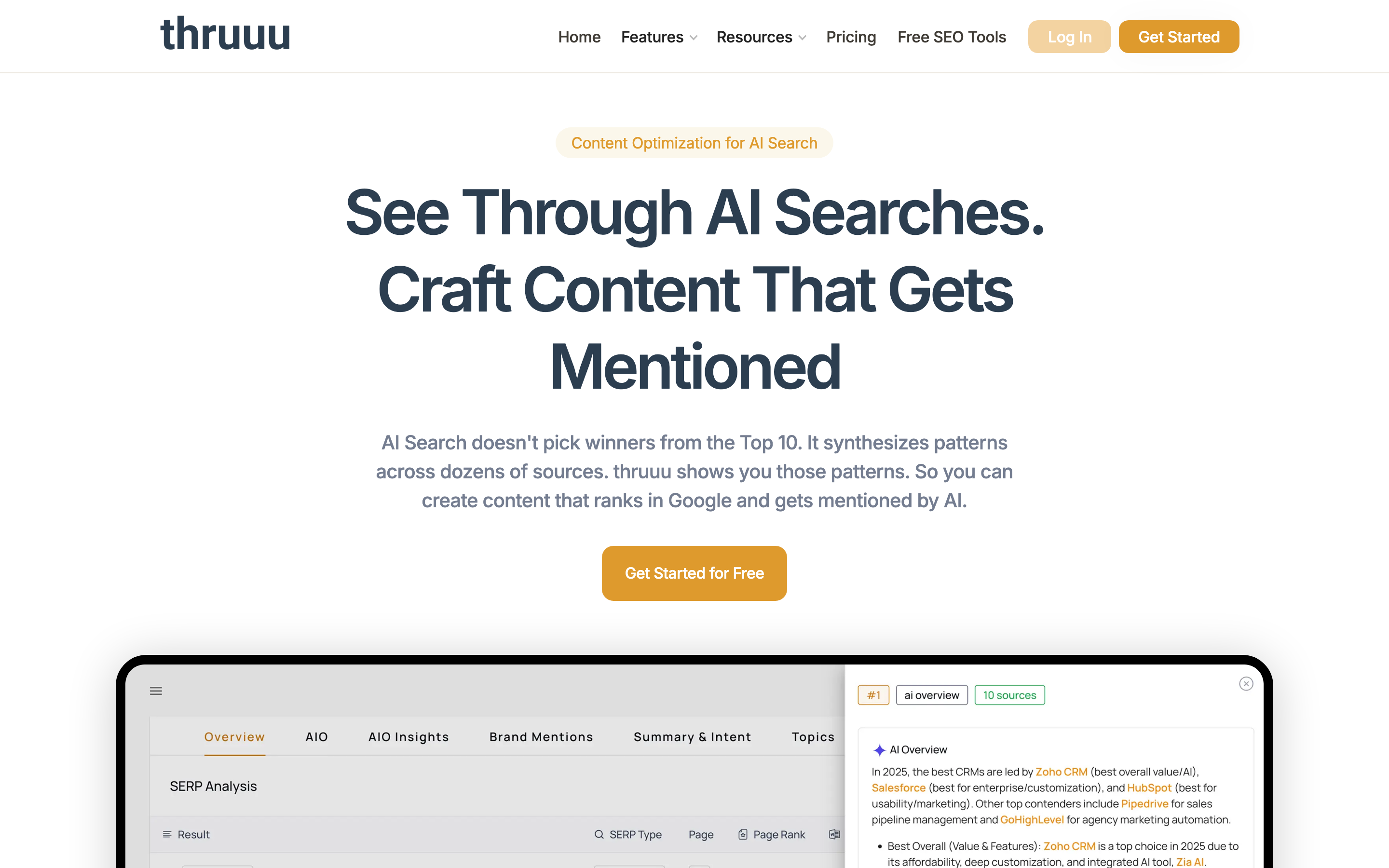
Thruuu is a SERP research platform for SEO teams that need to assess intent before drafting.
It extracts People Also Ask questions, analyzes content structure, tracks AI Overviews, and supports content briefs and page audits. Teams still need a separate environment for drafting full articles.
What Thruuu does well
Deepest intent data in this list — Thruuu maps search intent at the SERP level using PAA extraction, content structure analysis, and AI Overview tracking. No other tool in this comparison goes this deep on intent alone.
Intent split analysis — Run "project management software" through Thruuu and you get a clean split: roughly 65% informational results (comparison guides, listicles) and 35% commercial (product pages, free trials). That single signal tells you whether to write a feature roundup or a landing page before you draft a single word.
Here is how Thruuu compares to a typical content optimization tool across the dimensions that matter for intent-first research:
Dimension | Thruuu | Typical content tool |
|---|---|---|
Intent depth | PAA extraction, SERP-level intent split, and content structure analysis | Basic keyword metrics and topic suggestions |
AI Overview tracking | Native tracking of triggering keywords and cited sources | Traditional rank tracking is more common |
Content support | Briefs, page audits, and AI heading/content analysis; no full drafting editor | Built-in drafting editor and optimization scoring |
Entry price | $19/month for 75 credits | $49-$99/month typical |
Limitations worth knowing
No full drafting editor or article generator — Thruuu supports content briefs, page audits, and AI heading and content analysis. Drafting the finished article still happens in another editor or writing workflow.
Plan research sprints around credits. A SERP analysis uses one credit, a content brief uses five, and clustering 1,000 keywords uses 50 (Thruuu pricing page).
Credit consumption adds up on large projects — each SERP analysis draws from a monthly credit pool. Heavy research sprints on the Starter or Pro plan can exhaust credits quickly, requiring a plan upgrade or pause in research.
Steep learning curve for non-SEOs — Thruuu's output assumes the user knows how to interpret SERP data, intent signals, and clustering outputs. It rewards experienced practitioners and is harder to hand off to generalist writers.
No CMS or analytics integrations — Thruuu has no native connectors for WordPress, Google Search Console, or Google Analytics. Teams have to manually export data and move between platforms to apply insights, which adds friction if you rely on a connected content toolchain.
Pricing
Thruuu starts at $19/month for 75 credits and has a free tier. Pro costs $49/month for 250 credits, while Agency costs $99/month for 700 credits (Thruuu pricing page).
Plans include research, briefs, and audits. They do not include a full drafting editor or article generator.
Plan | Billing basis | Included users | Primary allowance |
|---|---|---|---|
Free | $0 one-time | Not stated | 10 credits |
Starter | $19/month | 3 seats | 75 credits/month |
Pro | $49/month | 10 seats | 250 credits/month |
Agency | $99/month | 10 seats | 700 credits/month |
How it stacks up against Surfer SEO
Thruuu supplies SERP research before drafting begins. Surfer SEO combines writing and optimization in the same workflow.
Teams using Thruuu still need a separate editor or writing process after the research is complete.
Before relying on any content score, check which ranking pages are included, whether you can edit the comparison set, and whether intent and heading coverage are shown separately.
This comparison combines vendor documentation with individual workflow observations. It does not apply one controlled keyword set or timing rubric to every product.
Dimension | Thruuu | Surfer SEO |
|---|---|---|
Core focus | SERP research and clustering | Writing and optimization |
Content score depth | No full scoring editor | Real-time NLP scoring |
Content writing | Research only | Full content editor |
AI/GEO visibility | Native SERP tracking | AI Tracker included |
Keyword clustering | Up to 14,000/month | Content planning only |
Team seats | Up to 10 | Varies by plan |
Starting price | $19/month Starter | $49/month Discovery |
Best fit | Intent-first research | Content optimization |
The table groups each tool by core strength, starting price, and best-fit user.
Surfer SEO alternatives compared: features, pricing, and best use case
The tools are grouped by workflow fit rather than a universal score.
Tool | Key strength | Best use case | Workflow automation | Pricing |
|---|---|---|---|---|
RankUp | SEO content system | SaaS content teams | Strategy through updates | |
Clearscope | Content optimization | Topical authority mapping | Optimization workflow | $129/mo (Essentials) |
MarketMuse | Enterprise content planning | Enterprise planning teams | Planning workflow | Check current pricing |
Scalenut | Research and optimization | Long-form content teams | Research through optimization | $59/mo (Starter) |
Frase | Research-heavy briefs | Brief-building workflows | Research through draft | $49/mo (Starter) |
Search Atlas | SEO and link building | Content and link teams | Suite workflow | $99/mo (Starter) |
Semrush Writing Assistant | Toolkit integration | Semrush ecosystem teams | Full suite with tracking | Starter, Pro+, Advanced |
Writesonic | AI drafting | High-volume draft teams | Drafting workflow | $49/mo (Lite) |
NeuronWriter | Budget optimization | Budget-conscious writers | Optimization and drafting | $19/mo (Bronze, annual) |
SE Ranking | SEO suite | SEO agencies | Full suite with tracking | $103.20/mo (Core, annual) |
Thruuu | SERP intent research | Intent research teams | Research only | $19/mo (Starter) |
Check each vendor's official pricing page before buying. Plans use different units, including credits, analyses, prompts, and tracked keywords, so a direct article quota can mislead.
Which Surfer SEO alternative should you choose?
RankUp, NeuronWriter, Frase, Semrush Writing Assistant, and Clearscope fit different content workflows.
RankUp fits SaaS teams that want content work completed, from a prioritized plan to publish-ready articles and ongoing updates. Your team contributes product expertise and reviews the changes.
NeuronWriter suits budget-friendly optimization. Frase fits research-heavy briefs, while Semrush Writing Assistant works for teams already using the Semrush toolkit.
Clearscope suits enterprise teams that need topical authority mapping or editorial optimization.
The right choice depends on the specific Surfer feature you rely on most. RankUp fits teams that need ongoing content structuring and updates rather than one-time scoring.
Check the scoring model before committing. Review the included SERP pages, editable competitors, intent signals, heading coverage, and entity guidance.
Match the tool to the work your team needs completed:
Page-level optimization: Clearscope and NeuronWriter focus on scoring and editorial guidance.
SERP research and briefs: Frase and Thruuu analyze intent and structure before drafting.
Broader SEO data: Semrush and SE Ranking combine content features with rank tracking, audits, and research.
AI-first drafting: Scalenut and Writesonic turn keywords into first drafts that still require editing.
Tools that only score a page leave research, drafting, updates, and reporting as separate jobs.
RankUp fits SaaS teams that want the work completed with their company context carried forward. Strategy, writing, updates, and reporting run from the same knowledge base instead of restarting with each article.
That persistent context is the real difference. RankUp gets sharper about your product, buyers, positioning, and content history while helping the right prospects discover you through Google and AI search.
If that is the gap you need to close, start your 7-day free trial. RankUp builds your brand voice, knowledge base, and topical map from your site.
FAQ
Who are Surfer SEO competitors?
RankUp covers strategy, content creation, updates, and reporting with persistent company knowledge carried between sessions.
NeuronWriter is a lower-cost option for content optimization.
Frase centers on SERP research and content briefs.
Scalenut combines drafting and on-page optimization.
Semrush Writing Assistant fits teams working inside the Semrush toolkit.
Clearscope focuses on editorial optimization and content grading.
The right replacement depends on whether scoring, research, drafting, broader SEO data, or persistent brand context is the bottleneck.
Clearscope is the closest match for hands-on page-level grading. Surfer also covers AI-search visibility and content improvement.
Is Surfer SEO better than Yoast?
Surfer SEO is a data-driven content optimization platform for any CMS, while Yoast is a technical SEO plugin specifically for WordPress.
The tools serve different needs:
Tool | Focus | Platform | Starting price |
|---|---|---|---|
RankUp | Keyword research, content generation, and live audits handled by AI agents | Any CMS | |
Yoast | Technical SEO: schema markup and XML sitemaps | WordPress only | $99/year |
Surfer SEO | SERP analysis and AI writing | Any CMS | $49/month |
WordPress sites can run Yoast and Surfer together because the tools cover different parts of the workflow.
RankUp covers a third use case by carrying company context through keyword research, content generation, and audits.
Is there a free Surfer SEO alternative?
No single tool fully replicates Surfer SEO for free, but users can combine limited tools like Keyword Surfer and SEMrush Writing Assistant.
Keyword Surfer provides search volume and CPC data directly in Google search results with no subscription required. Semrush's SEO Writing Assistant has a free tier covering real-time readability scoring and basic SEO suggestions inside Google Docs.
Neither replicates Surfer's full SERP analysis or content scoring depth, but the combination covers the basics for writers who need a lightweight optimization signal without a paid tool.
Which AI is best for SEO optimization?
No AI is best for every SEO job:
RankUp handles research, content creation, updates, and performance work with your company knowledge loaded throughout.
Surfer SEO or Clearscope: Hands-on page optimization
Semrush or SE Ranking: Rank tracking, audits, and broader SEO data
Test the output, source transparency, brand-context handling, and the human editing each workflow still requires.
What is the difference between Surfer SEO and Rankability?
Surfer SEO and Rankability both optimize content. Surfer centers on NLP scoring, AI-search visibility tracking, and a broader content workflow.
Rankability combines visibility tracking, keyword research, clustering, drafting, audits, and backlink analysis in a credit-based agency platform with unlimited users and clients.
Compare monthly usage units and the editor workflow in a trial.
How should you evaluate an SEO content score?
Check which SERP pages the tool includes, whether you can change the competitor set, and how it separates intent, headings, entities, and related terms.
For the fundamentals behind those inputs, read our complete guide to SEO content.
For the fundamentals behind those inputs, read our complete guide to SEO content.
:quality(80))
Author of the article
Georg Richard Aare
Georg is the co-founder of RankUp and an SEO nerd who spends (almost) every waking minute refining his craft and sharing his learnings. When he’s not behind his computer, which is rare, you’ll find him in the gym doing bench (never legs) to clear his mind.
This article was created using: