For SaaS and tech companies with English sites.
:quality(80))
Top 10 Writesonic Alternatives For AI Search Optimization
For SaaS and tech companies with English sites.
After editing more AI drafts than I want to admit, I've noticed the same pattern...
The output comes fast, but it rarely sounds like the brand it's supposed to represent.
Writesonic can generate a draft quickly, but speed alone does not make the result sound like your brand. When every piece follows the same patterns, the content becomes harder to differentiate and less useful in a buying journey.
This list compares 10 Writesonic alternatives for AI search optimization, including what each tool covers, its limits, and its published pricing.
What should you look for in a Writesonic alternative?
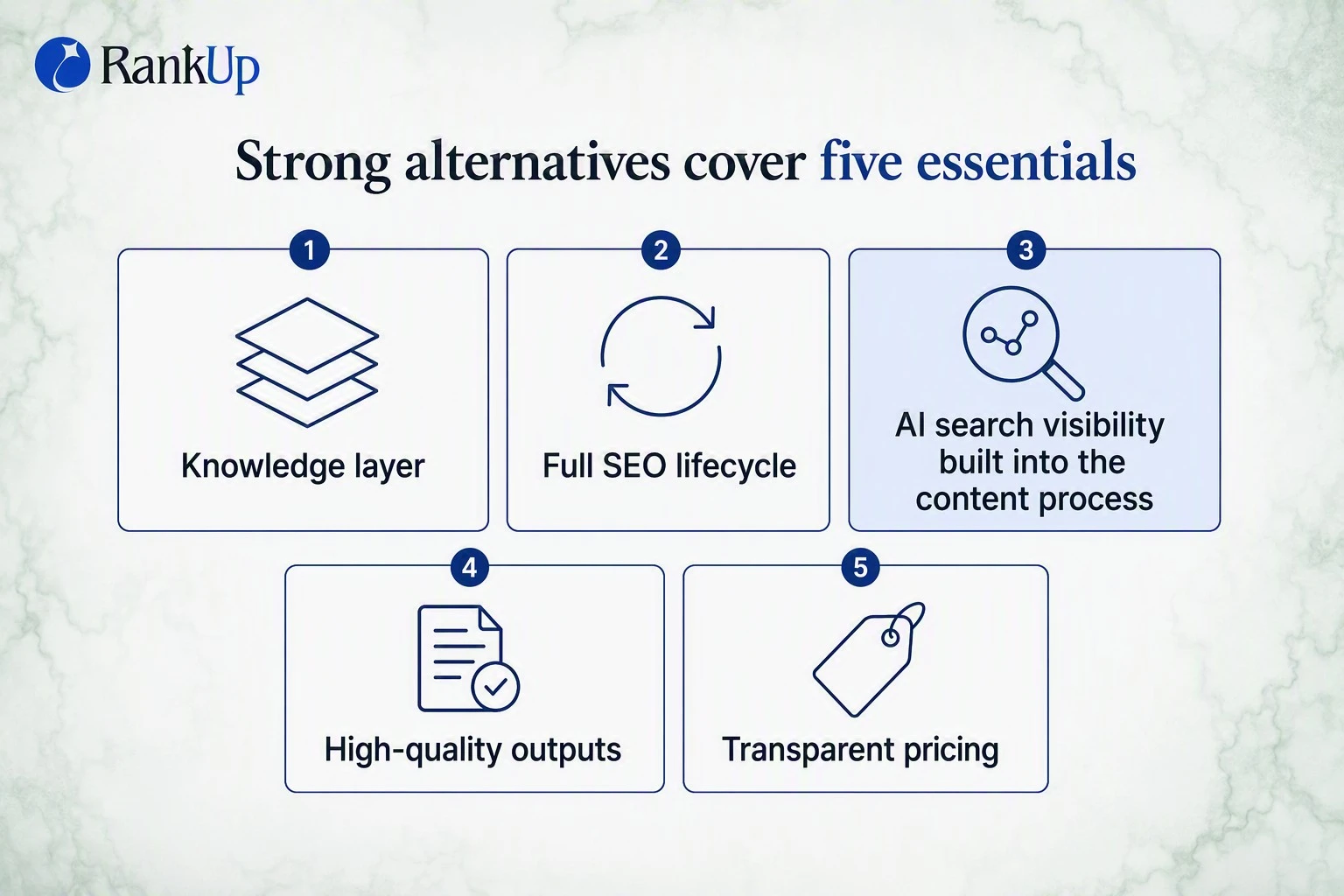
Here's what to look for:
A persistent knowledge layer
Full SEO lifecycle coverage
AI search visibility built into the content process
Output grounded in real product expertise
Transparent pricing that scales with use
Here are the tools worth comparing.
The 10 best Writesonic alternatives in 2026
Each entry covers what the tool does, its limits, who it is built for, and its published pricing.
1. RankUp
RankUp gives SaaS founders and lean marketing teams a dedicated SEO and GEO content team for the work they cannot keep doing by hand. It turns keyword and competitor research into a prioritized plan, publish-ready articles and pages, and reviewable updates to live content, helping buyers find and evaluate the product in Google and AI discovery. It fits teams that want finished content rather than briefs for a writer, and can contribute their product expertise.
Magnus handles planning, Cedric owns the writing flow, and Lyra manages updates and improvement work.
Magnus runs keyword research from start to finish: you drop in your domain, and it builds the full strategy.
The workflow follows a fixed sequence.
Competitor identification - finds who you're competing with in search
Keyword discovery - surfaces relevant keywords across your topic space
Automatic filtering - removes low-value terms without manual review
Topical clustering - groups keywords into content themes, e.g. grouping all "pricing comparison" keywords into one cluster
Prioritized publishing plan - puts high-intent clusters first, so you write what moves the needle earliest
You get a full content strategy in minutes, not days. No SEO background needed. Other tools give you data to interpret. Magnus gives you a plan ready to execute.
Magnus turns the research into a prioritized plan, so you can move from topic opportunities to a writing queue without manually sorting the data.
Before drafting begins, the content flow pulls relevant product knowledge and competitor context for the article's angle. A how-to guide draws on documented workflows, while a listicle uses the competitors relevant to that comparison.
Cedric writes section by section, using the brand voice system and curated information from the blueprint. That prevents the quality drop-off common in bulk AI writing.
The brand voice system gives Cedric three inputs:
Style guides - your documented tone, sentence patterns, and word choices
Masterpiece reference - your best-written article for that content type, so Cedric matches your actual voice, not a generic AI voice
Creative brief - how your customers describe the problem, how you present your solution, your pain point framing, and more.
After Cedric writes, Lyra reviews the full draft against your brand guidelines, SEO writing rules, and the masterpiece reference.
It creates specific improvement tasks and Cedric implements them directly into the draft.
You get a quality loop without managing it yourself.
P.S. You can also add a custom checklist if you have specific requirements for your content.
If you want to see the full breakdown of the writing system, check out the video below:
Knowledge Base
Your input compounds over time.
Share your take on a competitor during one writing session and that opinion gets stored. Walk Cedric through your actual workflow — the steps, the tools, the things most guides get wrong — and that process knowledge lives in the knowledge base.
The next article in that space starts with your real expertise already on the table.
Product details that were never formally documented end up here too — features you explain mid-session, industry opinions, workflow specifics. The more you contribute, the more autonomous content creation becomes.
You can also freely upload more sources e.g. help center articles, to fill up the knowledge base with fresh knowledge that isn't on your website yet.
Content audits and optimization
Lyra audits your content and surfaces pages that need updating, pages competing for the same search intent, and internal-linking gaps.
Stale pages - content losing relevance that hasn't been updated
Search intent duplicates - two pages targeting the same intent that Lyra flags for merging; Cedric then combines the stronger sections and adds internal links from supporting posts
Internal linking gaps - missed opportunities to pass authority across your site
Title optimizations - reviews your page titles against SERP competitors and best practices, then flags titles that are misaligned or underperforming
GSC keyword movement - monitors which subtopics on a page are gaining impressions and clicks, then flags those subsections for expansion so you capture more of the traffic already building
... and more.
P.S. Every audit finding includes reasoning and competitor data so you know exactly what to fix and why.
Cedric turns approved audit findings into reviewable draft changes.
Pages that need deeper work can go through Full Optimization, Content Refresh, or Internal Linking workflows. Lyra frames the work with audit and performance context, then Cedric writes the changes for review.
Site-wide updates in one chat
You can open an ad-hoc chat with Lyra for a repositioning, product update, or terminology change. Lyra maps the pages affected and routes the writing work to Cedric as reviewable draft edits before anything goes live.
Pros and cons
TL;DR: RankUp brings strategy, writing, updates, and reporting into one workflow, but it works best when you contribute real brand and product context.
Pros:
Quality focus - RankUp prioritizes depth and uniqueness over volume. Every output reflects your expertise.
The SEO work is done for you - Keyword research, content creation, auditing, and optimization are all handled. Your job is to contribute brand knowledge and steer the agents. One person in that role operates like a full SEO team.
Transparent reasoning - every audit finding and recommendation includes context, so nothing is a black box.
Scalable control - you choose how involved to be. Review each step in detail, or let the agents run more autonomously as you build trust in the system.
Cons:
Slower than bulk AI - RankUp takes more steps and asks for your input. It won't produce 50 articles instantly, but that's by design.
Requires your input - the agents ask for your knowledge and brand context. If you want 100% autopilot, this will feel like work. That input is also what makes the output unique.
Built around long-form SEO content - not the right fit for press releases or social copy.
Pricing
RankUp starts with a 7-day free trial. Onboarding builds a brand voice, knowledge base, and topical map from your site. The trial is only available to SaaS and technology companies with English-language websites.
During the trial, RankUp analyzes your site, learns your brand context, runs a light AI-search audit, maps next actions, and proposes a tailored ongoing plan.
(For SaaS and tech companies with English-language sites only.)
Getting started
Start with the 7-day free trial. Onboarding grants the trial automatically and builds the initial brand voice, knowledge base, and topical map from your site.
Use the trial to see what RankUp finds on your site. RankUp learns your brand context, runs a light AI-search audit, maps next actions, and proposes a tailored ongoing plan.
(For SaaS and tech companies with English-language sites only.)
If you only need on-page scoring, the following tools focus more narrowly on optimization and monitoring.
2. Surfer SEO
Real-time content scoring against live SERP competitors is where Surfer SEO earns its reputation. I've run 20+ articles through it across two client sites and the on-page scoring is genuinely useful as a directional guide.
The Content Editor analyzes top-ranking pages for your target keyword and assigns a live score as you write. It shows exactly what to adjust to compete. Google Docs and WordPress integrations let writers optimize inside tools they already use.
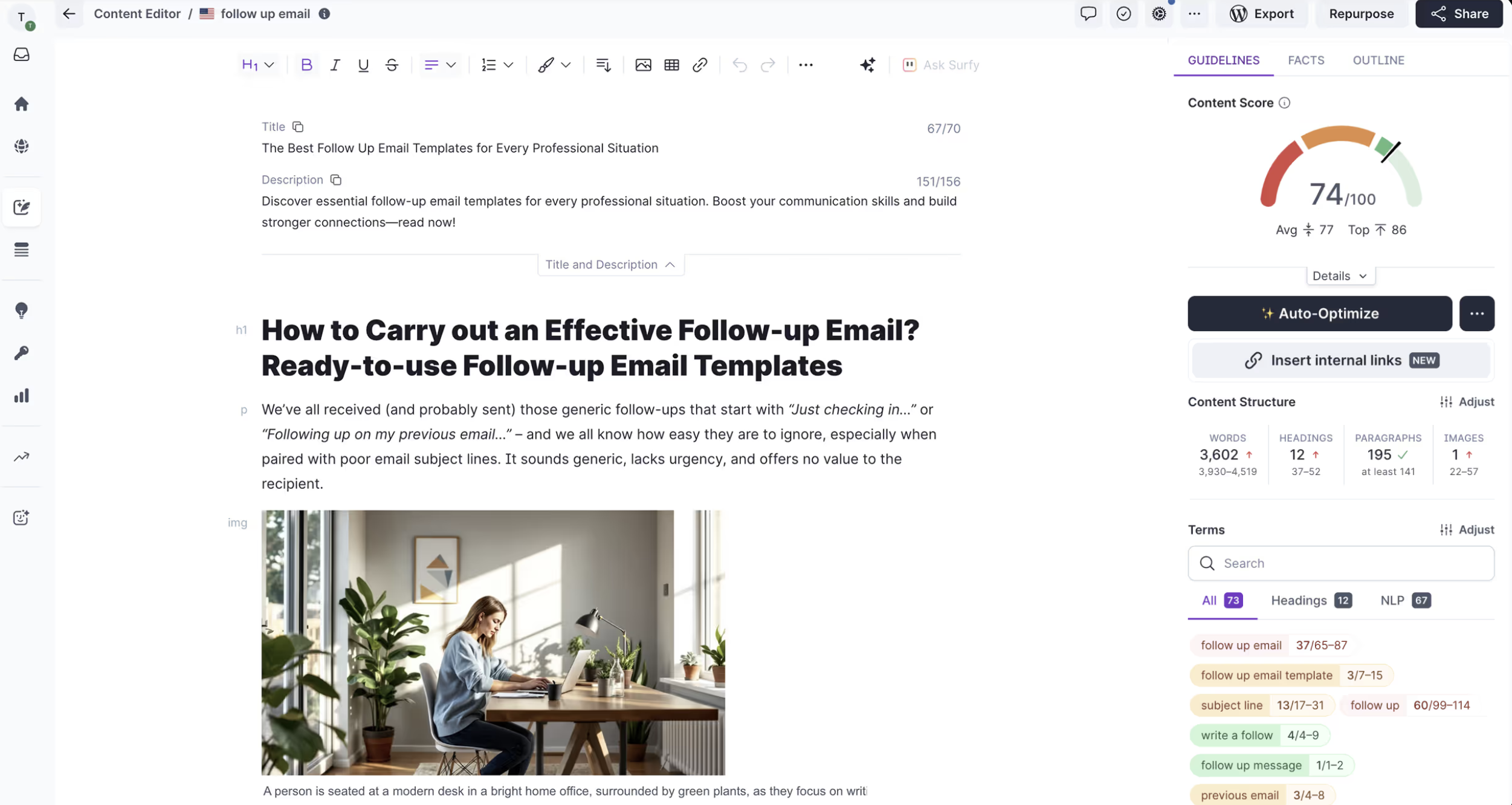
AI Visibility tracking is included on Discovery, Standard, Pro, and Peace of Mind plans, showing how visible your brand is inside AI chat responses. API access is available on the Peace of Mind plan and Enterprise.
Pricing starts at $49/month on the Discovery plan, billed annually. The Standard plan (the most popular starting point for growing teams) is $99/month billed annually.
Surfer SEO is built for teams that want strong on-page optimization first, but it also includes keyword research, topical mapping, and AI-assisted drafting. It still leans more heavily toward optimization than a persistent, knowledge-driven writing workflow.
I've used it directly, and the on-page optimization is solid. Surfer does include Brand Knowledge on Standard and above, with Brand Workspaces and Custom Voices on higher tiers.
That said, the brand context integration is lighter than a purpose-built knowledge, creative brief and style guides system — it informs the editor, but it doesn't quite replace a human writer that adapts to different scenarios, and it doesn't integrate your unique knowledge into the content.
The keyword density scoring also feels mechanical. It pushes you to hit numbers rather than write naturally.
Watch out for: Surfer's density scoring can push unnatural keyword repetition. Use it as a directional guide, not a hard target.
Pro tip: Use Surfer's Content Score as a floor (aim for 70+), not a ceiling. Once you hit it, stop optimizing for the score and read the article out loud. If it sounds like a keyword list, rewrite for the human, not the algorithm.
If Surfer's scoring approach doesn't fit how your team writes, our tested Surfer SEO alternatives breakdown covers 10 platforms evaluated against real production workflows.
3. AthenaHQ
Want to know how often ChatGPT or Perplexity mentions your brand? That's AthenaHQ's core job.
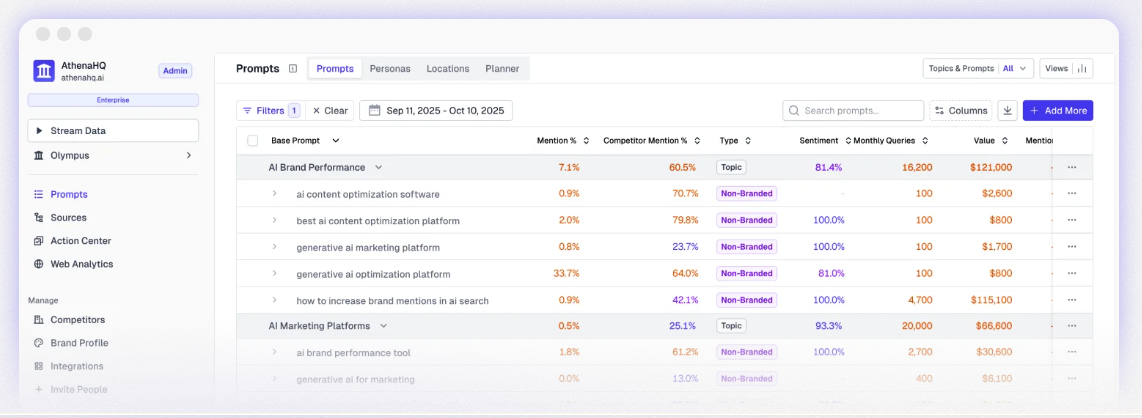
Tracks brand mentions and citations across up to 8 major AI platforms: ChatGPT, Perplexity, Google AI Overviews, AI Mode, Gemini, Claude, Copilot, and Grok
Provides recommendations to improve how AI models cite your brand in generated answers
Includes competitor AI visibility benchmarking to compare your brand's AI presence against rivals
AthenaHQ is built for marketing teams measuring AI-generated answer visibility and brand citations. Its content-generation features are secondary to monitoring and reporting.
Pro tip: Before paying for AthenaHQ, run your brand name manually in ChatGPT and Perplexity five times across different prompt phrasings. If your brand doesn't show up once, you have a baseline problem that monitoring won't fix on its own. AthenaHQ tells you how often you appear. The content strategy is still on you.
Limitations worth knowing:
The query volume estimation model (QVEM) is a proprietary feature for estimating how often prompts are searched in AI tools. That said, the data is statistical estimation — not direct measurement. Decisions based on estimated prompt volumes are less reliable than traditional search volume from established tools like Ahrefs or Semrush.
Content generation exists here, but it's secondary. AthenaHQ is a monitoring platform that added content features, not the other way around.
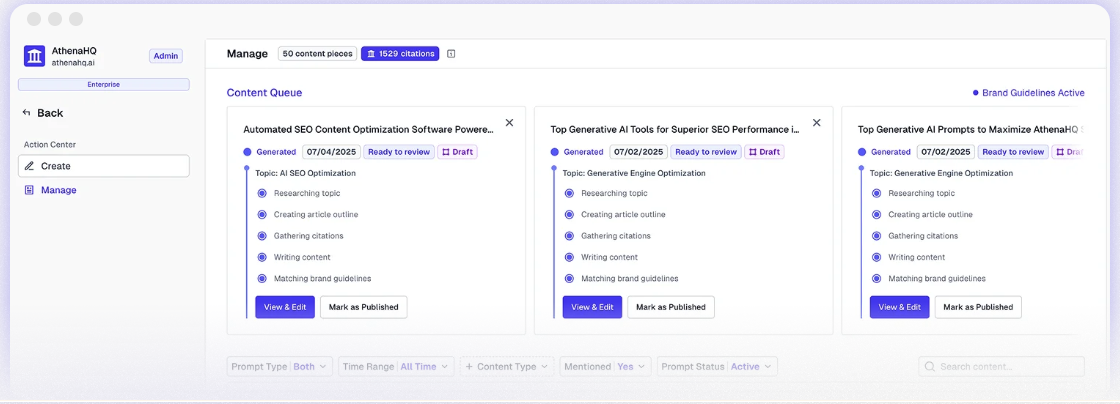
The "Pitch Workspace" feature generates AI search visibility reports for prospects in under 5 minutes, which signals a clear push toward agency users rather than solo marketers.
4. Clearscope
Clearscope grades your draft on an A–F scale based on what the top-ranking SERP pages cover, helping writers close topic gaps before publishing.
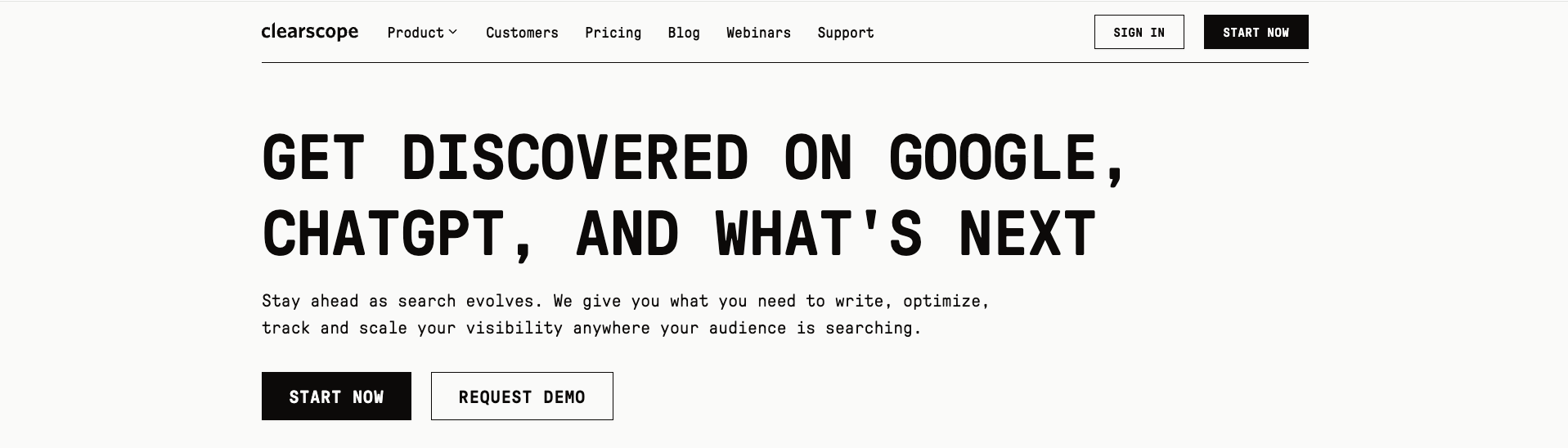
Integrations: Google Docs and WordPress, with unlimited user seats on all paid plans.
Keyword research: Limited compared with full SEO suites, but not empty. Clearscope does provide search volume, trend-related insights, and topic exploration data.
The Essentials plan runs $129/month for 20 AI Tracked Topics, 20 monthly Topic Explorations, and 20 monthly AI Drafts. That's roughly $6.45 per report. The Business plan is $399/month for 50 topics.
In practice, that means a two-tool workflow: discover keywords externally, then bring them into Clearscope to optimize content.
Best for: Freelance copywriters, bloggers, and software marketing teams under 50 people who already handle keyword research elsewhere. Not an all-in-one SEO suite.
What works:
Prompt simulation and LLM share-of-voice are useful additions, not just a gimmick
NLP scoring and keyword placement guidance are functional and reliable
Unlimited user seats on all paid plans keeps team costs predictable
What doesn't:
No knowledge system or brand engagement — grades what's already ranking, not what makes you different
Keyword research too shallow to build a topical map
Monitoring surfaces data with no action plan on what to do with it
Pro tip: Clearscope works best as a final-pass tool, not a starting point. Write your draft using your own expertise, then run it through Clearscope to catch topic gaps. Starting with the report tends to push you toward rewriting what's already ranking.
Profound focuses on showing where a brand appears in AI-generated answers and how that compares with competitors.
5. Profound
Profound is a full-stack AI search visibility platform designed to help brands monitor and optimize their presence in AI-generated answers. It tracks brand citations, sentiment, share-of-voice, and competitive benchmarking across eight major LLMs.
ChatGPT, Perplexity, Google AI Overviews, Google Gemini, Microsoft Copilot, Meta AI, Grok, and Claude.
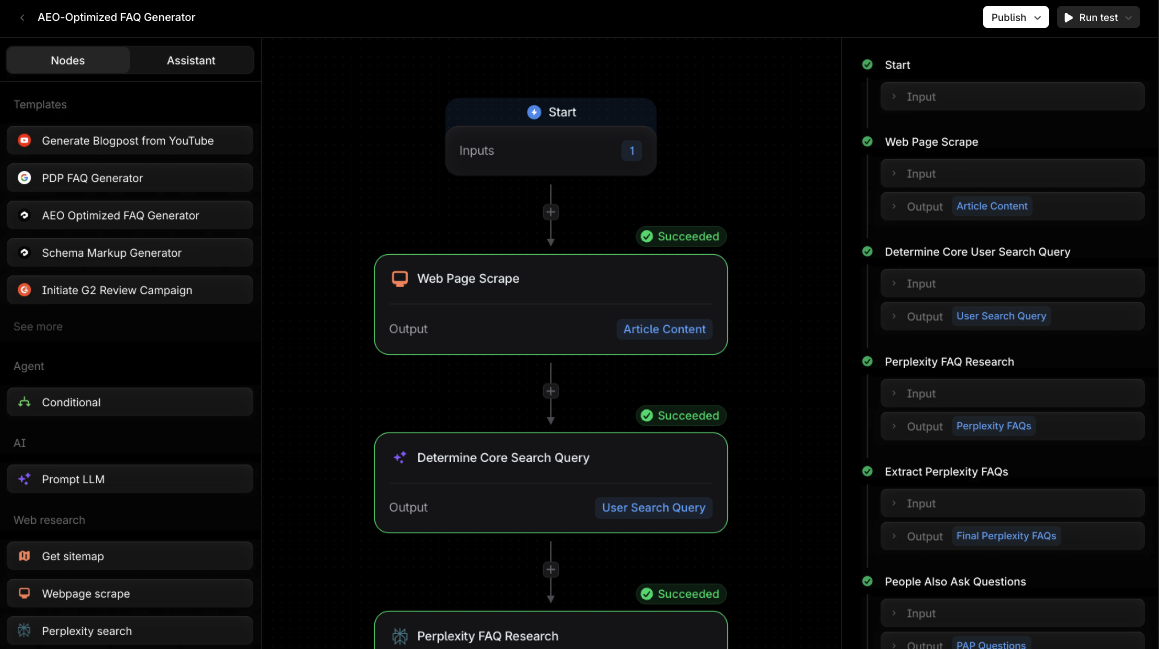
Profound's Answer Engine Insights tracks brand mentions, citations, sentiment, and competitive share-of-voice across AI engines.
Growth plan covers 3 engines. Enterprise covers 10+.
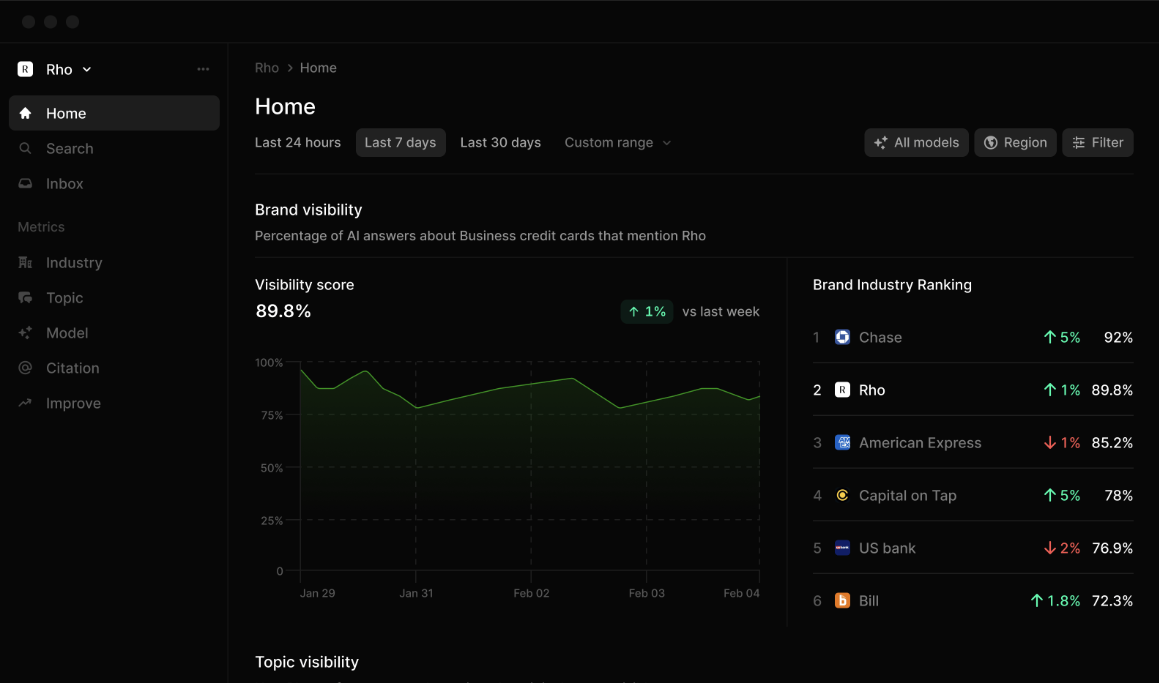
Users can see exactly where they appear in AI-generated answers and how that compares to competitors.
For example: if your brand appears in 12% of ChatGPT responses for 'best project management software for SaaS' but a competitor appears in 47%, Profound surfaces that gap along with the specific articles and sources driving their citations.
The platform also includes autonomous AI agents covering:
AEO/SEO optimization
Content generation and optimization
Demand generation
Brand management and PR
Growth plan: 100 agent trial runs. Enterprise: unlimited.
An Agent Analytics layer monitors how AI models crawl your site across unlimited domains.
Limitations worth knowing:
No transparent public pricing on the website
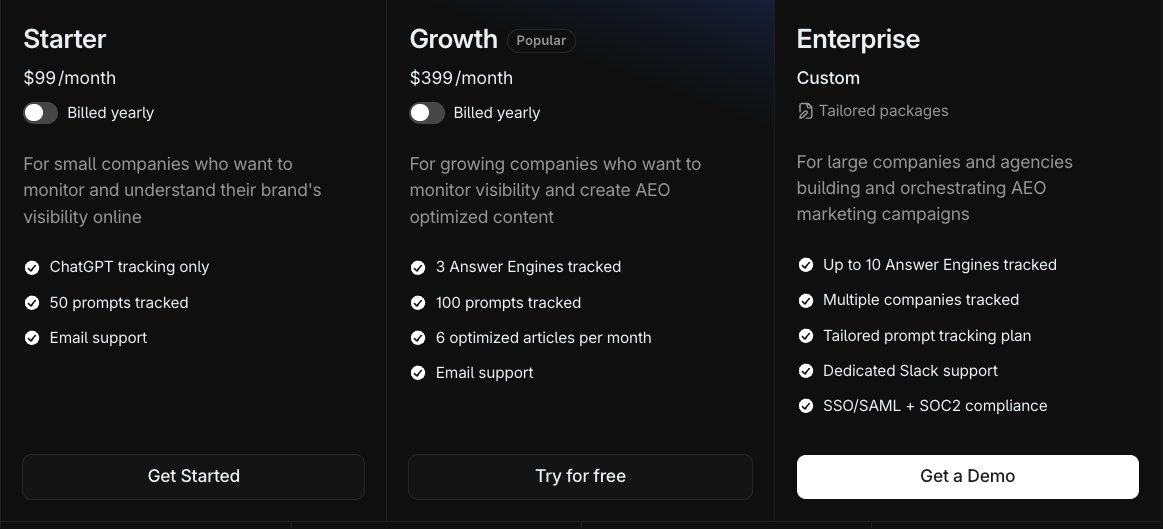
Growth plan caps at 3 engines, 100 prompts, and 6 optimized articles per month — tight for any active content operation
Enterprise pricing is custom; you'll need a demo call to get numbers
Profound does not list specific pricing on its website. The Growth plan is available with a free trial and includes 3 engines, 100 tracked prompts, 6 optimized articles per month, 100 agent trial runs, and 3 user seats.
Profound is best suited for marketing teams, SEO agencies, and enterprise brands that need to measure and improve AI search visibility, not just create content.
Its primary value is knowing where your brand stands in LLM-generated answers and actively improving that position.
It outperforms Writesonic specifically for AI answer monitoring: Profound tells you exactly how often your brand surfaces in ChatGPT, Perplexity, and Google AI Overviews, and what to do about it.
Profound focuses on AI-search monitoring, with prompt tracking, citation data, sentiment, and competitive share-of-voice reporting across supported engines.
Where it gets complicated:
The custom workflow builder is a real differentiator, but it's not beginner-friendly. You need to know what you're building before you can piece together a meaningful workflow.
The starter plan only tracks GPT, so the realistic entry point is the Growth plan at $399/month — 3 engines and 100 tracked prompts.
You'll hit Enterprise pricing faster than the plan structure implies. The 6 optimized articles per month on Growth won't cut it for any active content operation.
Profound is designed for teams that treat LLM visibility as a core metric. Otterly AI offers a lower-priced option for prompt and brand-mention monitoring.
6. Otterly AI
Otterly AI is the cheapest way to check if your brand shows up in AI-generated answers. Base plans track mentions across ChatGPT, Google AI Overviews, Perplexity, and Microsoft Copilot. Google AI Mode and Gemini are available as paid add-ons.
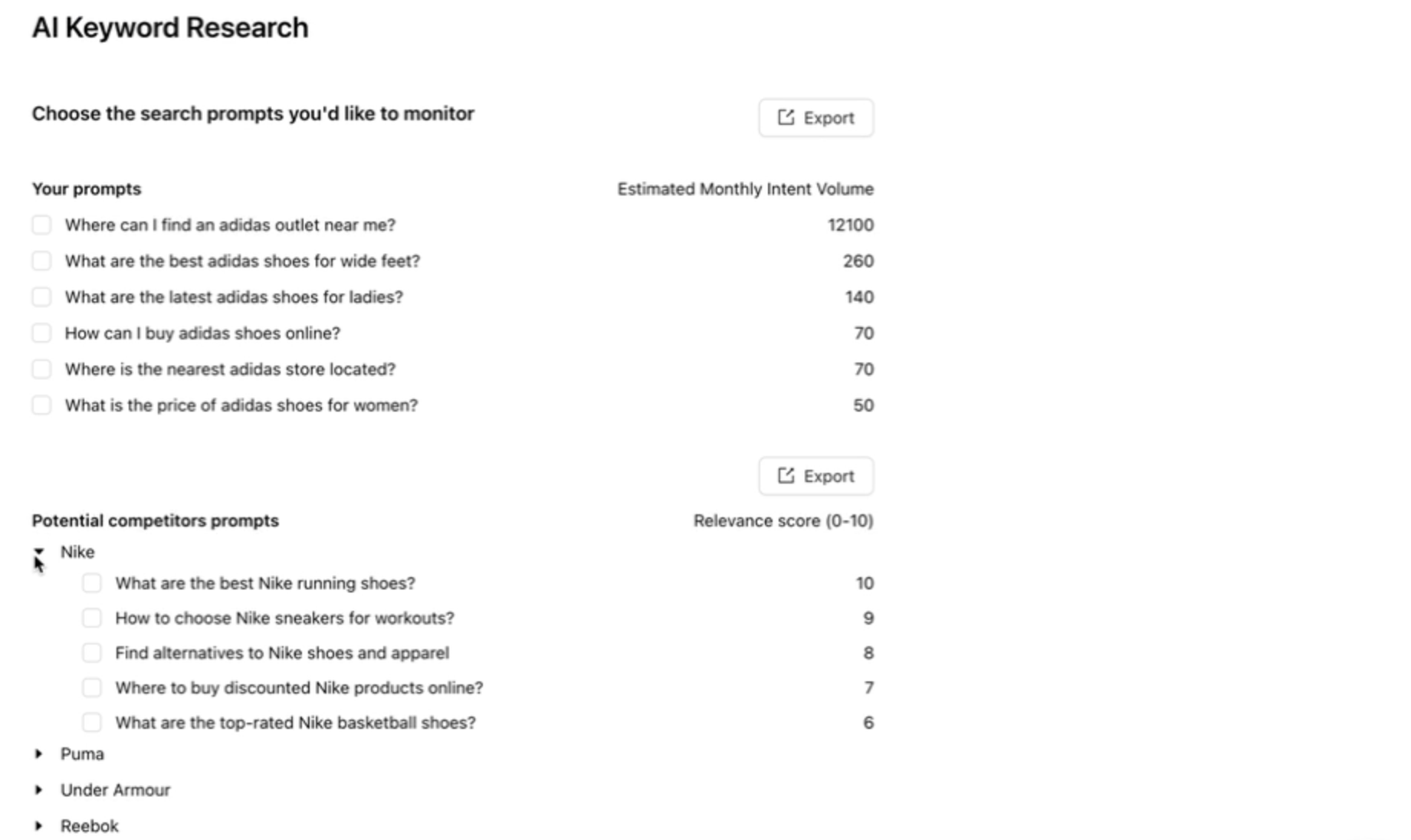
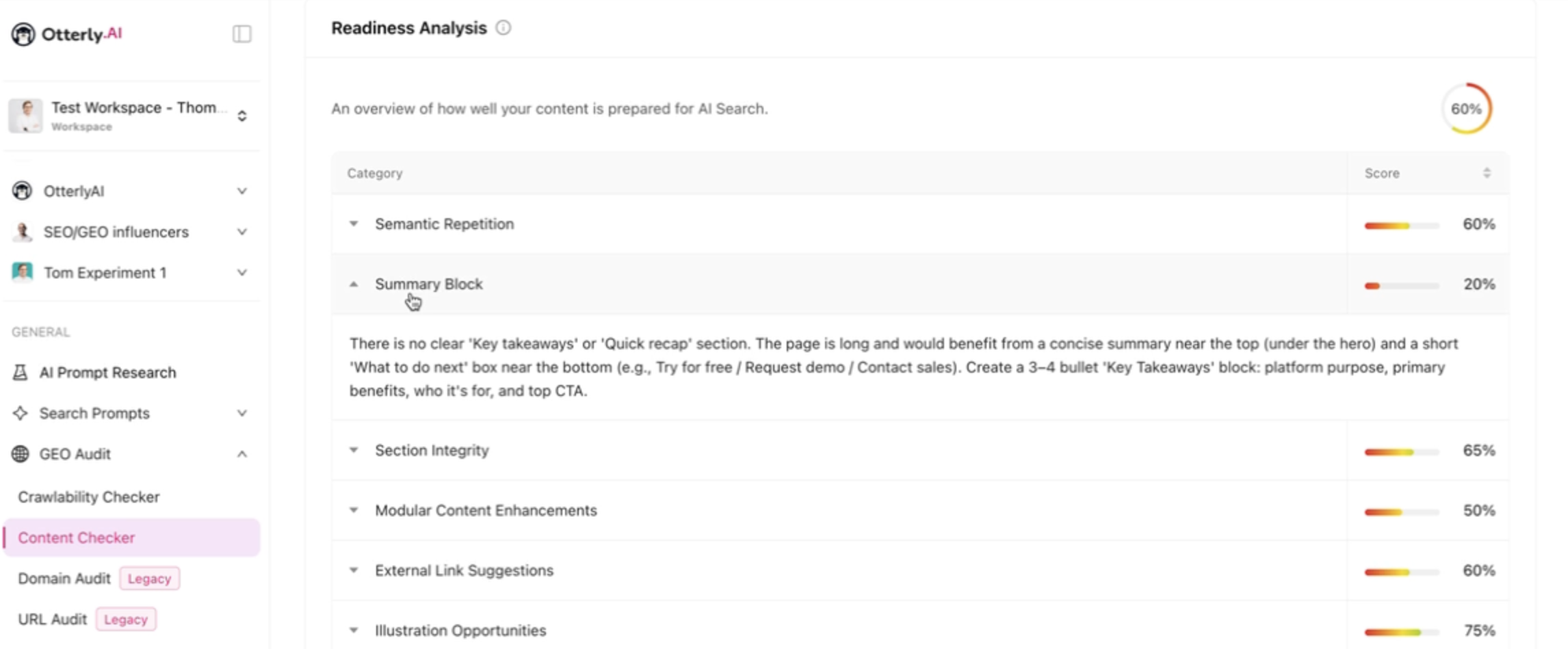
Otterly AI tracks brand mentions across ChatGPT, Perplexity, and Gemini. It generates share-of-voice reports showing which prompts surface your brand versus competitors, and lets you run specific queries to test how your brand appears in AI-generated responses.
Otterly AI's pricing: the Lite plan starts at approximately $29/month for 15 tracked search prompts and 1,000 GEO URL audits.
The Standard plan runs approximately $189/month for 100 prompts and 5,000 audits. The Premium plan costs approximately $489/month for 400 prompts and 10,000 audits. Enterprise pricing is custom. A 14-day free trial is available without a credit card.
It's built for brand managers and SEO teams tracking AI search visibility, not content creators. Otterly AI doesn't write or optimize content, so it works as a monitoring complement to your existing workflow, not a direct Writesonic replacement.
The 14-day no-card trial is the right way to evaluate it. Run your 10 highest-priority brand prompts for two weeks and check whether your brand surfaces consistently. If it doesn't, you have data to work from. If it does, you're monitoring blind spots you didn't know existed.
Limitations worth knowing:
Keyword brainstorming is shallow — surfaces only a handful of keywords per topic, not enough to map a topical landscape
The GEO and content audit flags gaps but stops there. No actionable specifics on what to change or where.
Common mistake: Treating prompt tracking volume as keyword volume. The prompts you track in Otterly AI are ones you define manually. You won't discover what you're not already tracking. Pair it with traditional keyword research to avoid monitoring in a blind spot.
Otterly AI tracks prompts you define. Frase addresses a different stage of the workflow, moving from keyword research to a finished draft.
7. Frase
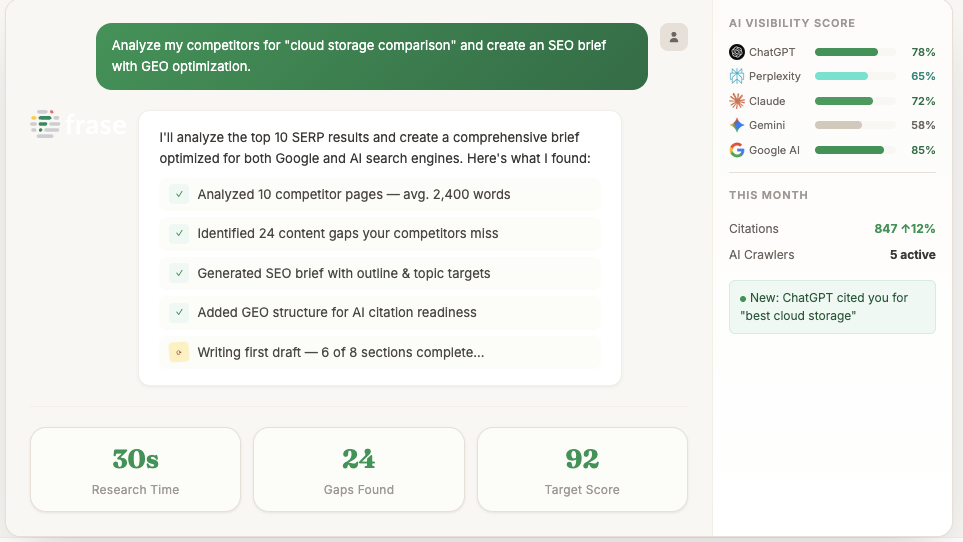
Frase builds content briefs by analyzing top search results, pulling competitor structure, headings, and topics automatically. It's praised on r/SEO specifically for brief creation at the planning stage.
Dual scoring is the standout feature. Frase scores content for both traditional SEO rankings and GEO (Generative Engine Optimization), measuring citation likelihood in ChatGPT and Perplexity. That's a real step up from pure keyword density tools.
On-page optimization is where Frase falls short. The on-page tools are less detailed than Surfer SEO, so if deep content grading is your priority, you'll notice the gap.
The Starter plan is $49/mo billed monthly, with a 20% discount on annual billing. That's still one of the cheaper research-to-draft workflows with GEO scoring included.
Frase fits content creators and small businesses who want to move from research to draft fast, with some AI search future-proofing built in. Teams needing high-volume output or deeper on-page analysis will hit its ceiling.
Frase is optimized for getting a draft fast. The problem is there's no knowledge system behind it. Without product knowledge or brand context baked in, the output is SERP content repurposed into your article. Fast, but not differentiated.
The shift from NLP scoring to GEO scoring is a genuine improvement over competitors still measuring keyword density. But it's still scoring, not a workflow that shapes how content gets written.
At $49/month, Frase is positioned as a research-to-draft workflow with GEO scoring and no persistent knowledge layer.
If content creation isn't your bottleneck but knowing where you rank is, Nightwatch is worth a look.
8. Nightwatch
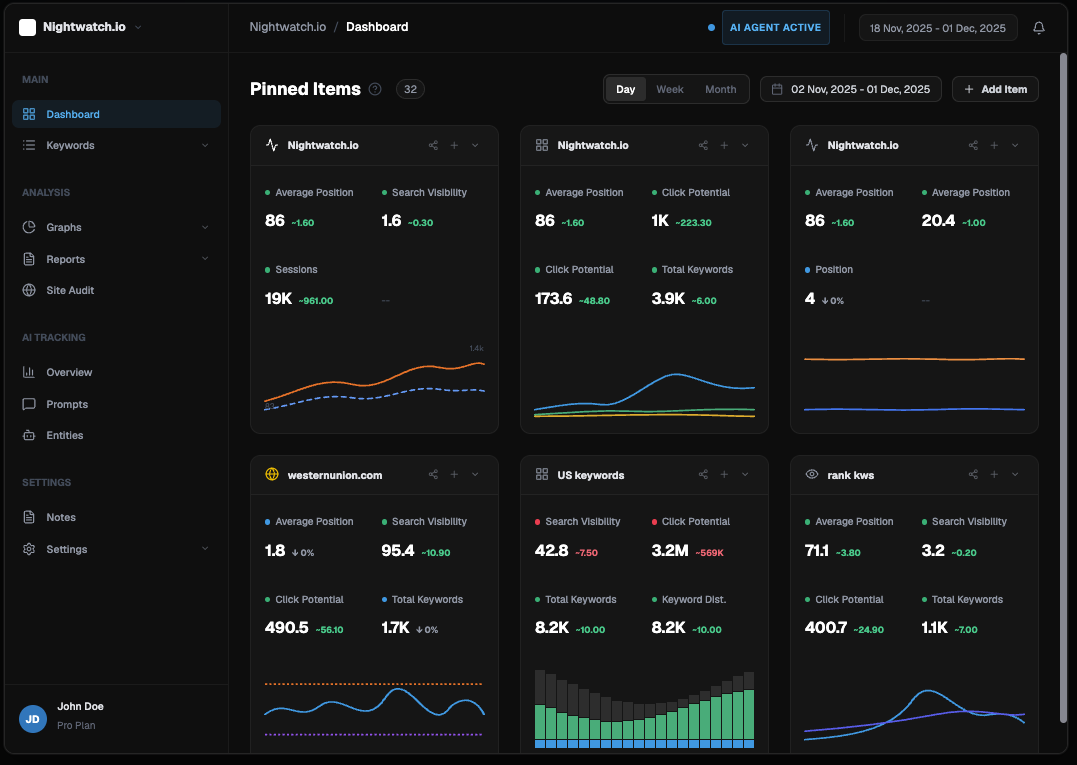
Nightwatch provides rank tracking across Google, Bing, and YouTube, along with granular local targeting and white-label reporting for client deliverables.
Keyword ranking — daily updates across Google, Bing, and YouTube
Location targeting — down to city, ZIP or postal code, neighborhood, and street-level localization, solid for local SEO work
SERP feature tracking — covers featured snippets, local packs, and knowledge panels with historical data going back to account creation
White-label reporting — scheduled automated reports built for agency client deliverables
Nightwatch has added an AI search prompt tracking add-on, so it's not purely a traditional rank tracker anymore. At $99/month for 100 prompts, it's roughly 4x cheaper than Profound's equivalent.
The catch: it's a beta feature with unverified quality, and it doesn't provide estimated prompt volumes. You get tracking only, with no data on actual search demand behind a given prompt.
Pricing: Starts at $32/mo (250 keywords, billed annually) and scales up based on keyword volume. According to their FAQs, a 14-day free trial is available, no credit card required.
Nightwatch fits SEO agencies and in-house teams that need granular rank tracking and white-label client reporting. No content generation, no knowledge system. It won't tell you what to write, only how existing content is performing.
Nightwatch covers rank tracking and reporting rather than content creation. Its $32/month entry plan and 14-day trial give teams a way to evaluate location-targeted tracking before committing.
If bulk content at scale is what you need to pair with your rank tracking, Brandwell is built for volume, though the tradeoffs are significant.
9. Brandwell
Quantity is Brandwell's pitch. It advertises 100+ pages in minutes, and the product is built around that promise.
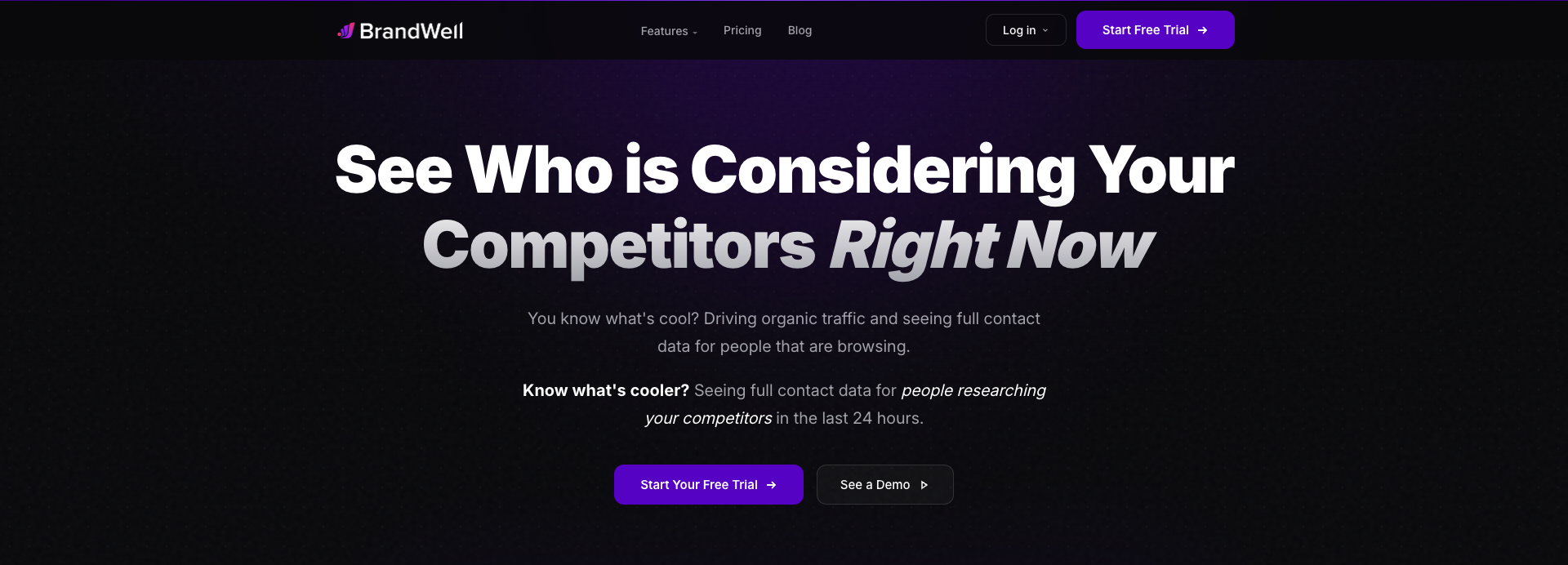
Brandwell splits its product into two modules.
AIMEE is a built-in AI assistant with 20+ skills and 70+ tools covering research, content creation, and ad creatives for Meta and Google.
RankWell is a programmatic SEO engine that generates bulk content from CSV or API inputs. Content supports 100+ languages for international SEO.
Key features at a glance:
AIMEE - 20+ skills, 70+ tools for research and ad creative
RankWell - bulk CSV/API content, 50–100 articles per month depending on plan
Multilingual - 100+ languages supported
Analytics - optimization auditing and reporting included
Brandwell markets its output as 'human-readable,' with blog posts typically scoring 70–80% on AI detection tools. The credibility issue: content rewritten by Brandwell's AI frequently fails its own proprietary detection software. Users on Trustpilot report output that requires full rewrites, which erases the time-saving benefit.
Pricing has changed significantly. The current plans - Growth, Scale, Agency, and DFY - now start at $799/month on the current pricing page, with higher tiers scaling up from there. There is still no low-cost entry tier.
Add-ons are steep:
25 extra articles: $99 one-time
Extra intent categories: $299/mo
Additional agency projects: $499/mo
Brandwell's positioning is quantity over quality. Advertising 100+ pages in minutes signals its target audience is large enterprises and agencies running high-volume programmatic SEO — at enterprise prices to match. It's not a budget tool.
It's a poor fit if you need:
AI visibility monitoring or LLM citation tracking (neither exists)
A short learning curve (multiple underlying AI engines create complexity)
Quality output without heavy editing (user reviews flag this consistently)
Brandwell emphasizes high-volume content generation. Scalenut takes a similar keyword-to-draft approach at lower published price points.
10. Scalenut
Cruise Mode is Scalenut's headline feature: keyword to full 1,500-word draft in one automated run.
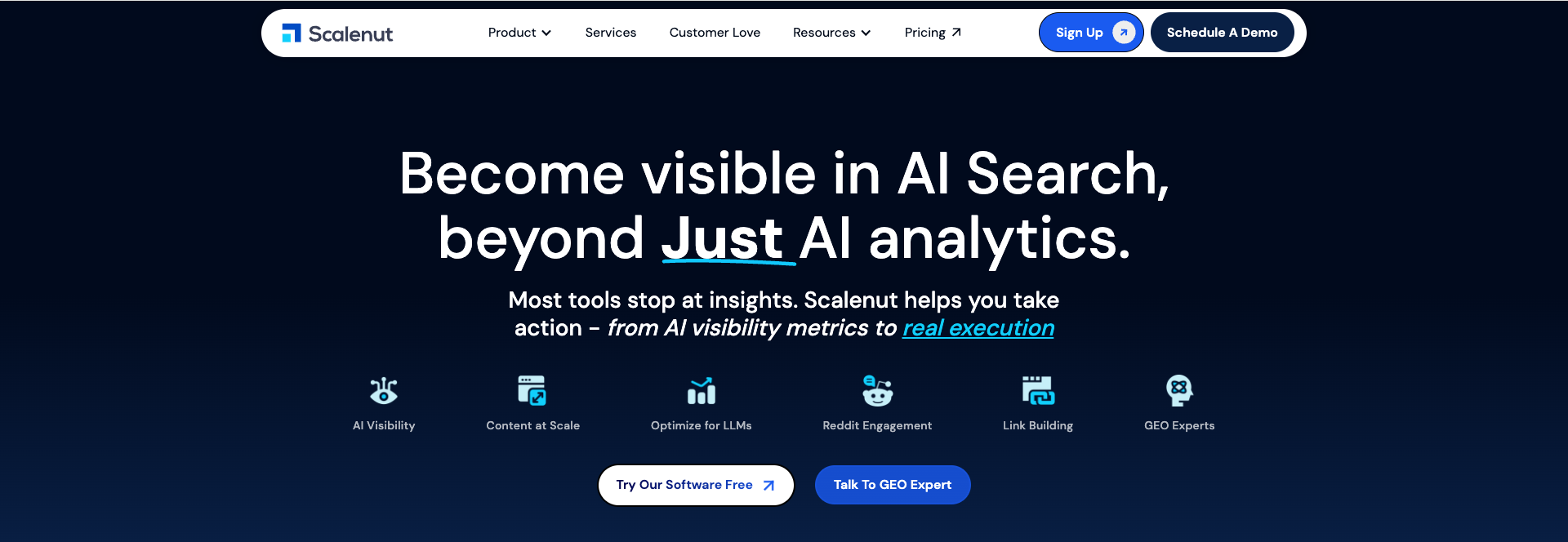
Scalenut's Cruise Mode generates 1,500–2,000 word SEO drafts from keyword to full article in one automated run. The SEO Assistant pulls NLP keywords, competitor outlines, and content scores from the top 30 Google results.
Scalenut also includes GEO features to position content as a reference source for LLMs like ChatGPT, with an option to hire Scalenut experts to manage GEO strategy directly.
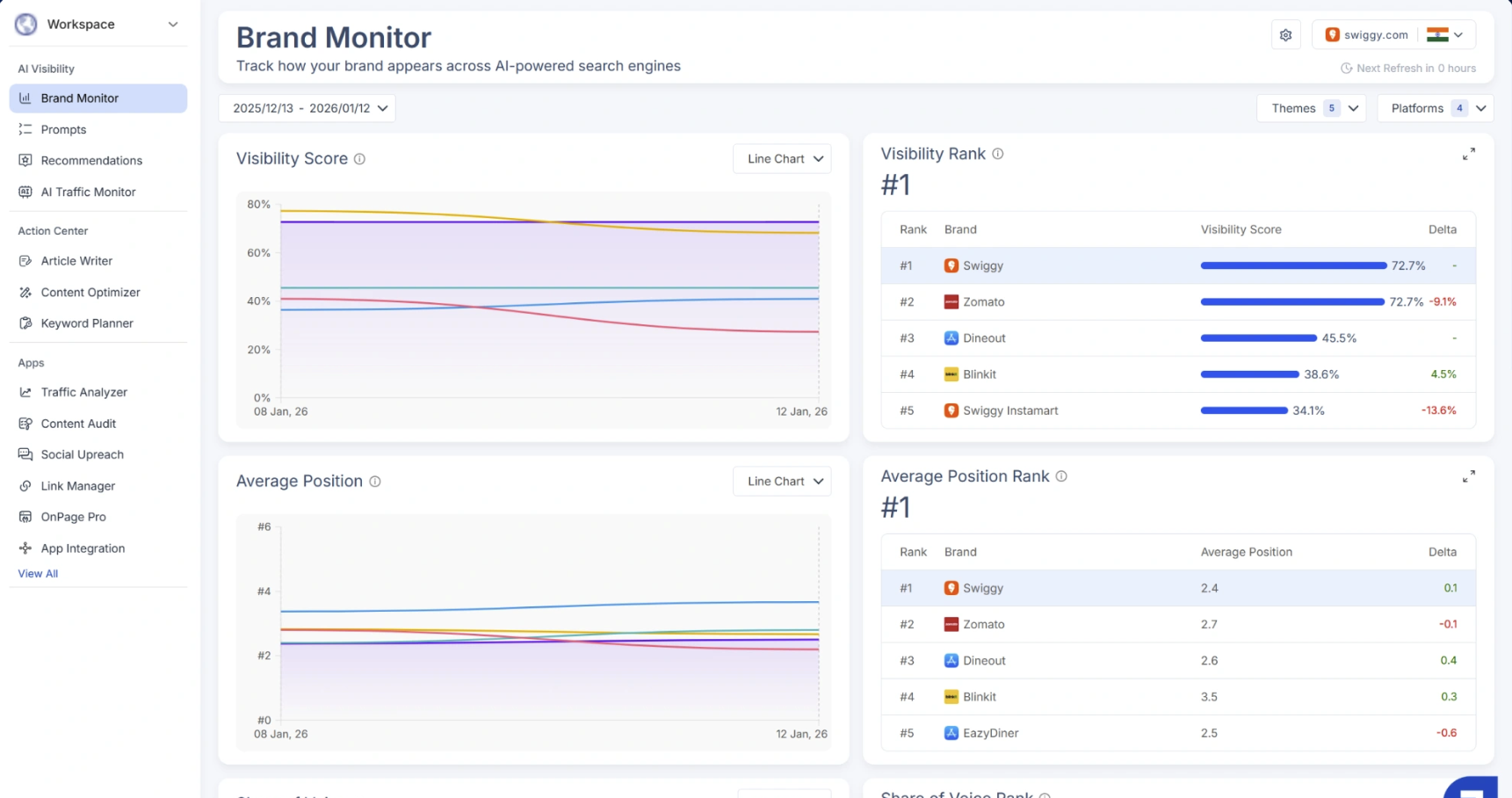
Scalenut's published plans sit below several tools in this comparison:
Starter: $59/mo ($30/mo annual) - capped at 5 articles/month
Plus: $89/mo ($45/mo annual)
Pro: $199/mo ($100/mo annual) - up to 75 articles/month
The Pro tier's 75-article output is quantity-over-quality. It's the same fully-generated, bulk-content model as Brandwell, just at a lower price.
The workflow has real gaps worth knowing before you commit:
Scalenut supports custom keyword-driven workflows, but the product is still split across separate AI Writing and SEO Research suites, which can make the workflow feel fragmented
AI Writing and SEO Research are split into separate suites, which fragments the workflow when moving between tasks
Starter caps at 5 articles/month, making it a poor fit for agencies or high-volume publishers seeking capable Scalenut alternatives
Recurring bugs and content inaccuracies require extra manual review
Two features stand out as genuinely uncommon: a link-building marketplace built into the platform, and social monitoring with Reddit tracking. Neither of these appears regularly in AI writing tools at this price point.
That said, the content workflow itself is generic: outline, generate draft, get a content score, done. Scalenut suits long-form SEO teams who want GEO features without paying enterprise prices. It's a poor fit for short-form content, agencies needing multi-site volume, or anyone who wants precise keyword control.
Writesonic alternatives compared: features, pricing, and best use case
Here's how all ten tools stack up across the three dimensions that matter most: full lifecycle support, best use case, and pricing.
Tool | Full lifecycle support | Best use case | Pricing |
|---|---|---|---|
RankUp | Yes, strategy, writing, updates, and reporting | SaaS teams building Google and AI-search content | 7-day free trial; custom ongoing plan |
Surfer SEO | Partial, on-page optimization, keyword research, topical mapping, and AI-assisted drafting | Teams wanting on-page scoring with research tools | From $49/mo (annual) |
AthenaHQ | No, monitoring and recommendations; content generation is secondary | Marketing teams measuring AI-search visibility | From $295/mo |
Clearscope | Partial, content grading, topic research, and AI-tracked topics | Freelancers and small teams optimizing drafts | From $129/mo |
Profound | Partial, AI monitoring, content optimization, and autonomous agents | Enterprise brands tracking AI-answer visibility | Pricing not publicly listed; free trial |
Otterly AI | No, AI brand-mention tracking | Brand managers and SEO teams monitoring AI search | From $29/mo |
Frase | Partial, research-to-draft workflow with GEO scoring | Content creators needing fast research-to-draft | From $49/mo ($39/mo annual) |
Nightwatch | No, rank tracking and SERP monitoring | SEO agencies needing local tracking and reporting | From $32/mo (annual) |
Brandwell | No, bulk content generation | Enterprises running programmatic SEO | From $799/mo (annual) |
Scalenut | Partial, writing and GEO scoring | Long-form SEO teams seeking lower-cost GEO tools | From $59/mo ($30/mo annual) |
Use the table to narrow the tools by workflow coverage, use case, and pricing.
The content system that compounds with every session
The tools in this list solve different parts of the content workflow. A score, a draft, or a visibility report can be useful, but your team still needs a way to carry product expertise into the next piece of work.
RankUp keeps your brand voice, product knowledge, and market context available across planning, writing, and content updates.
That continuity matters when you need more than a fast first draft.
The autonomous content flow reads your knowledge base before it asks for input. It uses focused interview questions only where your expertise would materially improve the article.
The same context supports Lyra’s content-management work. As your knowledge base grows, Lyra can draw on it when prioritizing updates, strengthening internal links, and routing writing work to Cedric.
Alonso frames it as a channel that compounds rather than one that pays back in proportion to a first month's spend. That is what the stored context is for.
Want to put that context to work on your site? Start your 7-day free trial.
Alonso Solis of Guardian Home used that same continuity to publish 55 blogs and landing pages in about three months. Leads started arriving around the first month, and organic search became one of Guardian Home's main pipeline channels.
FAQs
Why look for a Writesonic alternative?
Users look for Writesonic alternatives due to output quality issues and limited SEO optimization capabilities.
Output quality
Voice and style rarely match your brand without manual correction. Capterra reviewers describe the text as robotic and repetitive, requiring heavy manual editing before anything is publishable.
Factual accuracy
Inaccuracies slip through regularly. System glitches can force regeneration, burning extra credits with no added value.
The SEO community on Reddit also flags plagiarism risk. GPT-generated segments can mirror existing content closely enough to need a third-party check.
Pricing
The Advanced plan costs $499/month (or $399/month billed annually) and includes 200 articles per month. That works out to roughly $2.50 per article on monthly billing, or about $2.00 per article annually — before editing time. The free tier credit limits are too low for meaningful testing.
Do any Writesonic alternatives have a free plan?
Free-plan availability changes frequently, so check each product's pricing page before choosing an alternative based on a trial or free tier.
Several tools offer free trials:
Nightwatch, Otterly AI: 14-day trials (no credit card required)
Scalenut, Frase: 7-day trials
AthenaHQ: first-month discount with free credits
For paid plans, Otterly AI starts at $29/mo for monitoring. On the content side, Scalenut starts at $30/mo (annual) and Frase at $39/mo (annual) are the lowest entry points.
Which Writesonic alternative is best for SEO?
RankUp fits SaaS teams that need strategy, writing, updates, and reporting in one connected content system. Profound fits teams whose primary need is AI visibility and brand monitoring.
RankUp wins for SEO teams that want the whole system - keyword research, writing, audits, optimization, and reporting stay connected instead of getting split across separate tools.
Profound wins for AI visibility monitoring, not full SEO execution - it fits teams that already have content production covered and need tracking for brand presence across AI answers.
Choose RankUp when you need connected SEO and GEO content execution. Use Profound when AI visibility monitoring is your main requirement.
:quality(80))
Georg Richard Aare
Author of the article
Georg is the co-founder of RankUp and an SEO nerd who spends (almost) every waking minute refining his craft to make RankUp’s product the best it can be. When he’s not behind his computer, which is rare, you’ll find him in the gym doing bench (never legs) to clear his mind.
This article was created using: