
For SaaS and tech companies with English sites.
:quality(80))
10 Best Scalenut Alternatives for SEO Content in 2026
:quality(80)) Georg Richard Aare
Georg Richard Aare For SaaS and tech companies with English sites.
Drafts come back fast, then read like a worse version of whatever already ranks.
I compared all ten tools on the criteria shown throughout this page: research depth, output quality, workflow coverage, AI visibility, and pricing.
The best Scalenut alternatives in 2026 are RankUp, Surfer SEO, Frase.io, Jasper AI, and Writesonic.
RankUp for SaaS teams that want publish-ready content and monthly updates grounded in their product knowledge; you supply expert input and approve changes.
Surfer SEO for writers who want live SERP-based scoring; your team still writes and edits.
Frase for turning SERP research into briefs and drafts; your team supplies the angle and revises the output.
Jasper for brand voice across blogs, ads and emails; keyword research needs a separate tool.
Writesonic for fast drafts across blog posts, ads, landing pages and product copy; plan for human editing before publication.
The list below is sorted by how much of the rewriting burden each tool removes.
Why look for a Scalenut alternative?

Scalenut helps with drafting. It becomes a weaker fit the moment a SaaS team needs a repeatable content system rather than another AI writer.
Research depth is shallower than dedicated tools like Ahrefs or Semrush. The AI writing and SEO research features also live in separate modules, so moving from a keyword report into a draft means switching contexts rather than continuing a single workflow.
For a 1 to 3 person SaaS marketing team, those gaps compound quickly:
Brief quality - shallow briefs make it harder to publish content with a clear angle or product insight
Repetitive output - the AI cycles through similar phrasing across sections, requiring extra editing passes to add variety before publishing
Technical reliability - users have cited bugs and content inaccuracies as direct reasons to cancel, adding unpredictable overhead to every draft
No brand or product context - there is no knowledge base or brand voice logic, so output cannot reflect your positioning, differentiators, or customer language
Workflow sprawl - AI Writing and SEO Research live in separate suites, and strategy, optimization, and reporting still spill into other tools
Switching tools is not the answer on its own. The question is whether you need another writing assistant or a system that tells you what to create, helps produce it, and keeps improving it after publish.
In 2026, getting your product recommended in ChatGPT, Perplexity, or Gemini requires content that goes beyond drafting speed. Some tools in this list address that directly. Several do not.
What to look for in a Scalenut alternative
The right pick depends on where the content workflow is actually breaking for your team.
Workflow coverage
Workflow coverage is the first filter because it changes everything else. Some tools help with one stage. Others handle the whole content cycle with less manual coordination between them.
The tools in this list fall into four categories:
Research and strategy tools - Semrush and Ahrefs give you data and planning inputs, but writing and implementation still fall on your team
Briefing and optimization tools - Frase, Surfer SEO, Clearscope, and Outranking help shape content, but they do not replace a full operating system
AI writing tools - Writesonic and Jasper speed up drafting, though research depth and edit quality vary
System-level platforms - RankUp connects keyword research, publish-ready content creation, audits, applied updates, and reporting in one repeatable process
Research depth
Research depth decides whether your article says something useful or just repeats what is already on page one. The best tools pull from SERP data, competitor pages, and topic relationships rather than dropping isolated keywords into a draft.
Five signals worth checking:
SERP analysis - Surfer SEO, Frase, and Outranking pull structure and topic signals from ranking pages
Keyword breadth - Ahrefs and Semrush have the largest databases in this list: Ahrefs at 28.7B keywords and Semrush at 26.4B (Sources: Ahrefs Keywords Explorer; Semrush Keyword Database).
Topic modeling - Clearscope is strong when depth and topical coverage matter more than drafting speed
Rank tracking scope - SE Ranking is worth noting if you want rank tracking bundled with broader SEO tooling, though it is not covered in this list
Brief quality - the best systems turn research into detailed briefs with unique angles instead of generic outlines
Output quality
Publishing a fast draft is not the same as publishing something good. Generic AI copy creates editing debt, especially for SaaS teams that need product nuance and specific category knowledge.
A practical test: generate a full section on a core topic, then check how much rewriting it needs for clarity, tone, and product specificity.
Four things to evaluate:
Brand voice control - Jasper is known for stronger voice governance
Brief-to-draft alignment - Frase is strongest when you already know the angle and need speed
Optimization guidance - Surfer SEO and Clearscope are more useful for refinement than original thinking
Writing process quality - the strongest systems apply SEO copywriting best practices at the section level, not just keyword insertion
AI search visibility
Treat AI visibility claims carefully. Coverage differs by platform, by feature set, and sometimes by plan.
Check whether the tool gives specific, actionable guidance on improving citation likelihood across ChatGPT, Perplexity, and Gemini. A generic 'AI-ready' badge is not enough.
Pricing model
Figure out the workflow fit first. A cheaper tool that leaves you running two or three other tools alongside it usually costs more in time.
Four pricing traps to watch for:
Monthly credits that expire - unused article credits can disappear at the end of the billing cycle
Per-seat pricing - costs climb fast as soon as a second or third teammate needs access
Add-on charges - some platforms keep core content features behind extra fees
Low base price, high labor cost - a cheaper tool is not actually cheaper if every draft still needs heavy editing
Once you know where Scalenut falls short for your team, the comparisons below are easier to evaluate.
1. RankUp
RankUp is an SEO and GEO content system for SaaS founders and lean marketing teams that want writing and upkeep done, rather than briefs for a writer or scores to act on. It turns keyword and competitor research into a prioritized plan, publish-ready articles and pages, and reviewable updates grounded in your product knowledge. That work helps buyers find and evaluate your product in Google and AI search.
Best for: SaaS founders and GTM, sales, and marketing leaders who want stronger organic visibility and AI-search presence without hiring an SEO specialist or stitching together separate research, writing, and audit tools.
Core strengths:
One system for the whole workflow: keyword research, strategy, writing, audits, and performance reporting live in one place instead of across separate tools.
Grounded in your product: a knowledge base holds your positioning, product facts, and voice, so the output gets less generic the more context you add.
Fixes get implemented, not just flagged: audits surface what to change and an agent applies the update, rather than handing you a score to action yourself.
After analyzing your site and situation, RankUp prioritizes the content work around your needs. Guardian Home co-founder Alonso Solis reported leads within the first month and organic search becoming one of the company's main pipeline channels.
You get a coordinated SEO and GEO team covering strategy, content creation, content management, and measurement. Magnus plans what to publish, Cedric takes articles from research to review-ready drafts, and Lyra turns content updates, audits, internal linking, and site-wide changes into reviewable work.
A prioritized content roadmap - competitors are identified, keywords discovered and clustered, and a publishing plan built around the highest-impact topics first.
A publish-ready article or page - live search results and product knowledge shape the research, angle, and finished draft before it reaches review.
A complete draft, then an improved page - articles are written section by section against your brand voice, then updated when audits flag what needs to change.
The typical setup: keyword data in one tab, a brief in another, drafts in Docs, and audit notes that never get actioned.
With RankUp, research, briefing, writing, and optimization happen inside one workflow. No stitching together Scalenut, a keyword tool, Docs, and a separate audit process.
The knowledge base is a big part of why the output gets stronger over time:
Brand context stays accessible - positioning, product facts, and audience insights do not need to be re-explained every session
Style guidance carries forward - voice rules and examples stay available while content is being created
Autonomy improves with input - the more context you add, the less generic the output becomes
For an existing page, review the written edit, its reasoning and the competitor examples behind it. When the change is ready, approve, then RankUp applies it to your CMS.
One caveat: RankUp is not a lightweight writing assistant. It asks for brand input, knowledge-base setup, and editorial involvement at key stages.
That is the trade-off for teams that want a content engine rather than a standalone writing tool.
RankUp builds content around the questions qualified SaaS buyers ask in Google and AI search, improving your eligibility to earn citations and mentions in ChatGPT, Perplexity, and Gemini.
RankUp gives SaaS teams one workflow for research, writing, and ongoing content improvement, built around the product knowledge that makes pages useful to buyers. That work supports better rankings and stronger eligibility for Google and AI visibility, without guaranteeing a specific search position or AI recommendation.
Key features
RankUp covers the full SEO content workflow end to end:
Automated keyword research - Magnus identifies competitors, discovers keywords from SERP and competitor data, and builds a prioritized content roadmap with topical clusters.
Publish-ready content creation - Cedric researches live search results and product knowledge, then produces review-ready articles and pages in your brand voice. Lyra is the Content Manager; she routes writing work to Cedric and coordinates updates as reviewable edits.
AI article writing - Cedric writes each section following proven SEO content structures and your brand's style guide, adapting to each section type.
Automated content audits - Lyra audits existing pages monthly, evaluating actual content quality, not just technical checks, and flagging what needs improvement.
One-click optimizations - Cedric implements audit recommendations in two steps, with reasoning and competitor examples included for every change.
Monthly performance reports - Lyra generates automated reports showing what changed, why, and what to do next, pulling data from Google Search Console.
Knowledge base and brand voice system - store positioning, product context, and writing guidance so Magnus, Lyra, and Cedric learn how your brand talks and what your product actually does.
Pricing
(For SaaS and tech companies with English-language sites only.)
RankUp analyzes your site and situation, learns your brand context, and runs a light AI-search audit with baseline findings and next actions.
The trial then proposes a custom ongoing plan tailored to your needs, instead of a one-size-fits-all package.
You can Book a call if you want help discussing the proposed tailored plan.
Pros and cons
Pros:
End-to-end workflow - keyword research, finished content creation, auditing, applied updates, and reporting in one system
Agents do the work - audit recommendations get implemented by Cedric, not flagged in a report for you to action later
LLM visibility built in - content is structured to improve your eligibility for citations in ChatGPT, Perplexity, and Gemini, not just Google rankings
Transparent reasoning - every audit finding and optimization includes context, competitor examples, and rationale
Cons:
Requires your input - agents ask for brand knowledge and expert context at key stages; it is not a set-and-forget system
Not a lightweight scorer - if you just need to check a draft against competitor content, the workflow is more than you need
Personalized pricing - no public tier pricing makes it harder to compare costs at a glance
RankUp vs. Scalenut
Scalenut is a content optimization and AI writing tool. It helps you write articles and score drafts against competitor content, but keyword research and content strategy still require your manual input.
RankUp carries competitor discovery and keyword prioritization through to publish-ready articles, then turns audit findings into written, applied updates inside the same workflow.
If you want a draft scorer, Scalenut works.
If you want a system that produces, improves, and compounds content, RankUp is the stronger fit.
Dimension | RankUp | Scalenut |
|---|---|---|
Primary focus | Agentic end-to-end SEO: keyword research, writing, audits, and GSC reporting | AI-guided writing with content scoring and keyword planning |
Content generation | Cedric produces publish-ready articles and pages using your brand knowledge and style guide | Cruise Mode guided AI writing workflow |
SEO research | Magnus handles competitor discovery, keyword clustering, and content prioritization | Keyword research and topic clusters built in |
Workflow coverage | Full lifecycle: strategy, finished content creation, audits, applied updates, and reporting | Writing and optimization; strategy and reporting require additional tools |
Ongoing maintenance | Managed content updates: live pages re-audited monthly and turned into reviewable edits | One-time optimization of the page you are working on |
LLM visibility | Content structured to improve eligibility for ChatGPT, Perplexity, and Gemini citations | Brand Monitor tracks AI visibility and GEO scores |
Pricing | 7-day free trial | Pricing varies by plan |
Best for | SaaS teams wanting a full content lifecycle system with compounding AI agents | Teams wanting guided AI drafting and content scoring in one workflow |
RankUp analyzes your site and situation, learns your brand context, and runs a light AI-search audit with baseline findings and next actions.
You receive a custom ongoing plan tailored to your needs. Start your 7-day free trial to begin with your own site.
(For SaaS and tech companies with English-language sites only.)
2. Frase
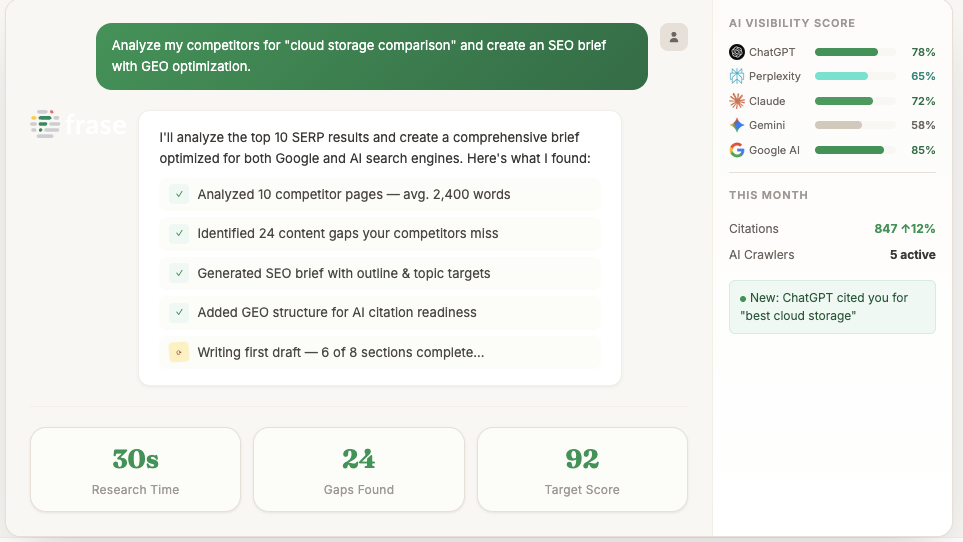
Frase does one thing well: research-to-draft speed. It pulls top-ranking pages, assembles a brief from SERP data, and generates a working draft without switching tools.
For SaaS teams publishing comparison posts, glossary content, or regular blog content, that removes a lot of manual setup time.
The limitation is predictable. Frase needs a strong human angle to produce differentiated output. If the brief is thin or the product insight is generic, the draft reads like every other article covering that keyword.
Best for: Deep competitor research and on-page optimization, the same core job Surfer SEO and Jasper AI cover among top Scalenut alternatives.
Core strengths: SERP-based content briefs, fast draft generation, and GEO visibility scoring across ChatGPT, Perplexity, and Gemini.
Pricing: Starts at $49/month, tied to article limits.
Key features
SERP research and briefing - pulls top-ranking pages into a content brief so writers can see headings, topics, and gaps quickly
Fast first drafts - generates draft content from SERP inputs, which suits teams trying to reduce briefing and outlining time
SEO and GEO scoring - combines traditional optimization signals with GEO-style visibility tracking for AI search workflows
Topic and gap analysis - surfaces related topics, keyword gaps, and supporting angles to strengthen coverage
Integrations and publishing workflow - supports tools like Google Search Console, WordPress, and Webflow for a smoother handoff from research to publishing
Pros and cons
Pros:
Fast research-to-draft workflow - Frase is built for teams that want to go from SERP review to first draft without juggling multiple tools.
Stronger briefing than many AI writers - The platform is more useful for outlining and topic coverage than general-purpose drafting tools.
Useful for AI search workflows - GEO-style scoring and tracking add value for teams watching AI visibility, not just traditional rankings.
Cons:
Less complete than full SEO suites - Frase does not replace deeper platforms like Semrush or Ahrefs for broader SEO operations.
Drafts may need heavier editing - Speed is the advantage, but raw output can still sound stiff or thin without human revision.
Article-based limits matter - Entry pricing is fair, but usage caps can feel restrictive for teams producing content at scale.
Pricing
Frase starts at $49/month, with entry pricing tied to article limits rather than broad team usage.
That makes it a reasonable fit for lean teams that care more about brief quality and research speed than unlimited content production.
Frase vs. Scalenut
Frase fits teams whose bottleneck is research and briefing speed. Scalenut fits teams relying on Cruise Mode's guided writing structure.
Frase also includes GEO scoring across ChatGPT, Perplexity, and Gemini, a differentiator for teams tracking AI search visibility.
Dimension | Frase | Scalenut |
|---|---|---|
AI/GEO Visibility Tracking | Built-in GEO scoring across multiple AI search platforms including ChatGPT, Perplexity, and Gemini | Not a core feature |
Content Generation | AI-assisted drafting from SERP inputs; output quality depends on brief depth | Cruise Mode guided AI writing workflow |
SEO Research Depth | SERP analysis, topic clusters, keyword gaps | Keyword research, content optimizer, topic clusters |
Team Collaboration | Flexible seat options with approval workflows | Limited team features on lower tiers |
Integrations | Google Search Console, WordPress, Webflow | Google Search Console, WordPress |
Entry Price | $49/mo | From ~$59-$199/mo depending on tier |
Best for | Lean teams needing a fast research-to-brief-to-draft pipeline with GEO tracking | Solo writers using AI-guided writing with Cruise Mode |
3. Writesonic
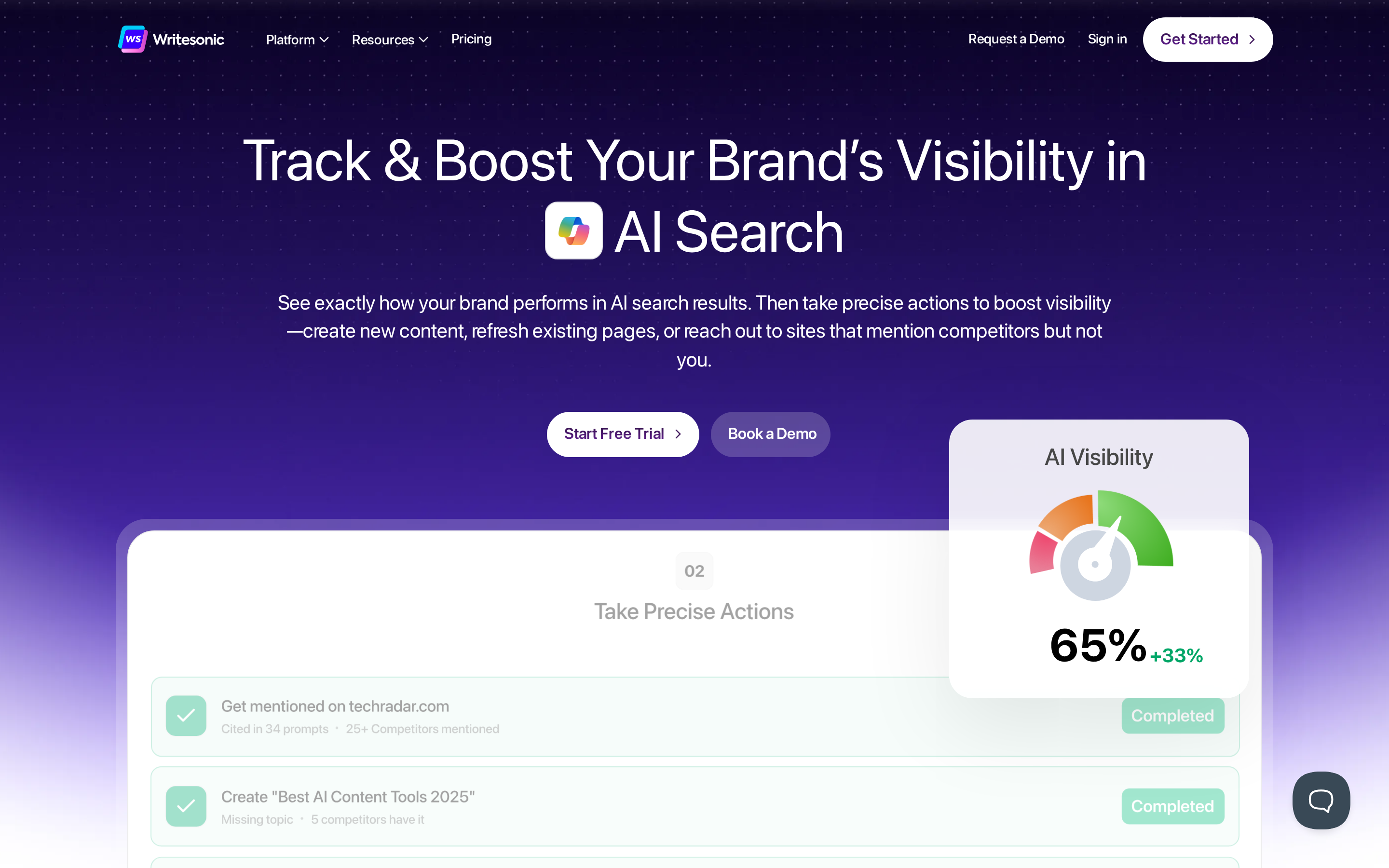
Writesonic covers more ground than Scalenut: drafting, content repurposing, multi-format creation, and AI visibility tracking across major AI engines. That breadth makes it a workable Scalenut alternative for teams that need more than a dedicated SEO workflow tool.
The tradeoff shows up in depth. SaaS teams with tight brief standards or detailed optimization requirements will hit Writesonic's ceiling faster than on a more purpose-built platform.
Best for: Automated, high-volume article generation.
Core strengths: Multi-format content creation, AI visibility tracking across ChatGPT, Perplexity, and Gemini, and fast first-draft generation.
Pricing: Writesonic plans start at $79/month (billed annually) on the entry plan.
Key features
AI visibility tracking - Monitors brand presence across ChatGPT, Perplexity, Gemini, and other AI engines.
Article generation with source support - Useful for creating faster first drafts that still need human review.
Keyword research and clustering - Keeps research and writing in the same workflow.
Multi-format creation - Supports blog posts, ads, landing pages, and product copy.
Publishing integrations - Connects with WordPress, Surfer SEO, Zapier, and other tools that help move drafts into production.
Pros and cons
Pros:
Broad workflow coverage - Writesonic handles drafting, repurposing, and AI visibility tracking in one place, useful for SaaS teams managing more than just long-form SEO.
Accessible entry point - The workflow is easier to pick up than heavier SEO platforms, which helps teams get moving without a long setup phase.
Multi-format support - Beyond blog posts, Writesonic covers ads, landing pages, and product copy.
Cons:
SEO depth is lighter - Teams that rely on detailed briefs and tighter optimization controls may find it shallow.
Output quality needs review - Fast drafts do not remove the need for editing.
Costs rise with usage - Higher tiers become expensive once volume increases.
Pricing
Writesonic starts at $79/month on annual billing. Higher tiers are $199/month and $399/month (Writesonic pricing).
That pricing is easier to justify if you will actually use the broader toolkit. If you only want content optimization, the value gets thinner fast.
Writesonic vs. Scalenut
Scalenut is the stronger pick when the workflow depends on structured keyword planning and guided writing.
One thing worth testing before committing: run Writesonic on a real article type with one reviewer in the loop. Its breadth can mask weak spots that only show up on actual content.
Dimension | Writesonic | Scalenut |
|---|---|---|
AI visibility tracking | Built in across ChatGPT, Perplexity, Gemini, and other AI engines | Limited; not a core workflow feature |
Content generation | Broad drafting and multi-format support | Stronger focus on SEO article workflows |
SEO research depth | Lighter, with research integrations available | More structured keyword planning and NLP briefs |
Ease of use | Lower learning curve; faster to start | More process-driven; stronger structure for SEO workflows |
Pricing entry point | From $79/mo on annual billing | From ~$59-$199/mo depending on tier |
Best for | SaaS teams needing broad AI content support plus AI visibility tracking | Teams focused on keyword-driven SEO planning and guided writing |
Already using Writesonic? Explore our Writesonic alternatives guide for other options worth testing.
4. Surfer SEO
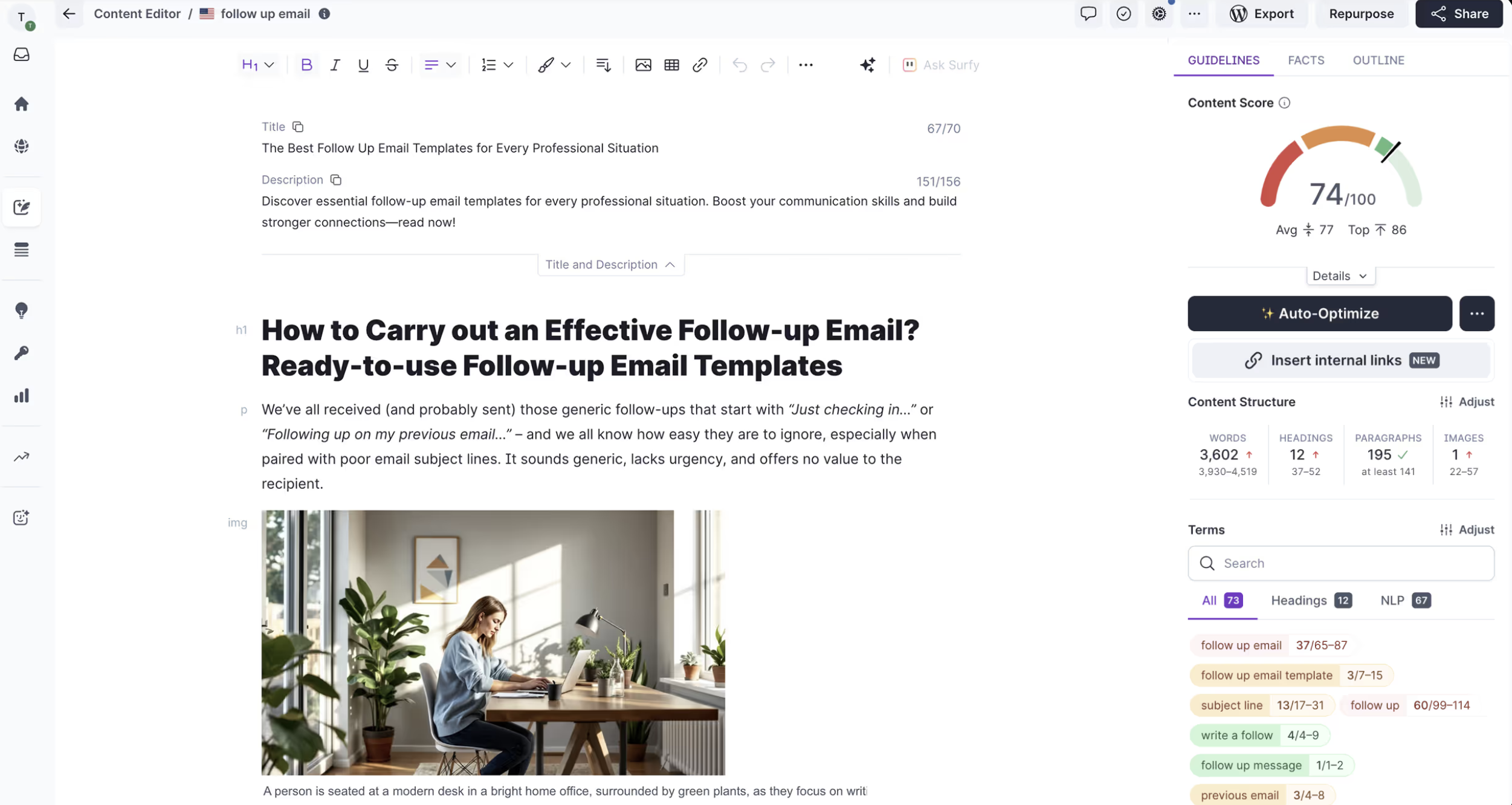
Surfer SEO is built for one thing: real-time optimization while writers work. If your team's bottleneck is inconsistent on-page quality, it is one of the fastest tools to adopt.
It is not a broad SEO suite. Surfer does not handle keyword strategy, reporting, or editorial workflows. The live scoring is the product.
Key features
Real-time content editor - Writers get live scoring and optimization guidance inside the drafting workflow.
SERP Analyzer and NLP scoring - Surfer studies top-ranking pages and turns those patterns into recommendations.
Topical coverage recommendations - Surfaces NLP terms and phrases from competitor pages so writers know what subtopics to address.
Cannibalization and topical workflows - Helps teams spot overlap and organize content more deliberately.
Pros and cons
Pros:
Easy for writers to use - The editor makes optimization more intuitive during drafting.
Strong optimization depth - Real-time scoring and SERP-driven recommendations remain the core appeal.
AI visibility tracking - Surfer tracks brand mentions across ChatGPT, Perplexity, and Gemini, a feature Scalenut does not currently match.
Cons:
AI writing is secondary - Draft generation exists, but editing is still part of the job.
Not a broad SEO suite - It is stronger for content optimization than full SEO management.
No compound knowledge system - Every draft starts from scratch. Surfer pulls optimization signals from top-ranking SERP pages, so the output reflects competitor patterns, not your product, positioning, or brand voice. Publish at scale and you will spend significant time rewriting each article to add the specifics that make your content worth reading.
Pricing
Surfer SEO starts at $49/month on annual billing.
The appeal for most teams is how fast writers can get up to speed. There is no complicated SOP to learn. The editor tells them what to improve as they type.
Surfer SEO vs. Scalenut
Surfer wins on optimization depth inside the writing workflow. Scalenut starts at $59/month versus Surfer's $49/month (Surfer pricing), and its guided AI drafting experience suits teams earlier in the SEO process.
Dimension | Surfer SEO | Scalenut |
|---|---|---|
Primary focus | Real-time on-page scoring while writing | AI-guided writing with built-in content planning |
Content generation | AI drafting available; optimization is the core strength | Cruise Mode guided workflow for full SEO articles |
SERP research | SERP Analyzer and NLP scoring from top-ranking pages | Keyword research and topic clusters built in |
Pricing | $49/mo on annual billing | From ~$59-$199/mo depending on tier |
Best for | Writers who want live scoring feedback during drafting | Teams who want planning and AI drafting in one workflow |
Surfer is the right call when inconsistent on-page quality is your main problem and writers need a tool that tells them what to fix without needing an SEO background. If you want a broader workflow with strategy and drafting built in, Scalenut is better suited.
Looking beyond Surfer? See our Surfer SEO alternatives guide for a full breakdown of your options.
5. Clearscope
Best for: Editorial teams that need consistent, SERP-matched quality across multiple writers.
Core Strengths: Real-time A-F content grading, topic and term recommendations from SERP patterns, and integrations with Google Docs, WordPress, and Microsoft Word.
Pricing: Starts around $129/month.
Clearscope is an editorial quality layer for teams managing multiple writers. It grades drafts against SERP patterns to keep topical coverage consistent across contributors.
If you want a tool that generates first drafts at volume, Clearscope will frustrate you. It is built to improve what your writers already produce, not to produce it for them.
Key features
Real-time grading - Scores content on an A-F scale as writers improve topical coverage.
Topic and term recommendations - Helps teams cover relevant terms and subtopics pulled from SERP patterns.
Editorial workflow support - Better suited to approval-heavy teams than fast-moving solo workflows.
Document integrations - Works with Google Docs, WordPress, and Microsoft Word.
Pros and cons
Pros:
Strong quality control - The grading system makes expectations clearer across contributors.
Good fit for editorial teams - It supports governance better than draft-heavy AI tools.
Integrates where writers already work - Google Docs, WordPress, and Microsoft Word support means writers do not have to change their tools to use it.
Cons:
Comparable optimization features exist in lower-priced tools.
No drafting, no brand knowledge - Clearscope tells your writers which terms to cover, but it has no concept of your product, positioning, or what makes your content different. Content can score an A and still read like it was written about any competitor in your space.
Overpriced relative to output - At around $129/month, you are paying a premium for keyword grading that does not generate content, incorporate brand context, or reduce writing time. Comparable optimization features exist in tools that cost a fraction of the price.
Optimizes for SERP patterns, not differentiation - Clearscope grades against what already ranks, so it pulls content toward the average rather than away from it. If your goal is to say something your competitors haven't, a high Clearscope score doesn't help with that.
Clearscope is the right pick when editorial consistency across a team is your actual problem and the budget supports it. If you are primarily looking for drafting help or cost efficiency, Scalenut fits better.
If you want a broader market view, explore our Clearscope alternatives guide before deciding.
Pricing
Clearscope starts at around $129/month (Clearscope pricing), making it one of the pricier options in this category for what it does.
That cost makes sense when you have multiple writers who need to hit the same optimization standard on every article. For smaller teams publishing infrequently, the per-report economics get harder to justify.
Clearscope vs. Scalenut
If content quality varies across contributors and nobody has agreed on what 'good' looks like, Clearscope solves that problem directly. Scalenut is a better fit when drafting speed and budget are the primary constraints.
Dimension | Clearscope | Scalenut |
|---|---|---|
Primary focus | NLP-driven editorial grading and quality control | AI writing with SEO content planning |
Content generation | Limited; supports outlines and optimization, not full drafts | Cruise Mode guided AI writing workflow |
SEO research | Topic and term recommendations from SERP patterns | Keyword research and content optimizer |
Editorial workflow | Strong: A-F grading, approval-friendly, multi-contributor support | Simpler workflow, lighter governance features |
Pricing | From ~$129/mo (Essentials) | From ~$59-$199/mo depending on tier |
Best for | Editorial teams needing consistent quality standards across contributors | Solo writers or small teams needing low-cost AI drafting |
6. Outranking
Outranking is built around SERP analysis, not writing volume. At $19/month to start, it is the cheapest entry point on this list, but that low floor comes with tight document limits and drafts that need real editing before they are publishable.
Key features
Low entry price - Starter begins at $19/month with 4 SEO documents per month. That limit suits teams moving carefully, not at volume.
SERP-driven research - analyzes SERPs using Google NLP, supports keyword clustering, and surfaces optimization signals. Drafting is available but needs editing before publish.
Auditable recommendations - each suggestion shows its reasoning, which matters for agencies or in-house teams that review every change before implementing it.
Pros and cons
Pros:
Lowest entry price - $19/month makes it the most accessible option here for teams watching budget
Research-first design - SERP analysis, NLP scoring, and clustering are the core strengths
Auditable workflow - built for operators who want to understand the reasoning behind each recommendation
Cons:
Tight document limits - 4 SEO docs per month on the Starter plan is a real constraint for teams publishing at any pace
Drafting needs editing - the writing output requires more polish than more automated alternatives
Maintenance questions - the platform has shown slower development activity compared to others in this list, which is worth factoring into a long-term decision
Pricing
Outranking starts at $19/month (Starter, 4 SEO docs/month). Higher tiers unlock more documents and additional workflow features.
Outranking vs. Scalenut
Outranking goes deeper on SERP research and costs less to start. Scalenut moves faster from topic to draft. If your priority is research depth on a tight budget, Outranking fits. If you want a smoother automated writing workflow, Scalenut is the more direct path.
Dimension | Outranking | Scalenut |
|---|---|---|
Primary focus | SERP research and optimization | Guided AI writing with content planning |
Content generation | Available, needs editing | Cruise Mode guided AI workflow |
SEO research | SERP analysis, Google NLP, clustering | Keyword research and topic clusters |
LLM visibility | Not a core feature | Limited AI visibility tracking |
Pricing | $19/mo (Starter, 4 docs/mo) | From ~$59-$199/mo depending on tier |
Best for | Budget teams prioritizing research | Teams wanting topic-to-draft automation |
7. Jasper
Jasper is not an SEO tool. It is a brand governance platform built for marketing teams that need consistent output across blogs, ads, emails, and campaign assets.
If voice consistency across channels is the job, Jasper is a strong fit. If the job is turning search topics into ranked articles, it is the wrong tool.
Key features
Brand voice controls - reusable style guidelines let teams lock in tone and terminology across every contributor and content type
Collaboration and approvals - shared workflows, comments, and approval steps are built into the core product, not bolted on
Multi-format output - handles blogs, ads, emails, and social copy in the same platform, not just long-form articles
Pros and cons
Pros:
Strong brand voice controls - reusable style guidelines and approval workflows make it easier to maintain consistency across contributors
Multi-format support - handles blogs, ads, emails, and campaign assets from one platform
Team governance - built for collaborative content operations where multiple people contribute across channels
Cons:
No native SEO research - keyword discovery and SERP analysis are not part of the product; plan on using a separate tool
Per-seat pricing climbs fast - costs add up quickly once more than a few people need access
Not built for ranking - if publishing search-optimized articles is the main goal, Scalenut is a more direct fit
Factual inaccuracies require manual verification - the AI can produce incorrect data points, dates, and false claims, so every output needs a fact-check pass before publication; this reduces the efficiency gains for technical or data-sensitive content
Quality doesn't hold at volume - marketing agencies have cancelled subscriptions after volume testing, citing Jasper's inability to maintain quality or efficiency when producing large quantities of content
Pricing
Jasper starts at $59/seat/month on the Pro plan (annual billing). Costs rise quickly as your team grows, since each seat adds to the monthly total.
Jasper vs. Scalenut
Jasper and Scalenut serve different jobs. Jasper governs brand output across channels. Scalenut produces SEO articles from search topics. Teams choosing between them are really deciding which problem they need to solve first.
Dimension | Jasper | Scalenut |
|---|---|---|
Primary focus | Brand-led content ops | SEO content workflow |
SEO research | Limited | Built in |
Team governance | Stronger | Simpler |
Pricing model | Per seat | Lower entry |
Best fit | Marketing teams | SEO content teams |
8. Copy.ai
Copy.ai is not an SEO tool. It is a GTM workflow platform built for sales and marketing operations.
If you are replacing Scalenut for search-driven content production, Copy.ai is the wrong category of tool entirely. It is built for large revenue teams running repeatable campaign workflows, not keyword-guided blog production.
Copy.ai vs. Scalenut
Copy.ai wins for campaign copy at scale: ads, emails, sales sequences, and GTM assets across large teams. Scalenut wins for keyword-guided blog production, briefs, and content optimization in one place.
Dimension | Copy.ai | Scalenut |
|---|---|---|
Primary focus | GTM workflow automation for sales and marketing | SEO content production workflow |
SEO research | Not a core feature | Built in: keyword research and content optimizer |
Content generation | Template-driven output for ads, emails, and campaign assets | Cruise Mode guided AI writing for articles |
Team size fit | Built for large teams, starting at 150 seats | Better suited to smaller SEO content teams |
Pricing | From $2,000/mo | From ~$59-$199/mo depending on tier |
Best for | Enterprise revenue teams with broad GTM campaign needs | Teams focused on keyword-guided SEO blog production |
Key features
Guided workflows - better for repeatable GTM tasks than open-ended prompting
Template-driven output - useful for ads, emails, sales messaging, and campaign assets
Large-team orientation - built for cross-functional marketing and sales environments
Pros:
Strong for campaign execution - better suited to structured GTM work than many writing tools
Good for large organizations - the seat model supports broad internal use
Fast iteration - teams can refine output without rebuilding prompts from scratch
Cons:
Weak SEO depth - not built around keyword research, SERP analysis, or optimization
High entry cost - unrealistic for most solo marketers and small teams
Less relevant for blog-led SEO - it solves a broader GTM problem, not the full content optimization workflow
Pricing
Copy.ai sits at the enterprise end of this list.
Entry point - from $2,000/month
Seat model - built around large-team access, starting at 150 seats
Best fit - revenue teams with broad campaign operations
That pricing model rules it out for most SEO content teams entirely.
9. Semrush
Semrush is a research and analytics suite first. The AI writing features exist, but that is not why teams buy it.
It outperforms Scalenut on keyword research, rank tracking, audits, and competitive intelligence. The tradeoff: it costs more, takes longer to learn, and still leaves you doing the writing yourself.
Key features
Large keyword database - built for serious search research and competitive analysis
Rank tracking and audits - useful when you manage more than a content calendar
Content optimization tools - supports briefs and optimization inside a wider SEO suite
Reporting depth - better suited to teams running a full SEO program
Pros:
Strong research depth - better fit for teams doing ongoing SEO analysis
Broader platform coverage - useful for audits, tracking, and reporting, not just writing
Better for mature programs - agencies and SaaS teams often get more value from the full suite
Cons:
Heavier workflow - there is more to learn and more to configure
Higher cost profile - content add-ons can push the total up quickly
Less execution-focused - it gives you a lot of data, but you still need to turn that into action
Pricing
Semrush sits in the premium suite category.
Semrush starts at $139.95/month on its Pro plan (monthly billing), or lower on annual. Content marketing features are available as add-ons on higher tiers, so factor that in if briefs and optimization are your main reason for buying.
Semrush vs. Scalenut
This is a depth-versus-execution decision.
Choose Semrush if you need keyword research, audits, monitoring, and analytics in one place. Choose Scalenut if you want a simpler route from keyword to draft and do not need a full research stack.
Dimension | Semrush | Scalenut |
|---|---|---|
Primary focus | Broad SEO research: keywords, audits, tracking, and reporting | AI-guided SEO writing and content planning |
Keyword database | One of the largest available, built for serious research | Lighter keyword research built into the platform |
Content writing support | Content marketing toolkit available as an add-on | Core product; Cruise Mode guides writing workflow |
Reporting depth | Strong: rank tracking, audits, GSC integration, analytics | Limited reporting outside content scoring |
Pricing | From $117/mo (Pro, annual) | From ~$59-$199/mo depending on tier |
Best for | SaaS teams and agencies needing a full SEO research and reporting suite | Teams wanting a simpler route from keyword to draft |
10. Ahrefs
Ahrefs is one of the best research tools in SEO. It is not a content production tool.
Keywords Explorer, Site Explorer, Site Audit, Rank Tracker, and Content Explorer give you serious depth across every stage of research. When you are ready to write, you are on your own.
Key features
Keywords Explorer - keyword difficulty scores, search volume, traffic potential, and cross-engine data (Google, YouTube, Amazon, Bing)
Site Explorer - backlink analysis with anchor text distribution, link counts, and domain strength; still the main reason most SEO teams buy Ahrefs
Site Audit and Content Explorer - technical health checks and top-performing content analysis for gap spotting and opportunity identification
Brand Radar - adds AI citation tracking, which makes the platform more relevant to GEO discussions
Pros:
Deep research coverage - Keywords Explorer, Site Explorer, Site Audit, and Content Explorer cover the full research stack in one platform
Cross-engine keyword data - Keywords Explorer covers Google, YouTube, Amazon, and Bing, useful for teams running multi-channel search strategies
More relevant for AI search than before - Brand Radar gives it a practical GEO angle
Cons:
Weak on execution - no native long-form article generation and limited writing support
Premium pricing - easier to justify for SEO-led teams than content-led teams
Requires a separate content stack - most teams pair it with a writing or optimization tool to complete the workflow
Pricing
Ahrefs runs a four-tier plan structure.
Ahrefs starts at $129/month (Lite), with Standard at $249, Advanced at $449, and Enterprise at $1,499. Each tier unlocks more data capacity and project limits.
Ahrefs vs. Scalenut
Ahrefs and Scalenut serve different jobs.
Choose Ahrefs when your main job is keyword discovery, backlink analysis, and competitive SEO research.
Choose Scalenut when your team needs to move faster from topic to draft inside one writing workflow.
Dimension | Ahrefs | Scalenut |
|---|---|---|
Primary focus | Keyword research, backlink analysis, and competitive SEO data | AI-guided writing and content optimization |
Keyword database | One of the largest in this category; cross-engine data including YouTube and Amazon | Lighter research built into writing workflow |
Backlink analysis | Core strength via Site Explorer; main reason most teams buy it | Not a feature |
AI/GEO visibility | Brand Radar adds AI citation tracking | Limited AI visibility tracking |
Pricing | From $129/mo (Lite); up to $1,499/mo (Enterprise) | From ~$59-$199/mo depending on tier |
Best for | Data-driven SEO teams focused on keyword discovery, backlinks, and competitive research | Teams wanting faster movement from topic to first draft |
With Ahrefs, you get a strong research foundation. Writing, briefs, and optimization still require separate tools or a system built around them.
Scalenut alternatives compared: features, pricing, and best use cases
The best Scalenut alternative depends on where your workflow breaks: strategy, writing, optimization, or reporting. Here's how the field breaks down.
RankUp - keyword research, publish-ready content creation, applied updates, GSC reporting, and content built for Google and AI discovery in one system.
Frase or Surfer SEO — if your team already has a process and mainly needs optimization guidance.
Semrush or Ahrefs — if deep keyword data and broader SEO research matter more than writing automation.
Jasper or Copy.ai — if brand voice governance or GTM workflow automation is the priority.
Outranking or Writesonic — if low entry pricing or fast drafting matters most.
On LLM visibility: Frase, Writesonic, Surfer SEO, Semrush, and Ahrefs all offer some form of AI citation or share-of-voice tracking. None of them build on your brand knowledge over time. That's the difference.
A few tools worth noting that are not in this list: SE Ranking bundles rank tracking with broader SEO tooling and is a reasonable pick for teams that want both in one subscription. MarketMuse focuses on content planning and competitor gap analysis without writing support. Rytr covers basic AI drafting for teams that do not need SEO workflow depth.
This comparison shows each Scalenut alternative's core strength, entry pricing, team fit, and workflow limitation.
The Scalenut alternative that runs your full SEO content lifecycle
Surfer and Clearscope focus on optimization, while Ahrefs and Semrush focus on research. Teams still need a separate process to produce publish-ready pages or apply updates.
RankUp helps SaaS companies earn stronger Google visibility and more opportunities to appear in AI answers by keeping product knowledge, style guidance, and positioning available while it plans, writes, audits, and updates content.
Alonso Solis, co-founder of Guardian Home, said his team saw pages rank soon after publishing with RankUp and continued adding content (Guardian Home customer testimonial).
Those results come out of one system: keyword research, content strategy, publish-ready articles and pages, audits, applied updates, and GSC reporting. Every output builds on the last, so each article comes out stronger than the one before it.
RankUp analyzes your site and situation, learns your brand context, and runs a light AI-search audit with baseline findings and next actions. That work shapes a custom ongoing plan around your needs.
Start your 7-day free trial to see the plan RankUp proposes for your site.
Guardian Home ran that loop with RankUp. Co-founder Alonso Solis says the team published about 55 blogs and landing pages in roughly three months.
Leads started coming in around the first month, and organic search is now one of their main pipeline channels.
https://youtu.be/oZVy6AXjJn4
Frequently asked questions
Do content optimization scores actually matter for SEO results?
They help, but a high score does not guarantee rankings. Scores measure topic coverage, not backlink authority, search intent match, or content depth.
Use them to spot gaps, not as a quality proxy. A generic piece hitting 90/100 will still lose to specific, well-linked content targeting the same keyword.
Which Scalenut alternative is best for a small SaaS team with no dedicated SEO hire?
RankUp is built for this. It handles keyword research, content creation, and optimization in one workflow, so you are not stitching tools together or depending on someone with deep SEO experience.
Surfer SEO or Frase are solid if you already have a writer and just need optimization guidance. Semrush is better suited to teams that have an SEO lead who can act on the data.
Is it worth paying for both an AI writing tool and a separate SEO optimizer like Surfer SEO?
Usually not. Teams paying for both often end up with duplicated effort and content that falls between the two tools.
One integrated platform reduces copy-paste overhead and keeps your writer optimizing for the right keywords from the start.
:quality(80))
Author of the article
Georg Richard Aare
Georg is the co-founder of RankUp and an SEO nerd who spends (almost) every waking minute refining his craft and sharing his learnings. When he’s not behind his computer, which is rare, you’ll find him in the gym doing bench (never legs) to clear his mind.
This article was created using: