

For SaaS and tech companies with English sites.

8 Best Peec AI Alternatives to Track AI Visibility and Grow Your B2B SaaS
 Georg Richard Aare
For SaaS and tech companies with English sites.
Your tracker shows a competitor cited in a ChatGPT answer to a buyer question, and your product is missing.
Peec AI deserves credit for making that gap visible. A clearer view of the gap is useful, but you still need to decide how the page, copy or third-party mention will get the attention it needs.
If you choose on dashboards alone, you risk paying for data that never becomes the work that brings the right buyers in.
I compared each alternative on how it monitors AI answers and how much follow-up work it takes off your team.
Peec AI alternatives at a glance
The alternatives differ in what they track and how they connect those findings to follow-up work:
RankUp connects monitoring to content and deal actions.
Profound combines visibility reporting with configurable marketing agents.
Semrush pairs prompt tracking with an AI crawler audit.
SE Visible retains original answers for reporting and inspection.
AirOps moves selected opportunities into content workflows.
Frase connects visibility topics to drafting and publishing.
Search Atlas offers visibility reporting alongside content and outreach tools.
Writesonic connects citation opportunities to article creation.
What makes Peec AI alternatives worth considering?
Peec AI monitors AI answers and turns its findings into tasks. The work it leaves with your team and the models included in each plan are two reasons to consider an alternative.
Peec helps organise the work that follows a visibility gap.
Peec’s Actions provide evidence, suggested content structures, task steps and completion tracking for your own pages, third-party mentions and crawlability. Its monitoring covers mentions, position, sentiment, competitors and citations.
For example, if an AI answer misstates your product, a Peec Action can show the evidence and steps for correcting the relevant page. You can assign and track the update, so the question is who will make and review the change.
The number of AI models included in each plan also affects what Peec can track.
Each Peec self-service plan includes daily tracking, unlimited users and 3 active models. You can choose from ChatGPT, Perplexity, Google AI Overviews, Google AI Mode, Gemini, Naver AI Briefing, ERNIE/Baidu and Bing AI Mode. Check whether the models you need fit within that allowance.
Monthly-billing plans offer these allowances:
Starter: $95 per month for 50 tracked prompts, one project and one country.
Pro: $245 per month for 150 prompts, two projects and three countries.
Advanced: $495 per month for 350 prompts, five projects and three countries.
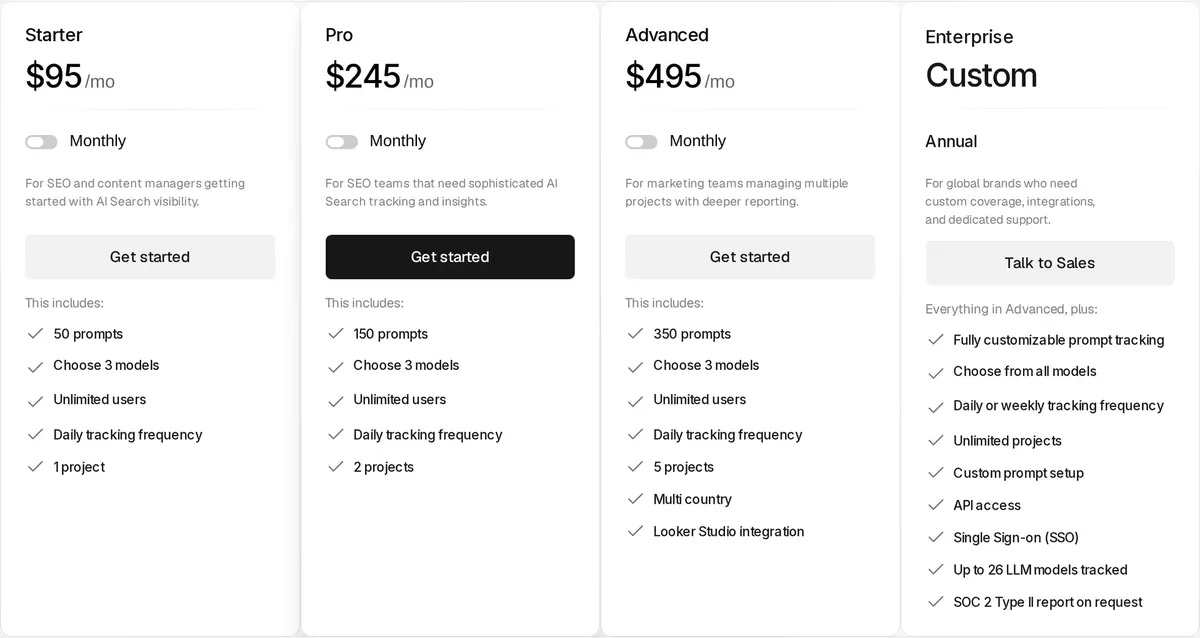
With annual billing, each additional model costs $30 per month on Starter, $70 on Pro and $140 on Advanced. Enterprise has custom pricing, annual billing, customisable prompts and models, and unlimited projects and countries.
Those allowances and the work your team carries out are worth comparing alongside each alternative’s coverage and price.
How we chose these Peec AI alternatives
I compared these alternatives on what they reveal about AI answers and what happens after a visibility gap appears.
For example, an answer might cite a page that mentions a competitor but leaves out your product. The page URL shows you where to pursue a mention, while search and conversion data help you assess the work separately from the citation itself.
I looked at five things that distinguish a useful replacement from another dashboard:
Engines and prompts: Which assistants each product covers, how it collects answers, and whether it supports custom prompts and historical trends.
Answers and competitors: Whether the product shows original answers and sentiment, and how it recognises competitors, brand names, aliases and domains.
Citations: Whether the product identifies the specific cited page alongside an answer, rather than only the source domain.
Follow-up work: The difference between recommendations and plans, article drafts, reviewed page edits, publishing and cited-site deal preparation, including what remains with the customer.
Results: Whether the product reports AI mentions and citations alongside Google Search Console search data and PostHog conversion data, with signups and demos distinct from discovery signals.
I considered prompt allowances alongside price and the ability to track relevant buyer questions. A larger allowance matters less if the prompts don't reflect what B2B buyers ask.
Peec AI alternatives compared: engines, citations, actions and pricing
Compare what each tool monitors, the follow-up work it handles and its entry price alongside the performance data it reports.
Alternative | Engines and citations | Follow-up work | Performance data | Entry price |
|---|---|---|---|---|
RankUp | Tracks mentions, cited pages and competitors, including answers from ChatGPT, Gemini, Google AI Overviews and Google AI Mode. Full plan-specific engine list not published. | Articles, reviewed edits and deal preparation. You approve updates and send letters. | Search Console, PostHog and AI search in reports on included plans. | Starter: $269 a month. |
Profound | Multi-model citations and sentiment. Full plan-specific engine list not published. | Configurable marketing agents and workflows. | Visibility and sentiment reports. | Enterprise: custom pricing. |
Semrush | Daily prompt tracking on ChatGPT and Google AI Mode. | Recommendations and crawler audits. Writing requires a separate toolkit. | Visibility and brand reports. | $99/month. |
SE Visible | ChatGPT, Google AI Overviews, AI Mode, Gemini and Copilot. Stores answers and identifies citation gaps. | Recommendations and beta agents. | Visibility reports. | €80/month, or €64/month billed annually. |
AirOps | Solo covers ChatGPT. Pro covers 10+ engines. Reports cited domains. | Selected opportunities feed Playbook workflows. | Traffic, engagement and referrals alongside visibility. | Quoted on request. |
Frase | Starter covers ChatGPT and Google AI. Professional adds Perplexity. Scale adds Claude and Gemini. | Drafts, publishing and Content Guard alerts with proposed fixes. | GA4 referrals. | About $49/month, or $39/month billed annually. |
Search Atlas | Prompt Simulator covers ChatGPT and Gemini. Reports source URLs. Full monitoring list not published. | Content tools and QUEST outreach research in the wider platform. | Visibility and citation reports. | Platform Starter: $99/month. |
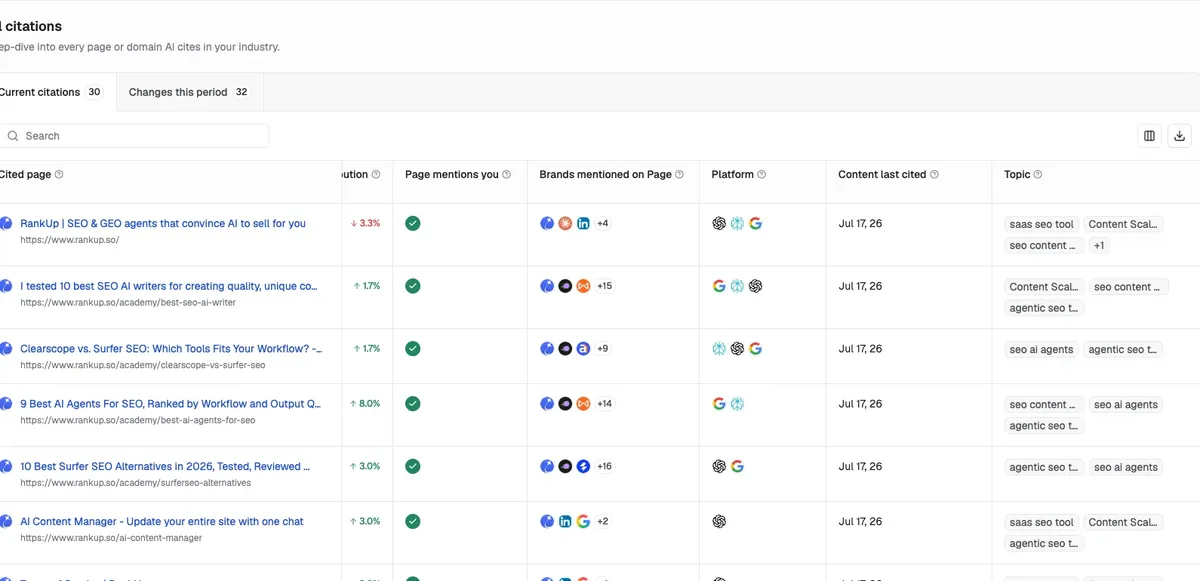
Writesonic | Starter through Growth cover ChatGPT, Gemini and Google AI Overviews. Finds cited pages naming competitors but missing your brand. | Outreach lists and Article Writer on plans with the relevant workflow. Growth includes five on-page and five off-page trial actions monthly. Enterprise has full Action Center access. | Citation reports. | $79/month billed annually. |
Frase’s monthly Starter price is about $220 less than RankUp Starter. Frase handles drafting and proposed fixes, while RankUp also prepares reviewed page edits and deals with cited sites.
1. RankUp
RankUp is our self-improving system to grow your B2B SaaS in AI search. Its specialist agents connect AI search monitoring to articles, page edits and deals with cited sites, with your approval directing the work.
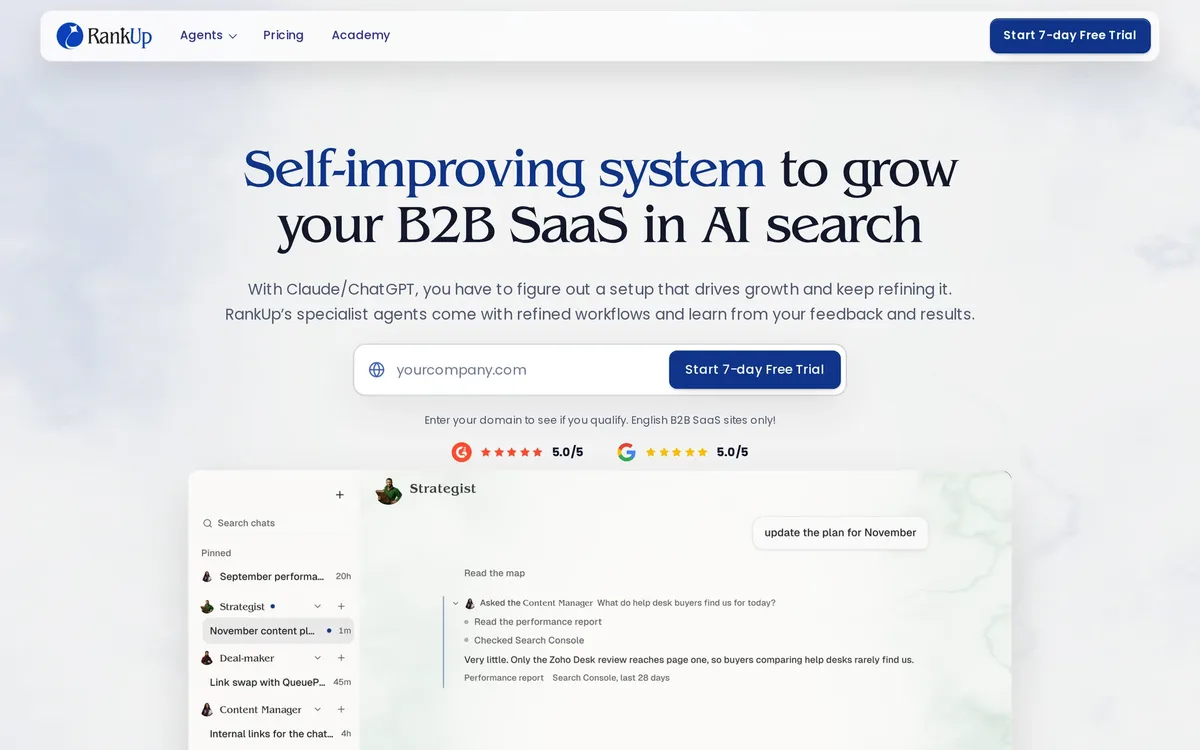
From AI answers to actions
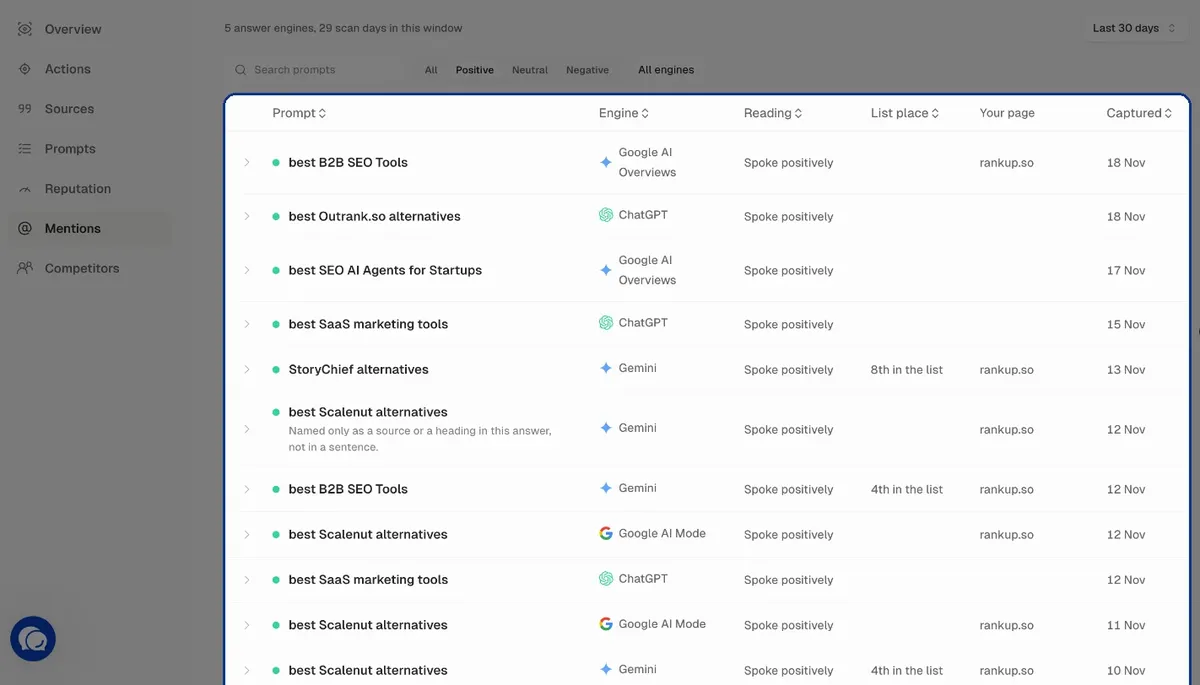
RankUp’s AI Search Monitoring tracks answers from ChatGPT, Gemini, Google AI Overviews and Google AI Mode daily, and Claude weekly. It saves answers alongside their prompts, engines, brand mentions and cited pages, so you can inspect where your product appears and which sources the answer used.
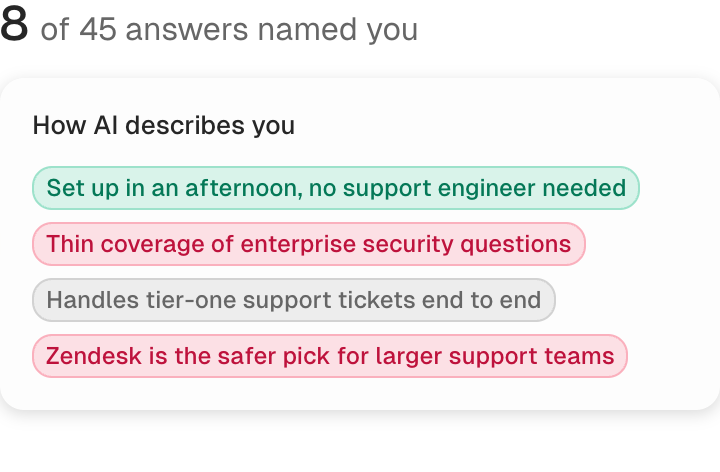
You can also see how those answers describe your product and compare it with competitors.
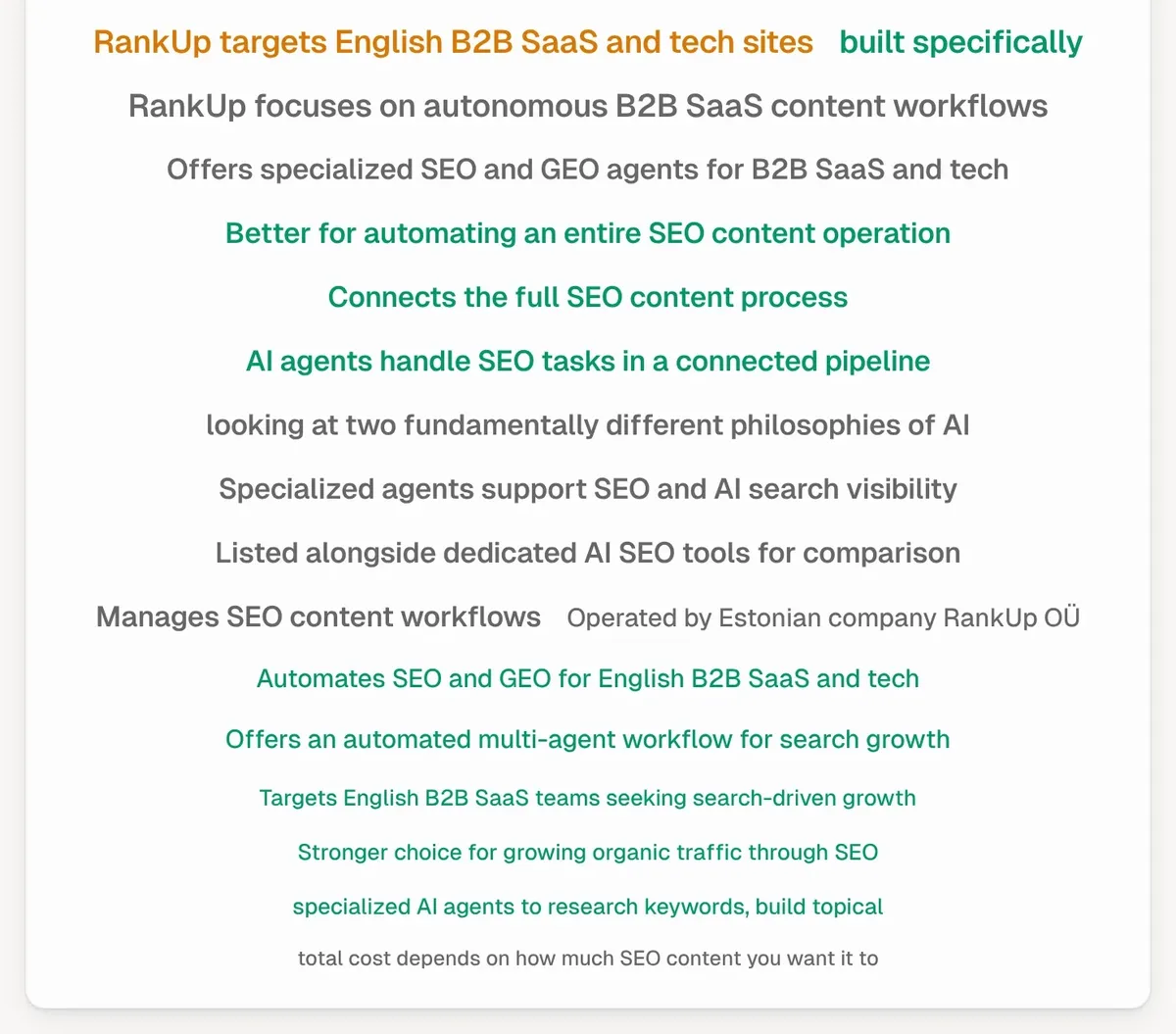
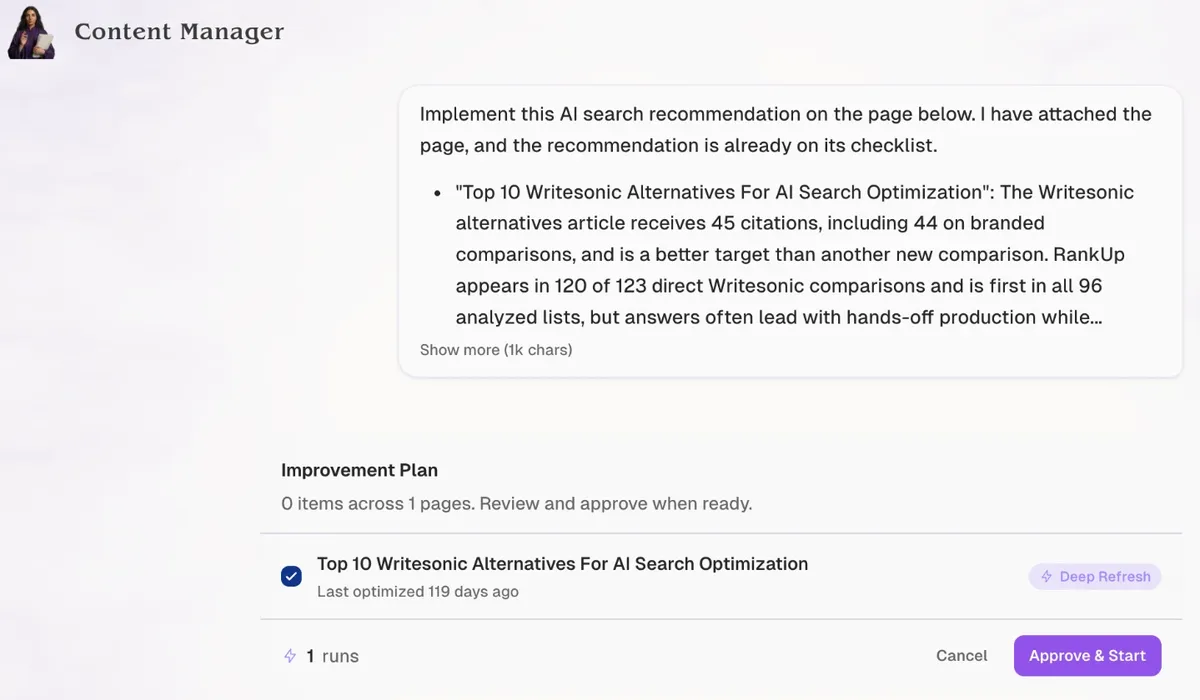
Each week, RankUp analyses those answers and proposes page updates, new content and deals with cited sites. An action identifies the page or site, explains why it matters and describes the work to do. You choose which actions the agents carry out.
For an existing page, RankUp can compare a passage quoted from a cited competitor with the equivalent section on your site. It uses your product knowledge to write a proposed improvement, which you can review before approving publication.
From content plan to reviewed articles and updates
The Strategist researches competing pages and keywords alongside your product context to propose topics for your content plan. It prioritises searches around your product’s use cases and buyer questions, and you decide which additions to keep.
The Writer researches competing pages and builds an outline before asking for the expertise and proof only you can supply.
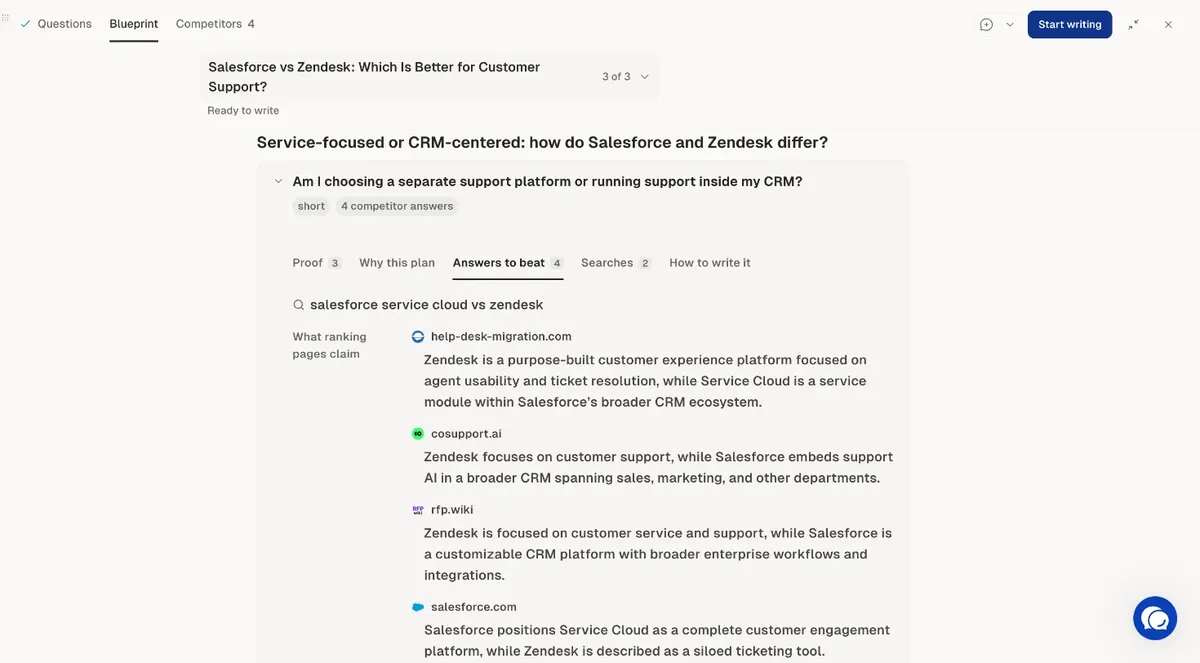
You can answer interviews for a batch of articles in one chat and share product details, examples and screenshots.
Once you have locked in the structure, the Writer drafts the articles section by section and flags points that need your judgment.
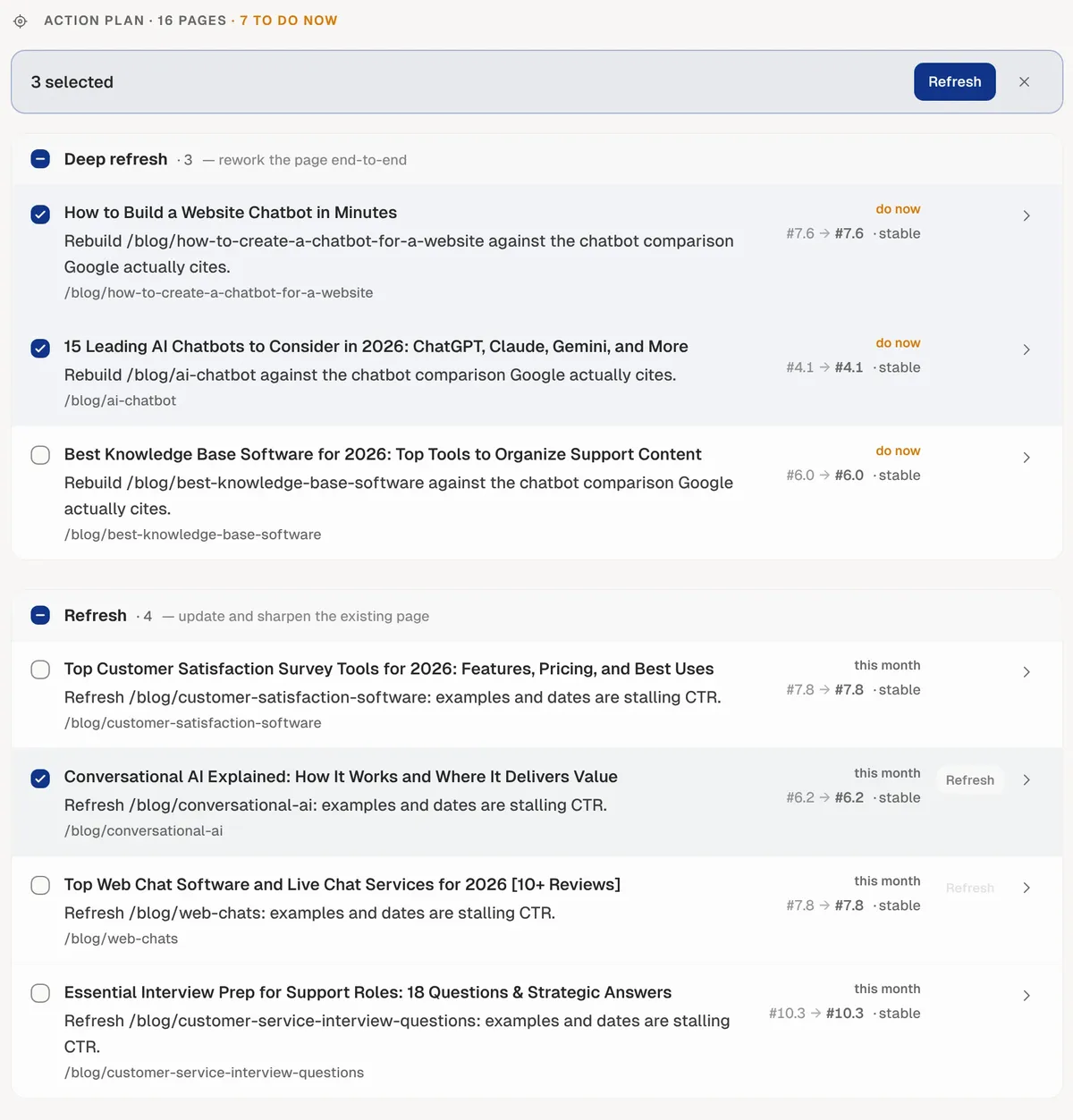
For pages you already have, the Content Manager plans and writes updates that you can keep or undo. Once you approve the content, RankUp can publish it through a connected CMS.
Anything that needs your call, from an agent's question about a draft to a batch of proposed page changes, waits in one Needs you queue.
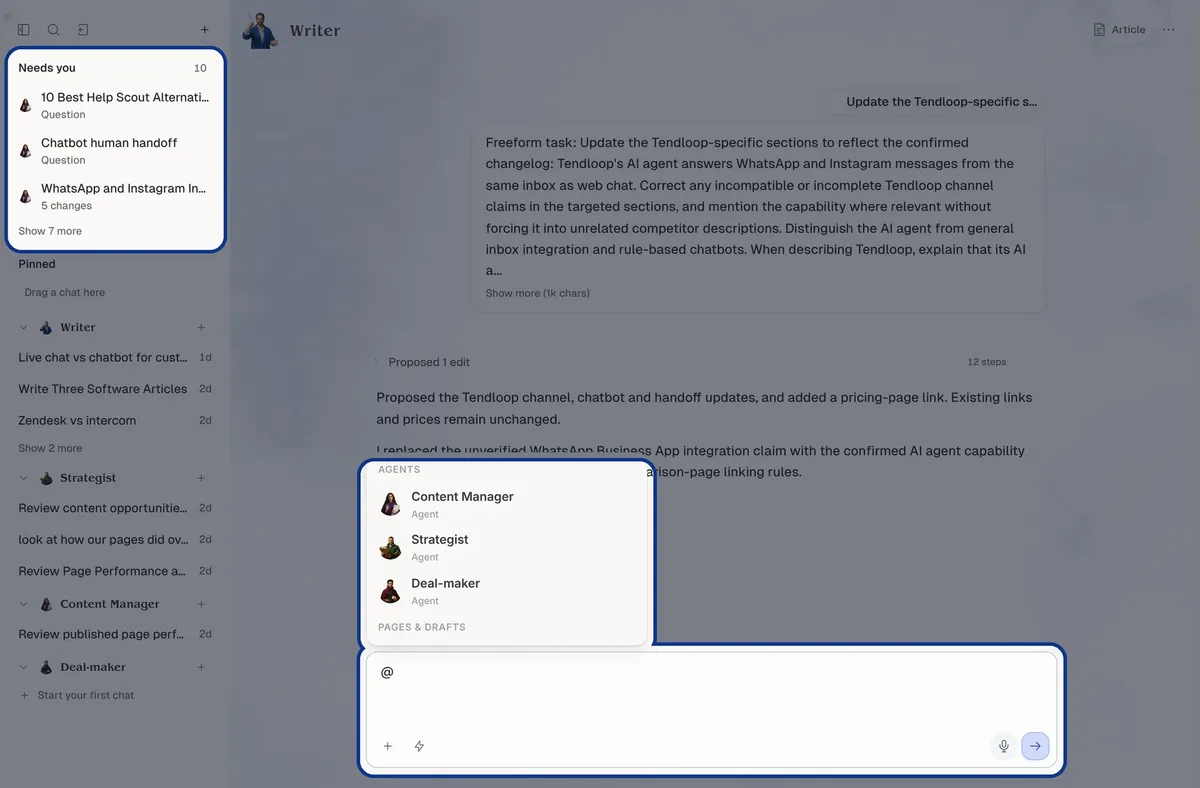
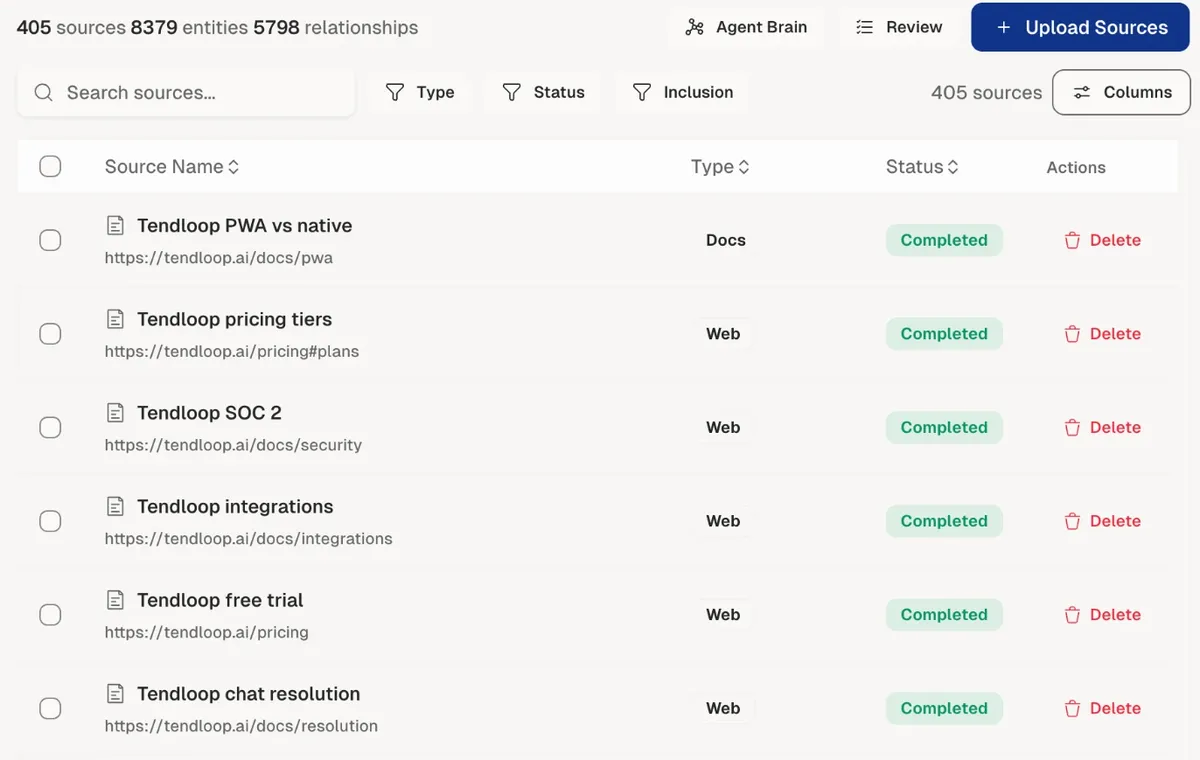
The agents share product documentation and the material you provide in interviews, so the Writer and Content Manager can use the same facts in new articles and page edits.
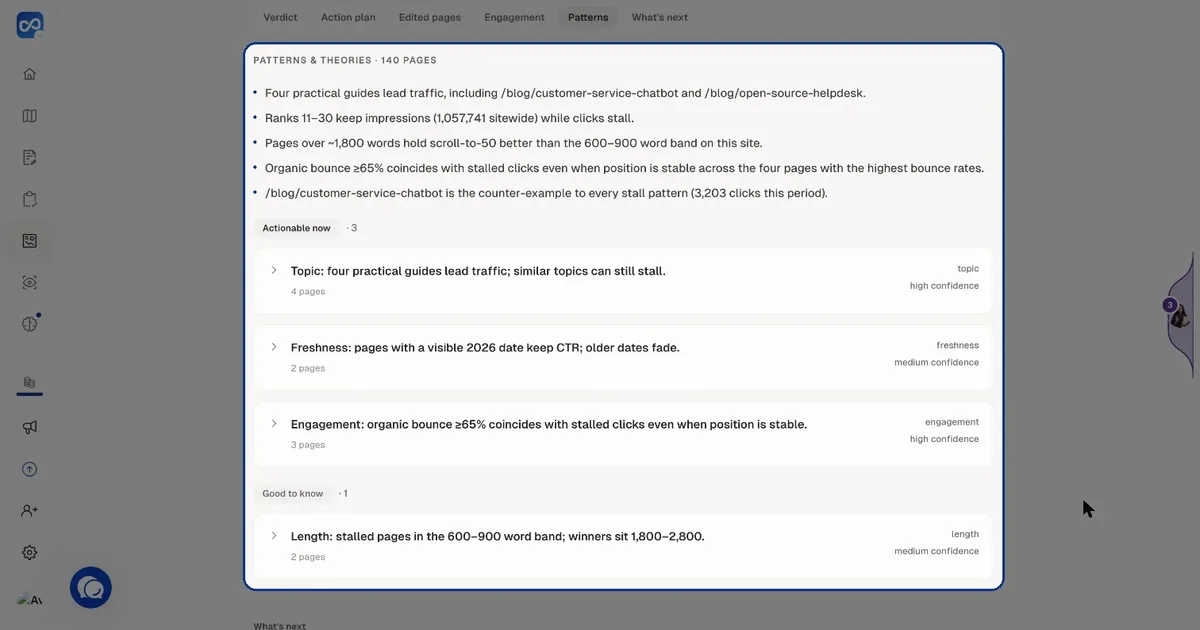
RankUp’s monthly performance analysis examines Search Console, PostHog and AI search data, saves patterns from your pages and proposes updates for review. Those patterns can inform later articles and rewrites.
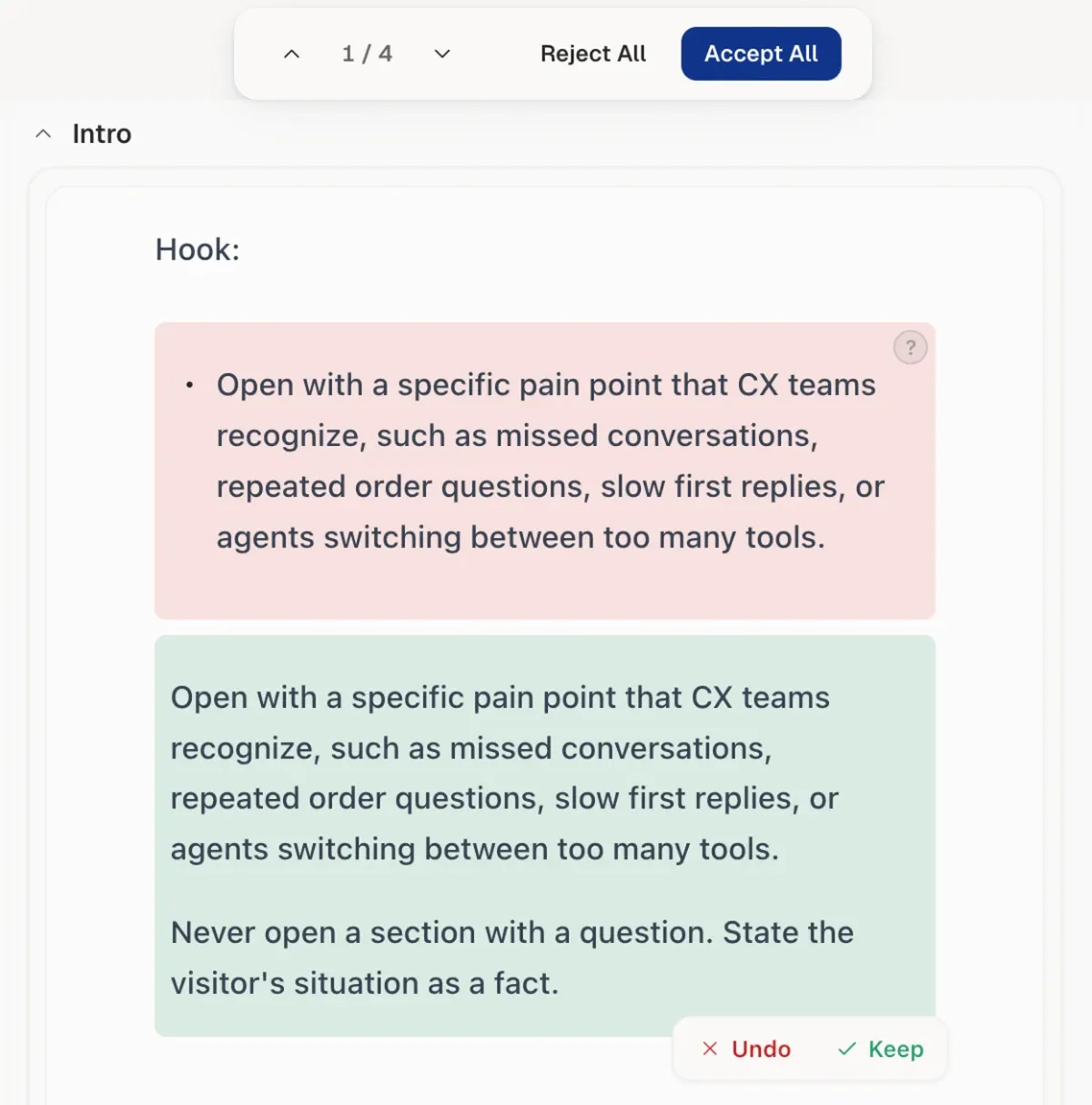
Your feedback can lead to changes in brand guidance, which come back to you to keep or undo.
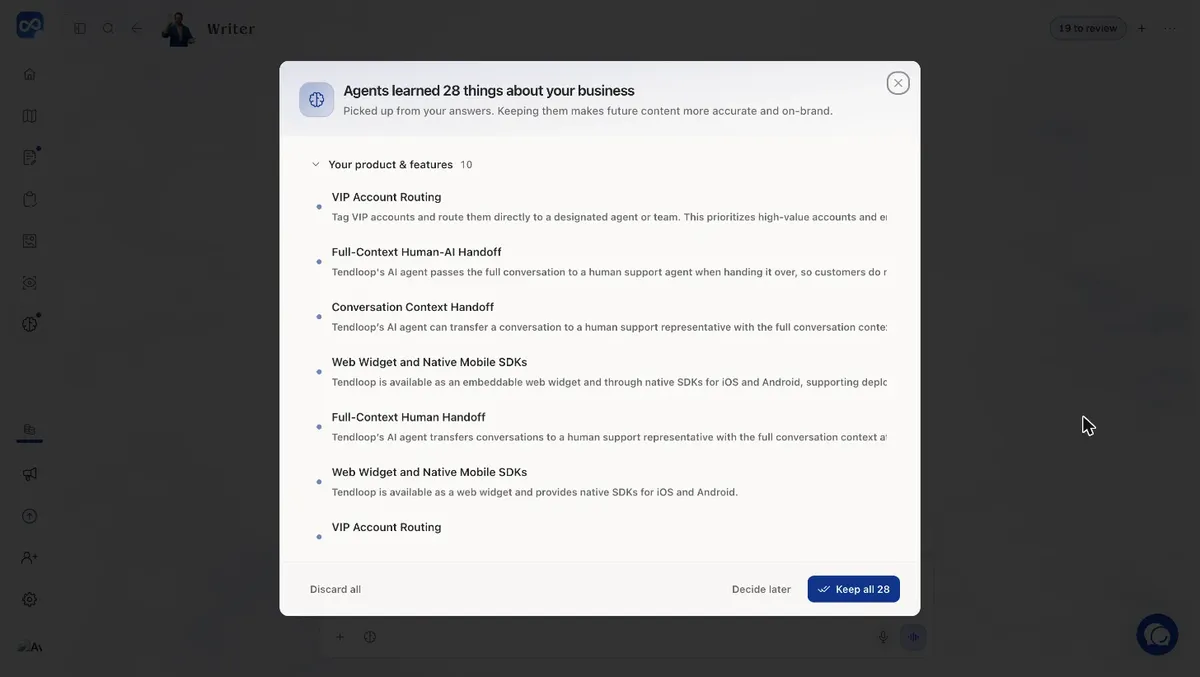
You can review and keep product information the agents learn from your answers, so it can inform later content.
Cited sites and results
The Deal Maker starts with pages AI answers have cited in your category over the past 90 days, excluding your own site.
It selects the strongest page from each domain and checks who owns the site, what it sells, which products the page lists and whether it already mentions you.
The offer depends on the site. A software company might receive a proposal to exchange mentions, a publisher might be a candidate for a commission deal, and a directory may have a listing you can claim. Each deal has a decision and a reason, including when the Deal Maker recommends waiting.
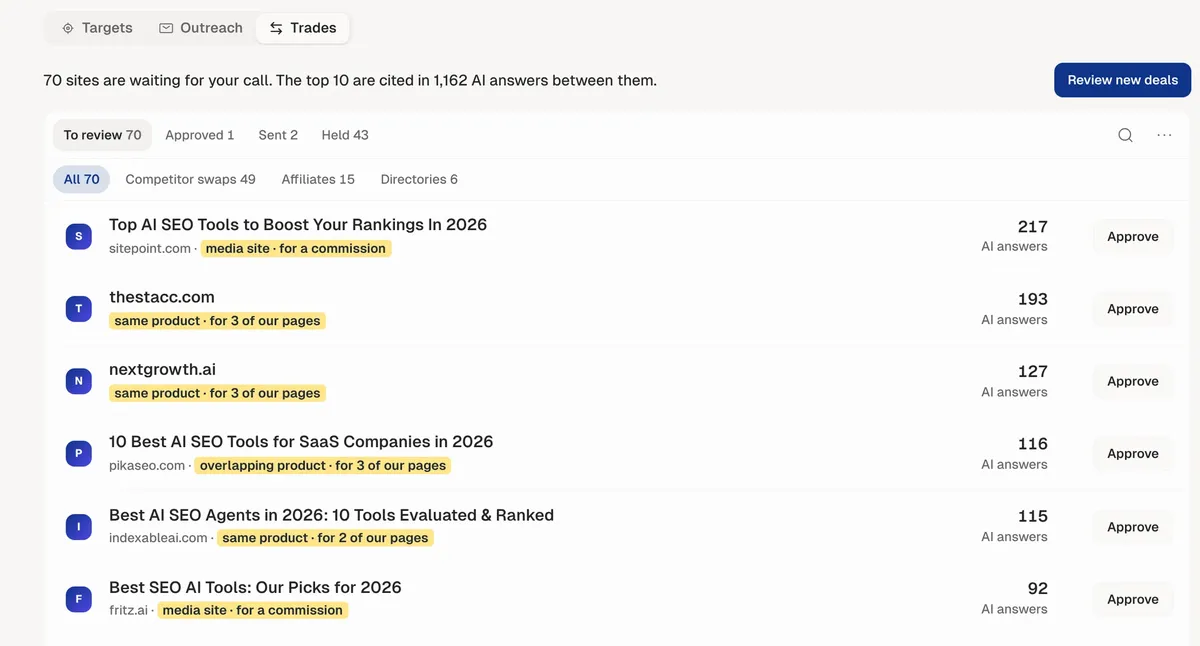
For a swap, the Deal Maker starts with the smallest suitable page on your site and adds another only when needed to make the trade even.
It shows the proposed pages side by side, using your page’s Search Console clicks alongside AI citations to help you assess the offer.
You mark the deals you want to pursue. The Deal Maker finds a contact and prepares a letter using the offer you approved, leaving any commercial terms you haven’t set for you to decide. You send the letter from your own mailbox.
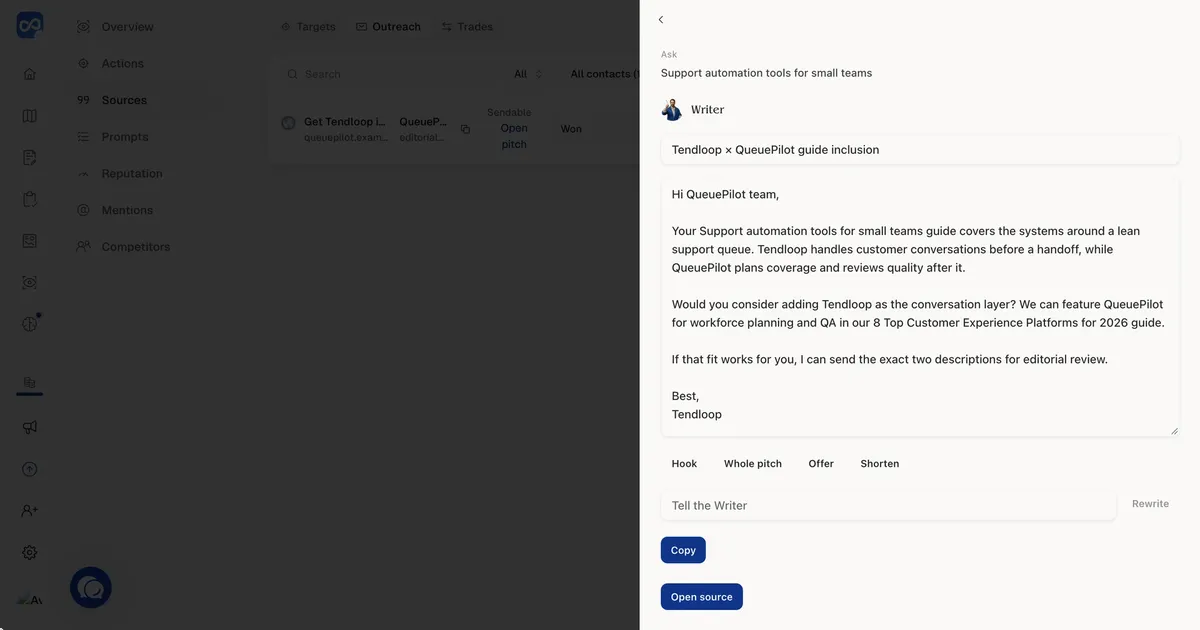
When a partner agrees to a swap, the Deal Maker hands it to the Writer, which prepares both entries for review. The Deal Maker checks the partner's page and flags the deal for your attention if the agreed entry has not appeared after two weeks.
On plans with performance reports, RankUp analyses search, conversion and AI search data alongside competing pages. It identifies patterns across your pages and suggests updates you can select for the agents to make and return for your review.
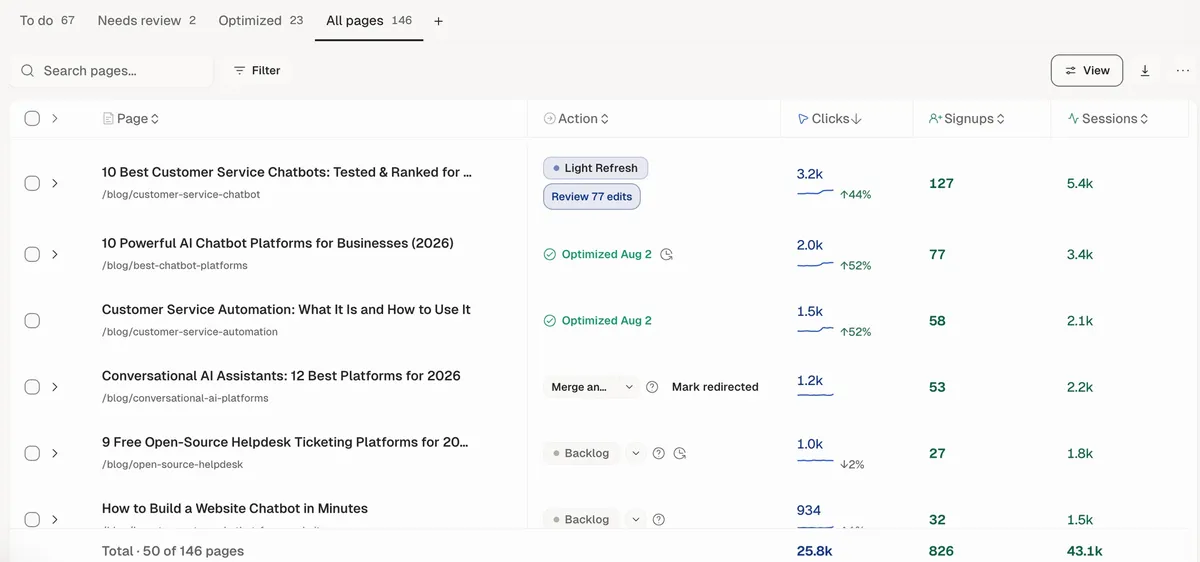
With PostHog connected and conversions configured, you can see content sessions and attributed signups alongside search performance.
User results
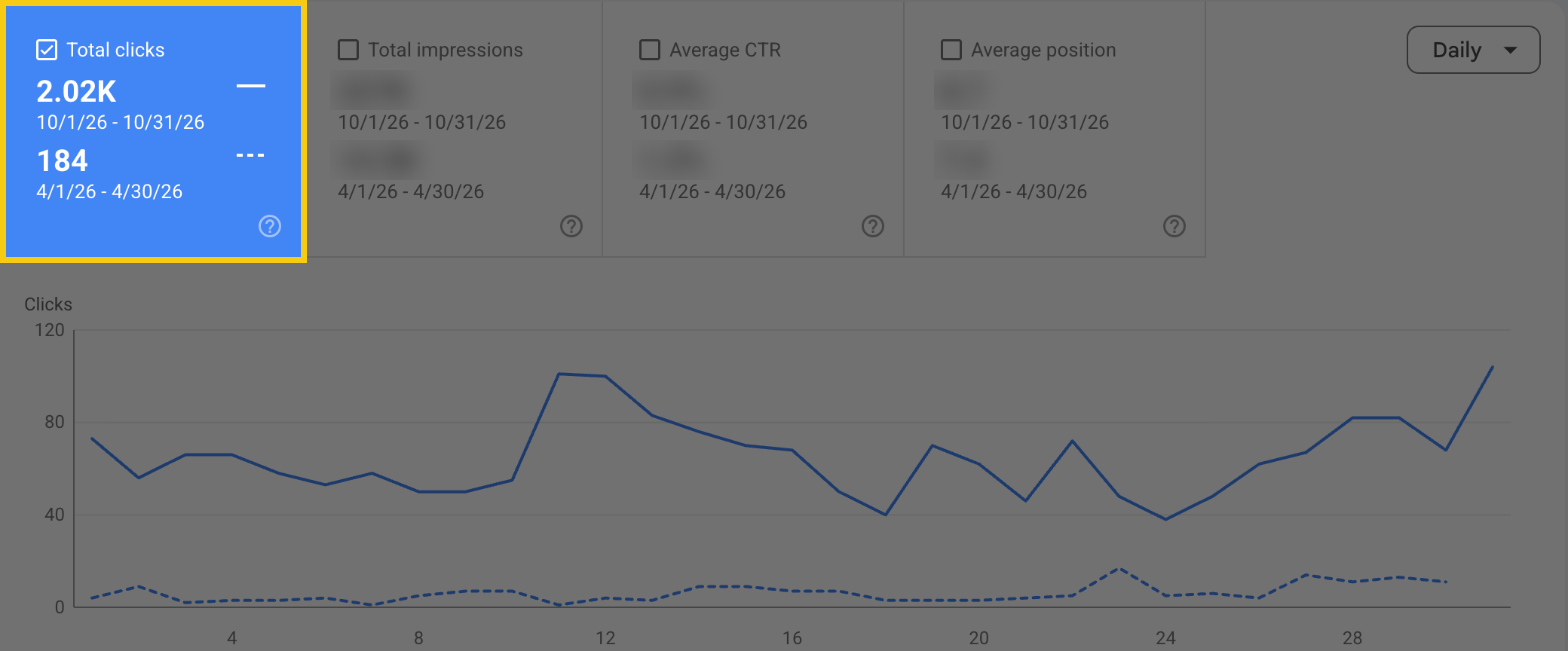
Bilt, which turns plain-language descriptions into mobile apps, used RankUp to publish 102 articles and make 369 updates over six months without an SEO hire, agency or other SEO tool. Its Google clicks grew 11x, from 184 in April to 2,022 in October 2026.
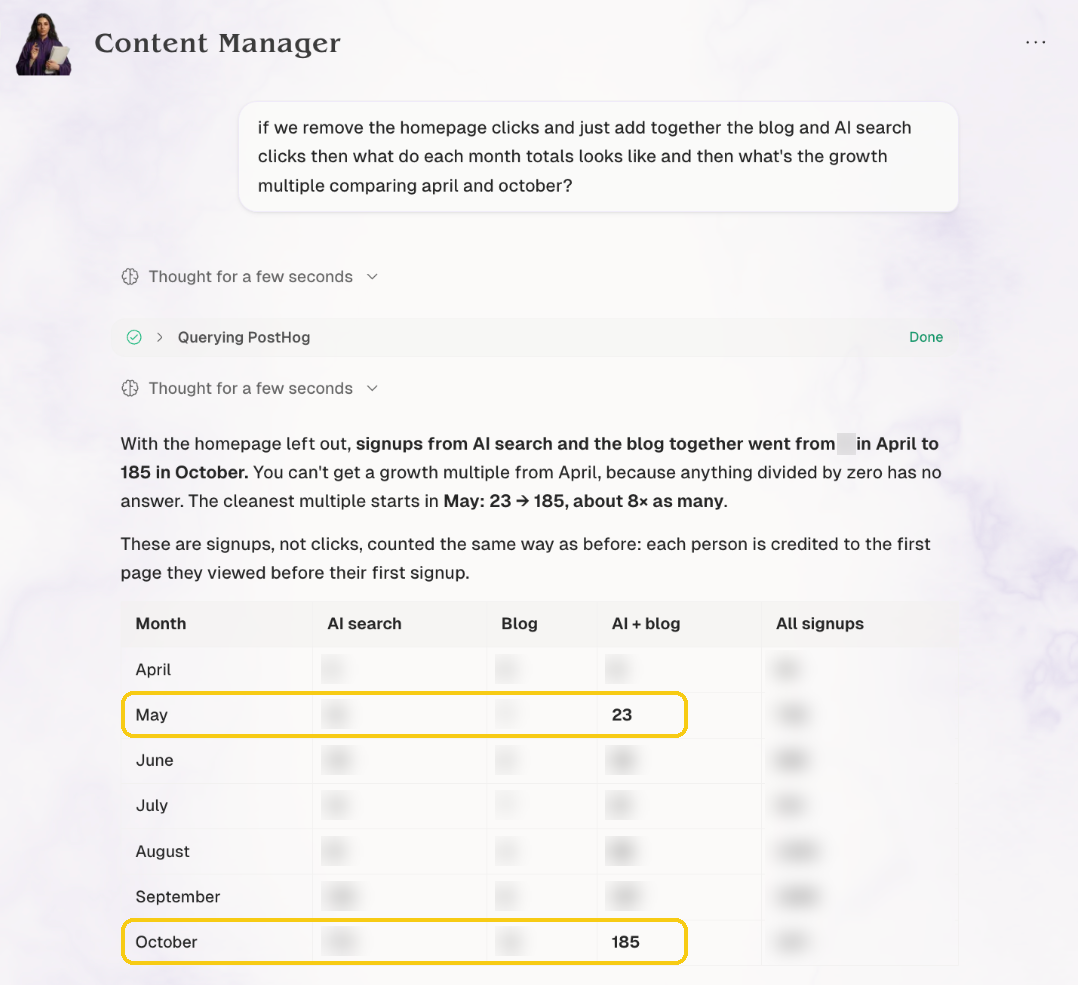
Bilt’s signups from AI search and its blog rose from 23 in May to 185 in October 2026.
AI answers named Bilt more than 5x as often in November 2026 as in August 2026.
Another example is Guardian, which helps care teams spot risks using connected sensors. Guardian published 80 articles and updated them 123 times in 5 months without an SEO hire.
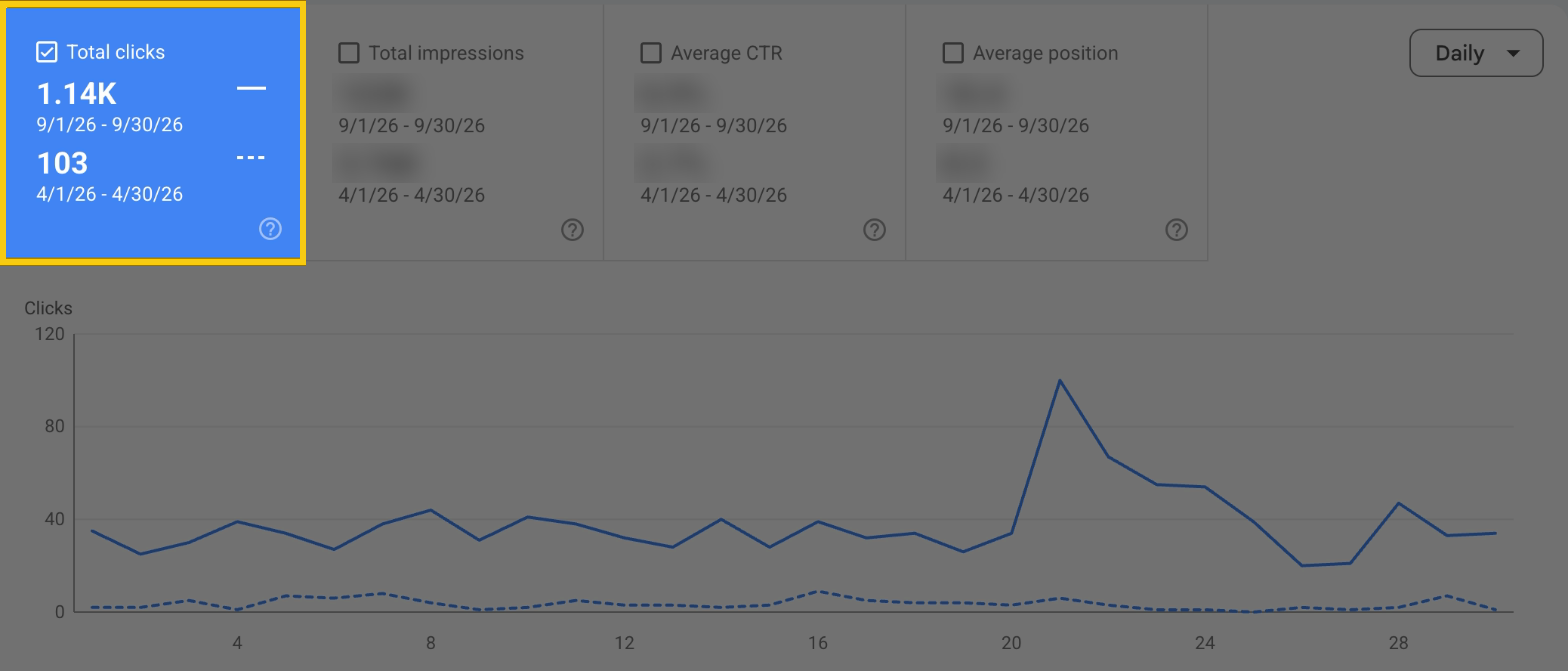
Google clicks rose from 103 in April to 1,145 in September 2026, and pipeline from Google reached €120K, up from €0.
A care facility booked a demo 27 days after the first articles went live.
Pricing
Each monthly plan includes keyword research and a content plan, plus articles, audits, refreshes and AI search prompts:
Starter: $269 a month for 8 articles, 25 articles audited, 5 content refreshes, 25 AI search prompts and a $40.50 iteration budget.
Growth: $629 a month for 16 articles, 100 articles audited, 15 content refreshes, 100 AI search prompts and an $81 iteration budget.
Scale: $1,219 a month for 30 articles, 250 articles audited, 45 content refreshes, 200 AI search prompts and a $145 iteration budget.
You can also set your own quantities of content pieces, refreshes, audit pages and AI search prompts. Keyword research and the content plan are included for $35.
The iteration budget covers your own tasks with agents in chat, including work on cited-site deals, and unused budget rolls over. Keyword research and the content plan are refreshed monthly on paid plans, rather than during the trial.
Best for
RankUp is for B2B SaaS founders and marketers who need the right buyers to find their product through Google and AI search, then sign up or book a demo.
RankUp is built for B2B SaaS companies, where buyers evaluate products by use case and product details can change after pages are published. Its agents use product knowledge to write articles about those use cases, prepare deals with sites AI answers cite, and propose page updates when product details change.
Founders and marketers choose which work the agents carry out and approve edits before publication. With PostHog connected, they can see attributed signups by article alongside Google clicks.
Pros and cons
Pros
Each week you get proposed page updates, new articles and cited-site deals, each naming the page or site and why it matters, and the agents carry out the ones you pick.
Interview answers and corrections are saved as product knowledge and brand guidance you can keep or undo, so later articles start from them.
You can review saved AI answers alongside their prompts and cited pages.
Articles are drafted section by section from the interview answers and proof you give for a whole batch in one chat.
The Deal Maker picks cited pages worth a deal, proposes the offer and writes the letter you send from your own mailbox.
Monthly performance reports turn winning and losing patterns on your pages into updates you select for the agents to make.
With PostHog connected, you see sessions and signups per article next to Search Console data.
Cons
Technical website changes stay in your own site or coding-agent setup.
RankUp is built for B2B SaaS, rather than agencies or ecommerce businesses.
Compared with Peec AI
Both RankUp and Peec AI track AI answers. The difference is how each turns a visibility gap into work:
Comparison | RankUp | Peec AI |
|---|---|---|
AI answer tracking | 25 prompts on Starter | 50 prompts on Starter across 3 models of your choice |
Follow-up work | Agents write articles and proposed page edits, and prepare cited-site deals | Actions provide evidence, task steps and completion tracking |
Your role | Choose actions, review changes and send deal letters | Carry out and track the suggested work |
Entry plan | Starter: $269 a month, with 8 articles and 5 content refreshes | Starter: $95 a month |
Peec AI fits a team with writers and editors ready to work through its task list.
RankUp fits B2B SaaS founders and marketers for whom that follow-up work is the bottleneck, and who would otherwise have to build it themselves around Claude or ChatGPT. RankUp brings the specialist agents, workflows and integrations as one system, and your feedback and results inform the agents' later work.
To see how a visibility gap can lead to reviewed work for your site, start your 7-day free trial. RankUp first proposes a plan for your site, and the trial gives you enough in-app balance to try the work that plan lists.
(For English B2B SaaS sites only.)
2. Profound
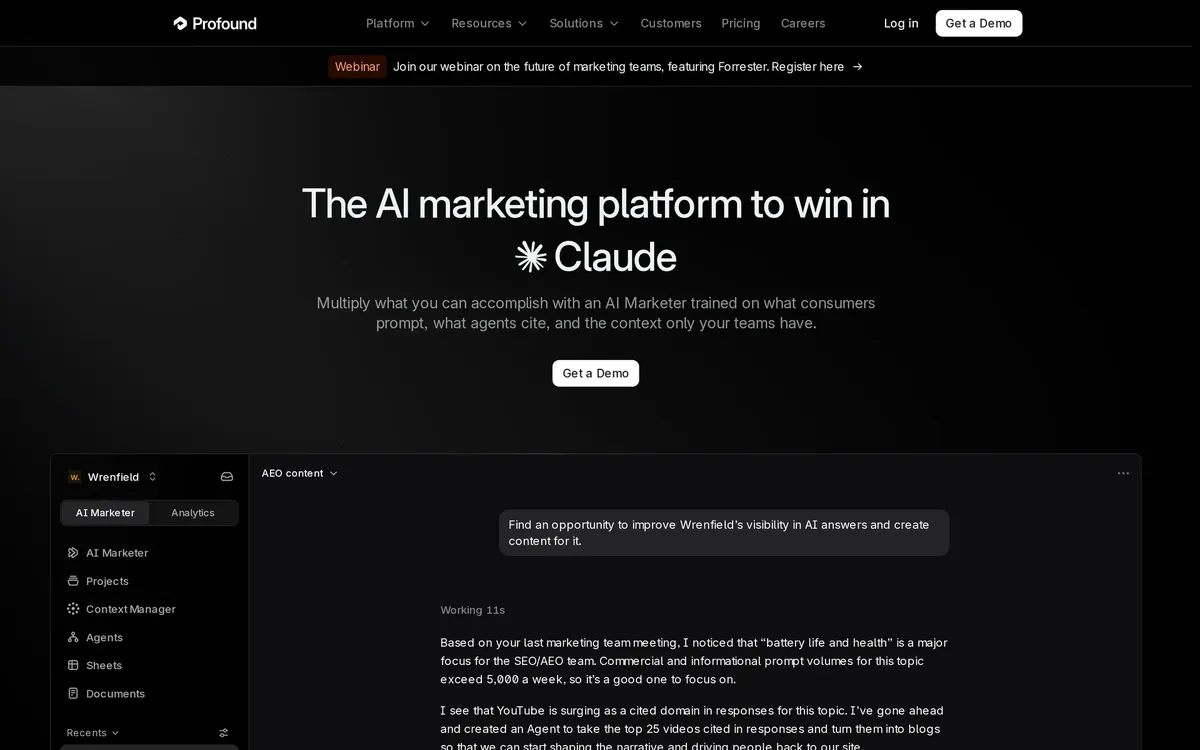
Profound pairs Answer Engine Insights, its AI search monitoring, with an AI Marketer and configurable Agents that create or update pages from what the monitoring finds.
Answer Engine Insights
Answer Engine Insights captures answers from the consumer versions of ChatGPT, Perplexity, Claude, Gemini, Google AI Overviews and Google AI Mode, among others, instead of calling their APIs.
Each tracked prompt runs daily. The visibility report shows how often a brand appears, how its share of voice compares with competitors and how those measures change by platform or topic.
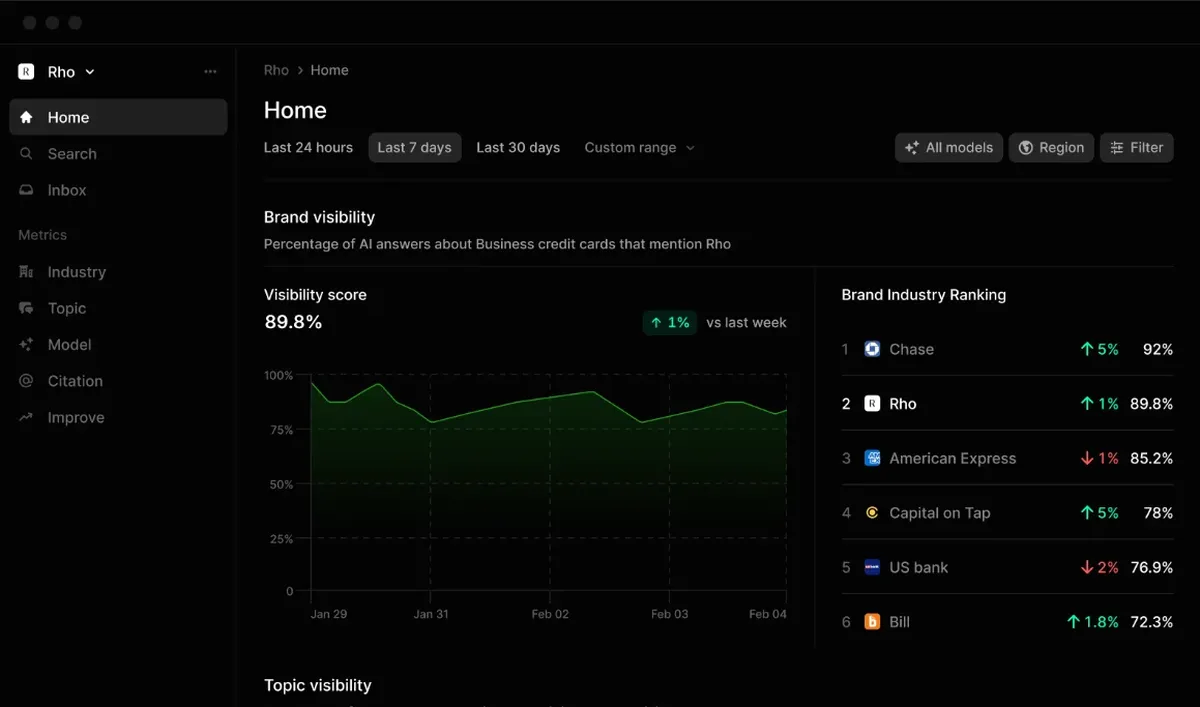
To build the prompt set, you can upload your own questions, use suggestions based on your brand and topics, or draw on Prompt Volumes, Profound’s dataset of real user queries.
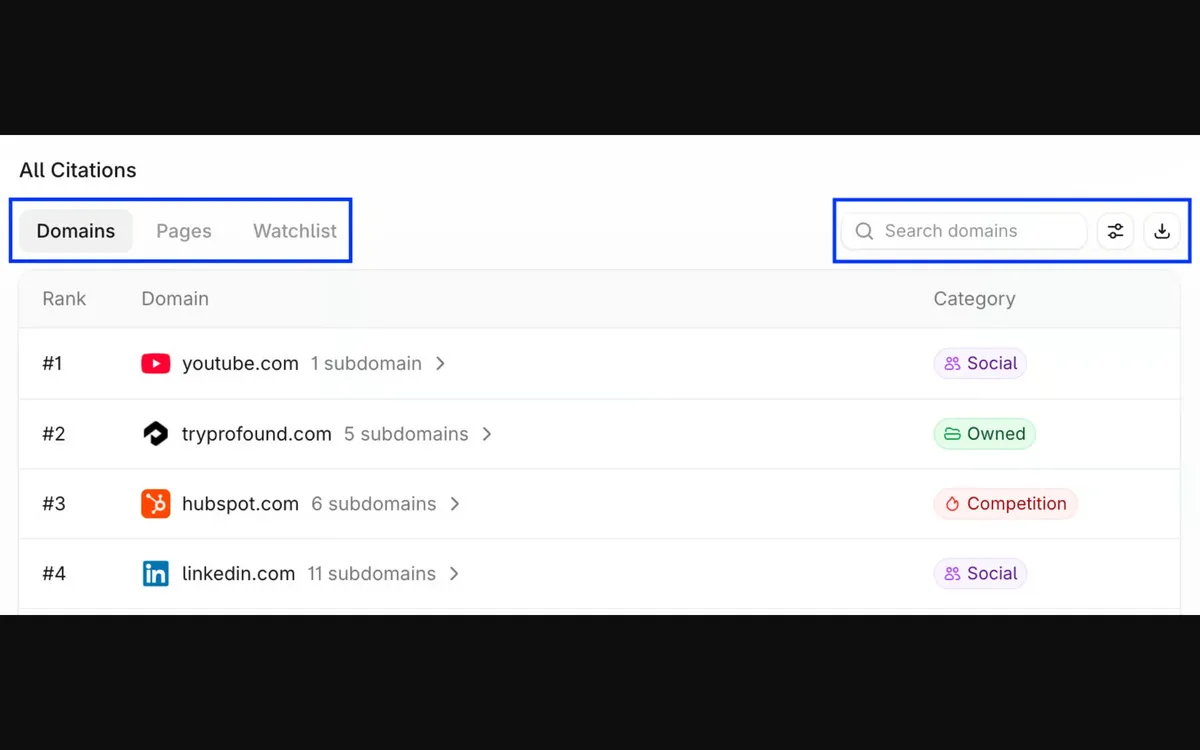
The Citations tab ranks the sources used in AI answers. You can switch from domains to individual pages or keep a watchlist of URLs, which helps you distinguish a page on your own site from a third-party source worth investigating.
FactCheck compares claims in AI answers with your source of truth and identifies URLs associated with inaccurate statements. Agent Analytics examines AI bot activity and referrals, adding information about how those systems interact with your pages.
Agents and workflows
Profound’s AI Marketer identifies opportunities, drafts work and asks for approval. You can describe a recurring task in chat and have it build an Agent, then review its instructions, tools and outputs before running it.
Profound describes agents that can rewrite pages losing citations and stage changes in a connected CMS, create pages for unanswered questions and address content AI crawlers cannot read. The work can return for approval before publication.
The Context Manager holds brand information for that work. For a process that needs defined steps, you can build a node-based Workflow and use it within an Agent, or configure a recurring report for your team.
Pricing
Profound’s brand Enterprise plan has custom pricing, prompt allowances and agent-credit allowances. Monetary credit and overage rates aren’t published, and credit use varies with agent complexity.
You see estimated credit use before a run and actual use afterward. You can configure overage billing or pause agent usage when you reach your allowance.
Best for
Profound fits if you have the capacity to configure marketing workflows and manage their usage alongside AI visibility reporting. If you move a workflow to a reasoning-based Agent, Profound recommends testing it.
Pros and cons
Pros
You can construct marketing Agents using conversational instructions.
Node-based Workflows let you define fixed steps within an Agent.
FactCheck identifies inaccurate statements about your brand and the sources behind them.
The AI Marketer can draft work from an opportunity and bring it back for approval.
Daily prompt tracking reports cited sources and competitor visibility across answer engines.
Cons
Moving a prompt to another topic changes its historical attribution, and reports cannot show the earlier configuration.
Editing a prompt changes the wording displayed on past answers, even though those answers used the earlier wording.
Enterprise tracks up to 10 answer engines, so its coverage has a ceiling.
Deleting a prompt removes its past answers from reports until the prompt is restored.
Compared with Peec AI
Peec AI and Profound both monitor AI answers, but differ in follow-up work and pricing:
Comparison | Profound | Peec AI |
|---|---|---|
Monitoring | Daily tracking across up to 9 answer engines | 3 models of your choice on self-service plans |
Follow-up work | Agents and fixed-step Workflows can draft pages and stage CMS updates | Actions provide evidence, task steps and completion tracking |
Your role | Configure workflows and manage agent credits | Make and track the changes |
Pricing | Custom Enterprise terms | Self-service plans from $95 a month |
The difference comes down to who does the work. Peec AI fits a team that wants affordable monitoring and a clear task list. Profound fits an enterprise team that wants agents acting on findings and has the capacity to set them up and manage credit use.
3. AI Visibility Toolkit by Semrush
Semrush's AI Visibility Toolkit adds AI search reporting to the Semrush platform through six reports: Visibility Overview, Competitor Research, Prompt Research, Brand Performance, Prompt Tracking and the AI Search Site Audit.
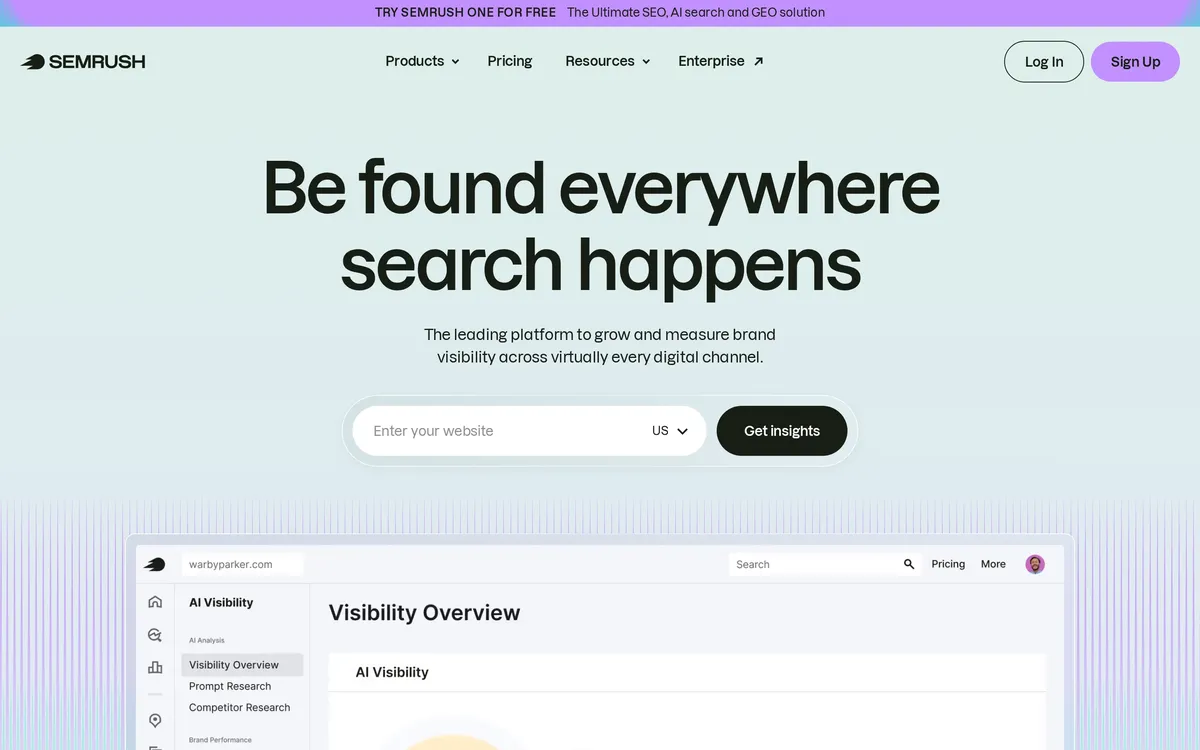
Visibility and prompt tracking
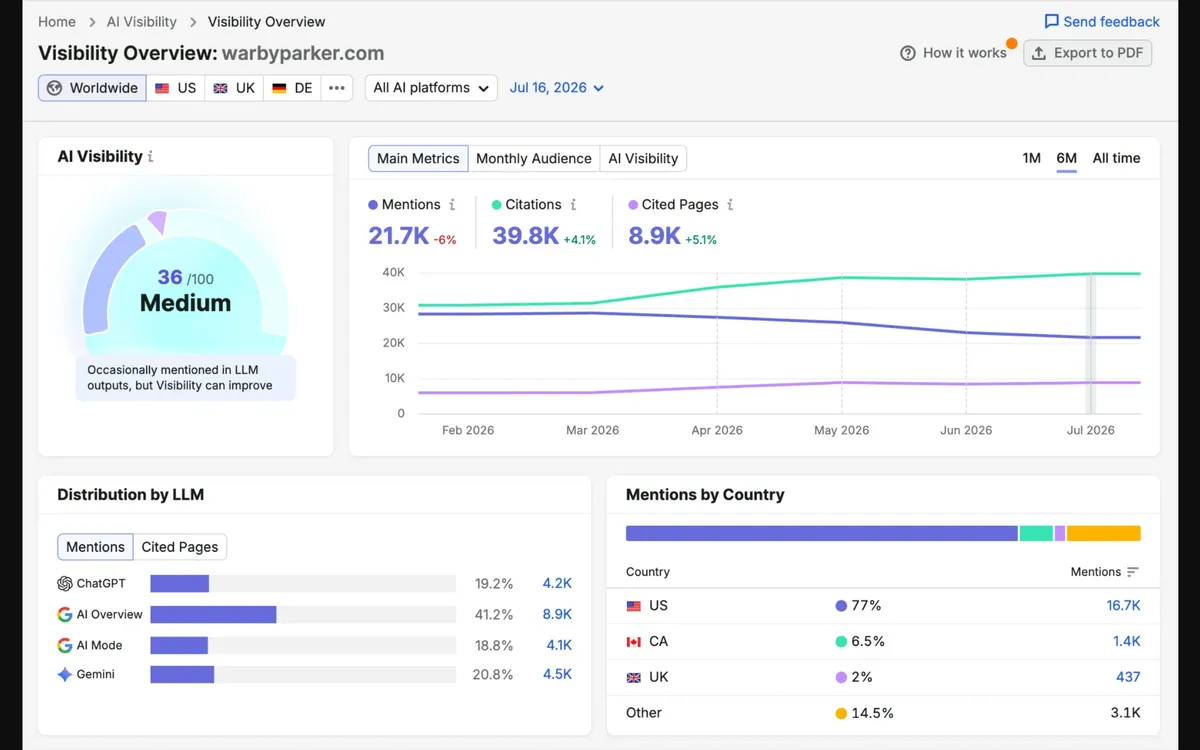
Visibility Overview shows a brand’s AI Visibility Score alongside trends in mentions, citations and cited pages. You can break the results down by AI platform or country to see where the brand appears.
Prompt Tracking follows questions you select each day on ChatGPT and Google AI Mode. That lets you watch a specific buyer question over time instead of relying only on an overall score.
Prompt Tracking follows questions you select each day on ChatGPT and Google AI Mode. That lets you watch a specific buyer question over time instead of relying only on an overall score.
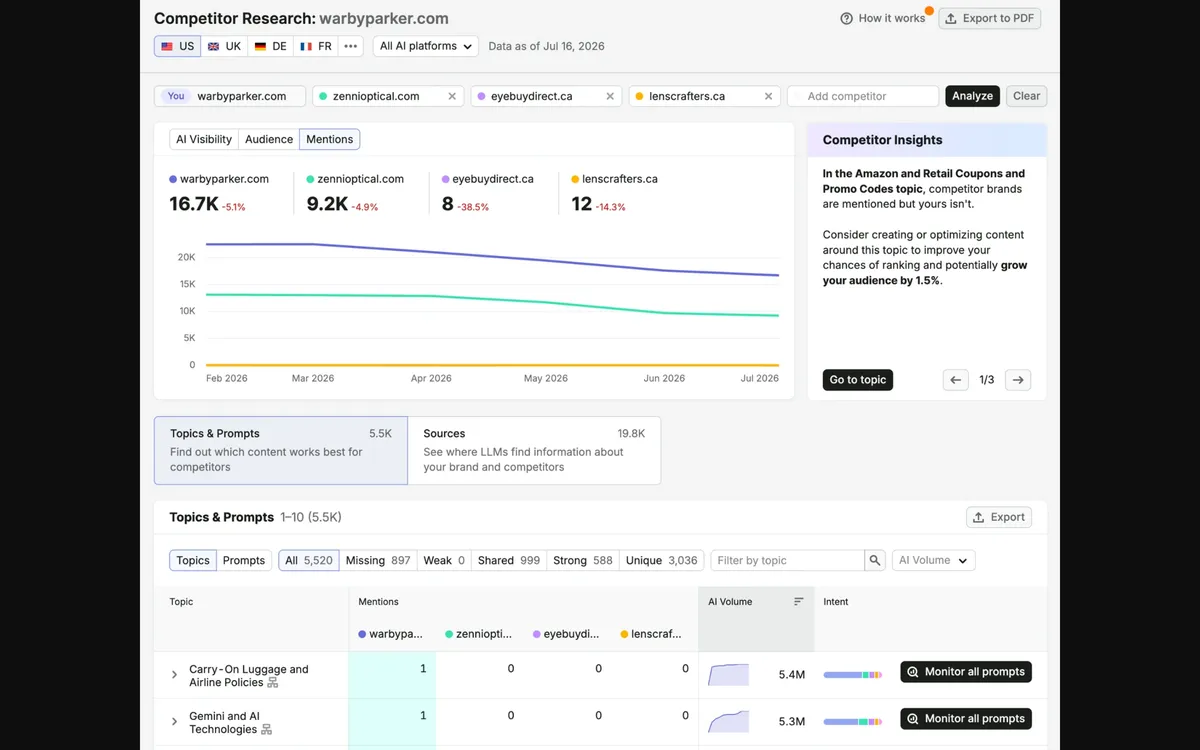
Prompt Research starts with a broad topic or product category and returns related questions, estimated topic volume and intent. Those details help you decide which buyer questions deserve a closer look before adding them to a tracking campaign.
The reports connect to Semrush's My Reports tool and export to PDF or CSV, so you can share findings before deciding which pages or external mentions need attention.
AI Search Site Audit
The AI Search Site Audit checks for technical issues that can stop AI crawlers accessing your site, including pages blocked in robots.txt. It flags problems to investigate, while the team responsible for the site decides and makes the technical changes. Writing sits in the separate Content Toolkit.
Pricing
The AI Visibility Toolkit costs $99 per month for 25 tracked prompts, one project and one Brand Performance domain. Extra prompts cost $60 per month for each 50, and each additional Brand Performance domain costs $99 per month.
Writing tools sit in Semrush's separate Content Toolkit, which costs $60 per month.
Best for
If you’re a marketer using Semrush, its AI Visibility Toolkit fits when you want to investigate AI visibility and direct the content and technical work that follows.
Pros and cons
Pros
Competitor and prompt research help you investigate visibility alongside brand performance.
The AI Search Site Audit flags blockers that may prevent AI crawlers from accessing your site.
You can track chosen buyer questions daily on ChatGPT and Google AI Mode.
Visibility reports can be exported to PDF or CSV for sharing.
Cons
Daily tracking of selected prompts covers ChatGPT and Google AI Mode, while the overview reports cover additional platforms.
The AI Visibility Toolkit does not write articles or apply its recommended page changes.
The base plan includes 25 tracked prompts, so a larger prompt set requires an add-on.
Writing tools sit in a separate Content Toolkit, with a separate subscription cost.
Compared with Peec AI
Semrush and Peec AI both monitor AI answers and recommend next steps. Their entry plans and supporting tools differ:
Comparison | Semrush AI Visibility Toolkit | Peec AI Starter |
|---|---|---|
Daily prompt tracking | ChatGPT and Google AI Mode | 3 models of your choice, including Perplexity and Gemini |
Entry allowance | 25 prompts | 50 prompts |
Monthly price | $99 | $95 |
Follow-up work | Recommendations and an AI Search Site Audit for crawler access | Actions with evidence, task steps and completion tracking |
Supporting research | Prompt Research and the wider Semrush SEO platform | AI answer and citation monitoring |
Semrush fits a marketer who already works in Semrush and wants AI visibility next to keyword research and a crawler audit, and who can direct the content work that follows.
Peec AI fits a team that wants more tracked prompts at entry level and a wider choice of models, with Actions that turn findings into task steps.
4. SE Visible by SE Ranking
SE Visible tracks how your brand appears in AI answers and keeps the unedited responses behind its visibility metrics.
SE Visible collects answers through the engines’ browser interfaces, with Claude collected through an API. It refreshes the results daily and stores the responses, so you can inspect what an answer says, which competitors it names and which sources it cites.
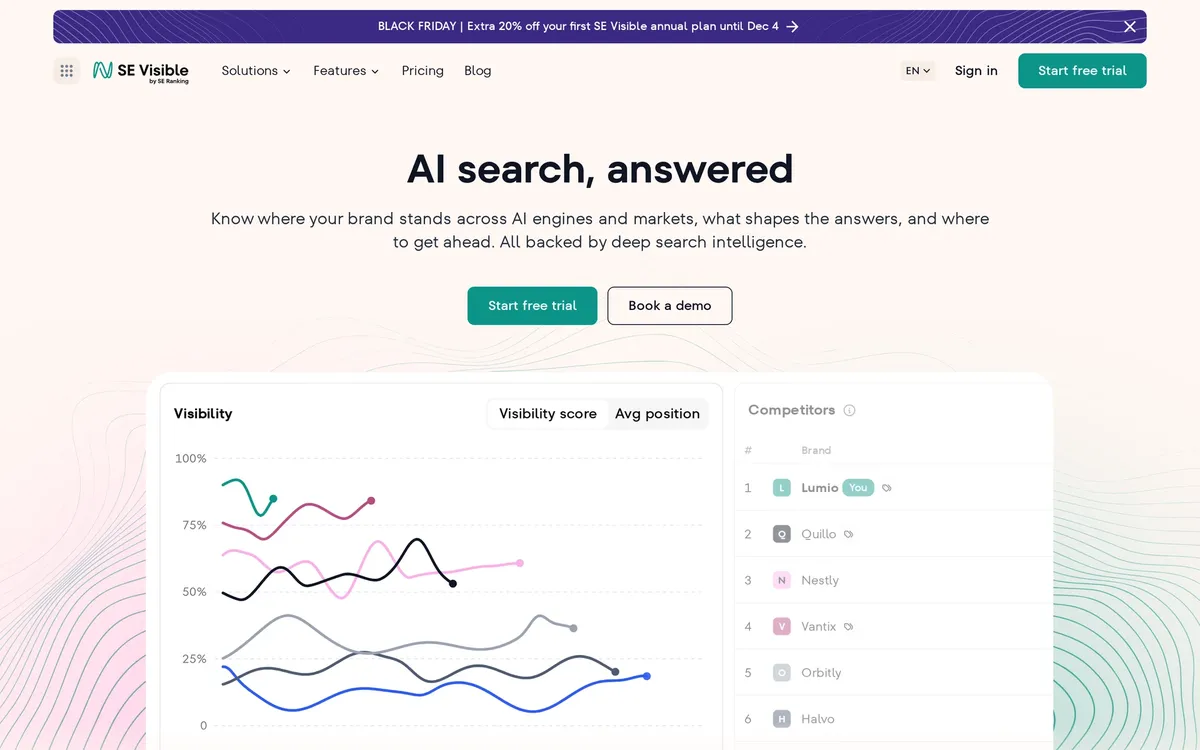
Answer inspection and prompts
You can add your own prompts or start from the topics and prompts SE Visible suggests during setup.
SE Visible labels prompts by language, intent, buying stage and whether they name your brand. That makes it possible to separate questions from buyers comparing options from searches that already include your name.
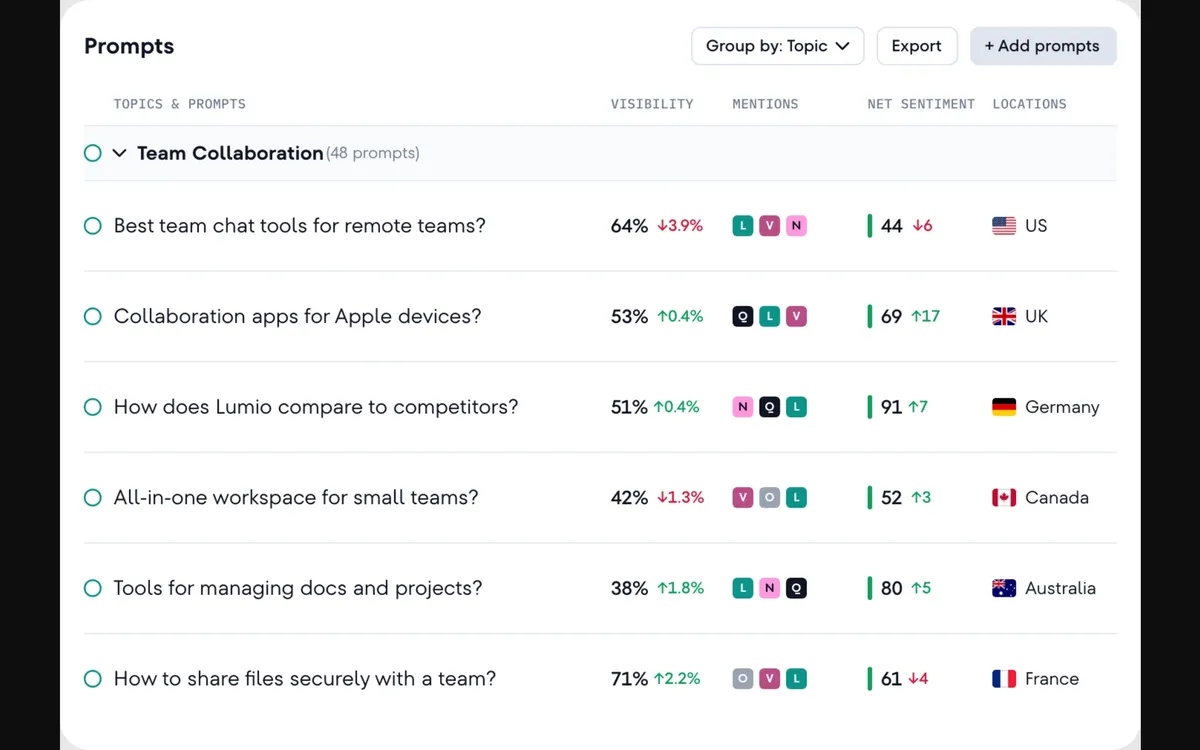
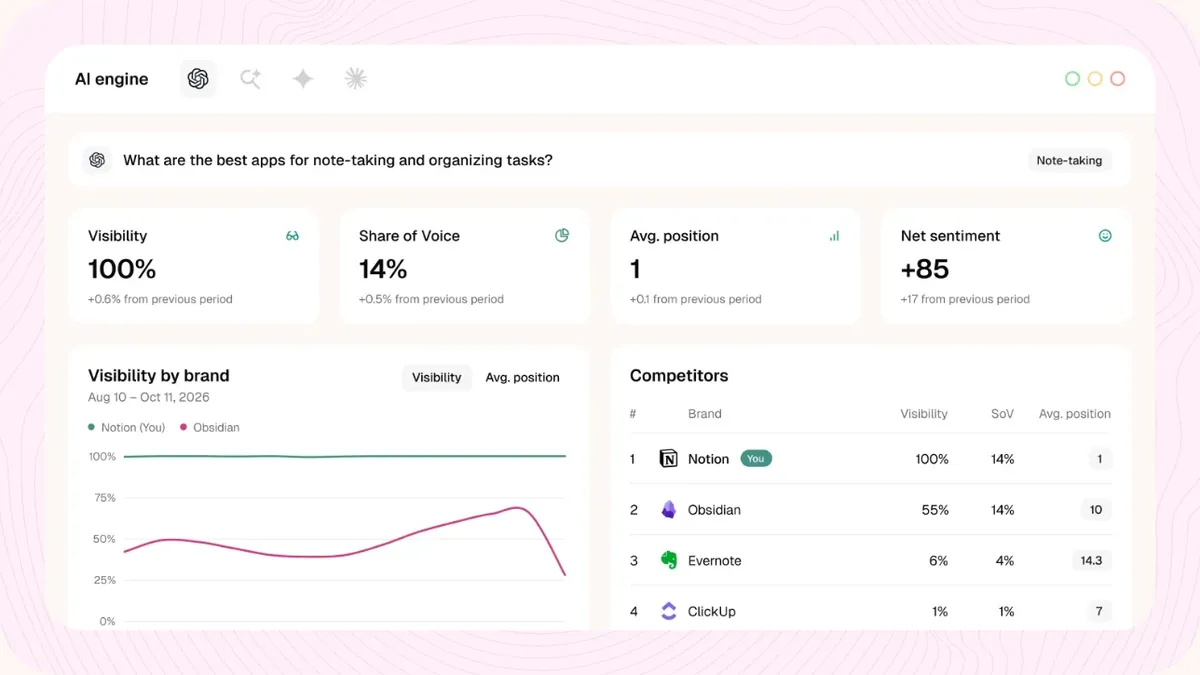
The overview compares visibility, share of voice, average position and net sentiment across engines and against the previous period. You can open the underlying answer to check the wording and cited sources behind a change. An AI Overviews overlap check shows whether those answers draw on Google’s top 20 results.
Competitor benchmarking
SE Visible compares tracked competitors by visibility, share of voice and position, with changes over time. It can suggest competitors found in the answers and highlight the topics where they lead, so you can inspect the questions behind the gap.
Citation gaps
The citation view lists cited domains and individual URLs, and sorting by source type shows whether the next move is social, community or blog outreach.
Pages that mention competitors but omit your brand are ranked by Gap score. Traffic, Domain Trust and backlinks sit beside the list, giving you context for deciding which sources to investigate or contact.
Pricing
Basic costs €80 per month, or €64 per month with annual billing, for 75 prompts, five projects and one location per project. Core and Agency both include unlimited locations:
Core: €169 per month, or €135 per month with annual billing, for 200 prompts and ten projects.
Agency: €355 per month, or €284 per month with annual billing, for 1,000 prompts and 30 projects.
Enterprise: Custom pricing from 2,000 prompts, with unlimited projects.
Projects share the account’s prompt allowance, so tracking one question in three locations on Core uses three prompts. Turning engines on or off doesn’t change prompt consumption.
Best for
SE Visible fits when your focus is reporting and you want to check original answers and share visibility data across projects. You’ll still need a way to turn those findings into content work.
Pros and cons
Pros
Weekly email reports and CSV exports make visibility findings easier to share.
Unlimited seats and tracked competitors are included across plans.
You can open the original AI answers behind visibility metrics and inspect their citations.
The citation gap view identifies pages that mention competitors but omit your brand.
Cons
Agency’s Claude Haiku checks use the API without web search, unlike its checks through other engines’ user-facing interfaces.
Agents are in beta, and full-workflow execution is still being built.
Self-service plans do not track Perplexity answers.
Content-gap identification is not yet available in SE Visible.
Compared with Peec AI
SE Visible and Peec AI both let you inspect the answers behind their metrics. Their entry plans and follow-up features differ:
Comparison | SE Visible Basic | Peec AI Starter |
|---|---|---|
Prompts | 75 | 50 |
Engines | ChatGPT, Gemini, Google AI Mode, Google AI Overviews and Copilot | 3 models of your choice, including Perplexity |
Reporting access | API, Data Studio and MCP included | API from Pro and Data Studio from Advanced |
Follow-up work | Ranks citation gaps by Gap score; agents are in beta | Actions provide evidence, task steps and completion tracking |
SE Visible gives you more prompts and engines at entry level and more reporting connections, which suits teams whose main job is auditing answers and reporting on visibility.
Peec AI does more to organise the follow-up work, so the choice depends on whether you need a reporting layer or a task list.
5. Insights by AirOps
AirOps pairs Insights, its AI search monitoring, with Playbooks, Workflows and Grids that turn selected opportunities into content. Quill, the AirOps agent, is where you plan campaigns, ask about performance and build workflows in chat.
AI search monitoring
Onboarding starts from five suggested competitors, and two or three of the ones AirOps picked for rankup.so matched my market.
From the brand, audience, site and competitor details, it generated 25 prompts and built an AI Search report card that put my brand rank at 6, with a 0.0% mention rate and a 0.0% citation rate.
Because some suggested competitors were outdated or unrelated, I read that comparison cautiously.
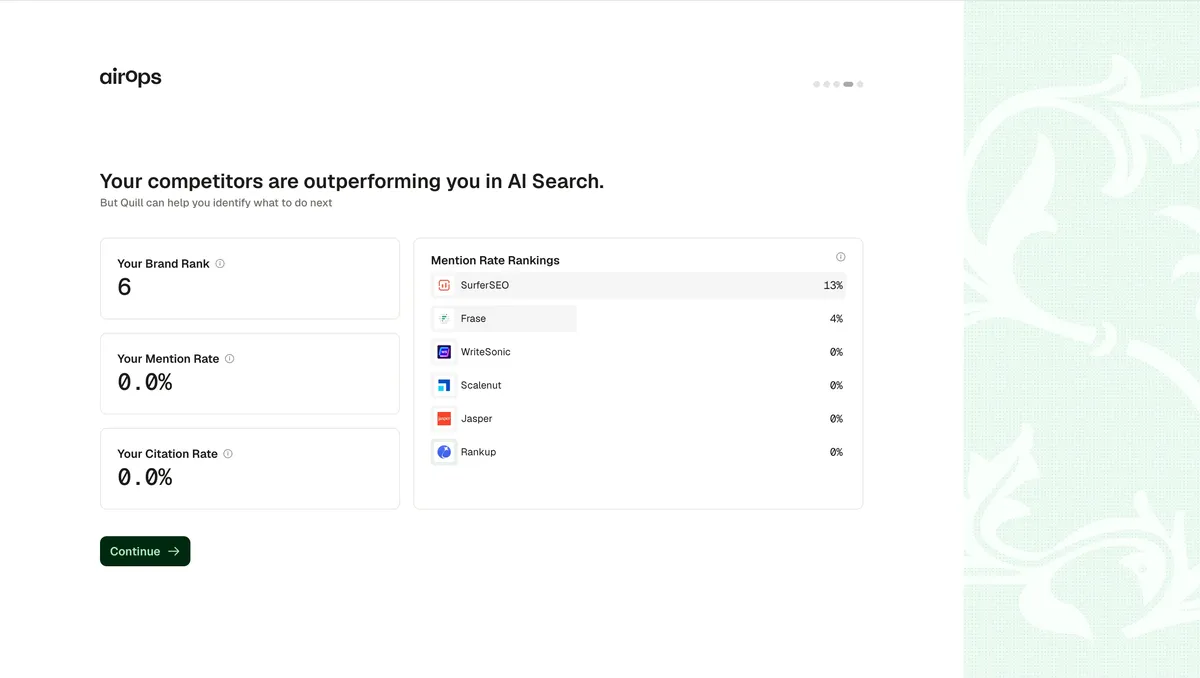
Every later metric and opportunity is built on those tracked prompts. Mine leaned toward traditional rank-tracking questions such as "What is the best rank tracking software?" rather than the AI search queries I'd prioritise.
You can add your own prompts, which is worth doing before acting on the recommendations, since guessed prompts can point the follow-up work in the wrong direction.
Finding and acting on opportunities
The Opportunities view groups suggestions into creation, refresh, outreach and community, led by Popular Prompt Gaps, which ranks them by demand. On the plan I used, that panel showed a "Prompt Volume Not Enabled" upgrade notice, so the demand behind each suggestion stayed hidden.
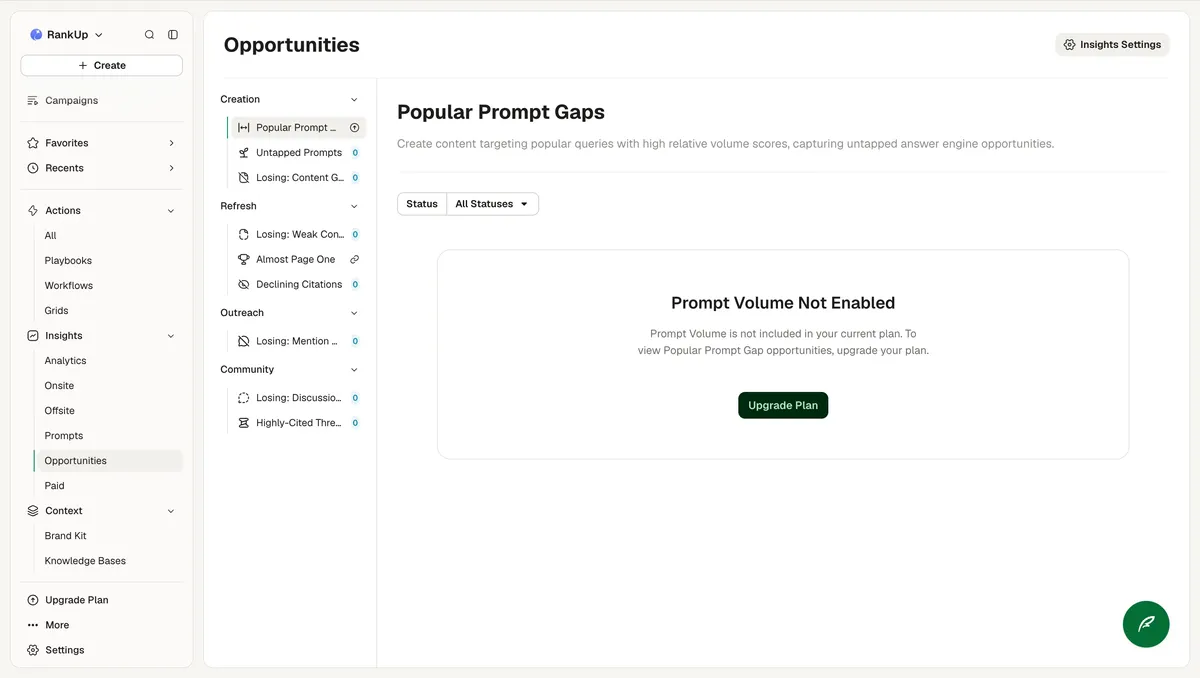
Quill can turn those gaps into a campaign. It first summarised the citation gap and asked whether to close it or connect GA4 and Search Console first.
It then built a campaign around zero-citation topics on rankup.so, pairing each prompt with a rationale and a draft-article action, and I worked through the activities from the campaign page.
Selected opportunities can also be mapped to columns in a new or existing Grid, the work table where a Playbook runs.
For work outside campaigns, Quill helps build a custom workflow. It proposed inputs and steps for a keyword-research workflow, but defining the problem, judging each input, testing the run and refining its steps stayed with me.
Pricing
Prices for Solo, Pro and Enterprise subscriptions are quoted on request. On Solo, tasks beyond the included allowance cost $0.025 each, and consumption depends on the workflow actions and data processed rather than a fixed task count per article.
Best for
AirOps fits a team that wants to direct repeatable content workflows and has the capacity to build and refine them. Defining the desired work is part of getting value from the workflow builder.
Pros and cons
Pros
Refresh opportunities identify existing content where competitors outperform you.
Pro includes Insights across 10+ answer engines and unlimited team seats.
Quill can group citation gaps into a campaign with draft-article actions.
You can add your own prompts to track questions relevant to your buyers.
Cons
Solo limits Insights to ChatGPT, so broader monitoring requires a different plan.
A keyword workflow I ran returned repeated and generic phrases, including “keyword find” and “your keywords”.
AirOps suggested traditional rank-tracking prompts for my account instead of the AI search questions I would prioritise.
The Popular Prompt Gaps panel in my workspace required an upgrade to show prompt volume.
The article AirOps generated for me reused information already on the web and lacked a distinct perspective.
Compared with Peec AI
AirOps and Peec AI hand over follow-up work differently once monitoring reveals a gap:
Comparison | AirOps | Peec AI |
|---|---|---|
Follow-up work | Selected opportunities can feed campaigns and Playbooks that draft content | Actions provide evidence, task steps and completion tracking |
Your role | Configure and direct the workflows | Make and track the changes |
Entry coverage | Solo Insights covers ChatGPT | 3 models of your choice on self-service plans |
Pricing | Subscription prices quoted on request | Self-service plans from $95 a month |
AirOps fits a team with the capacity to build and refine content workflows. Peec AI fits a team that wants monitoring and a task list without setting up a production pipeline.
6. Frase
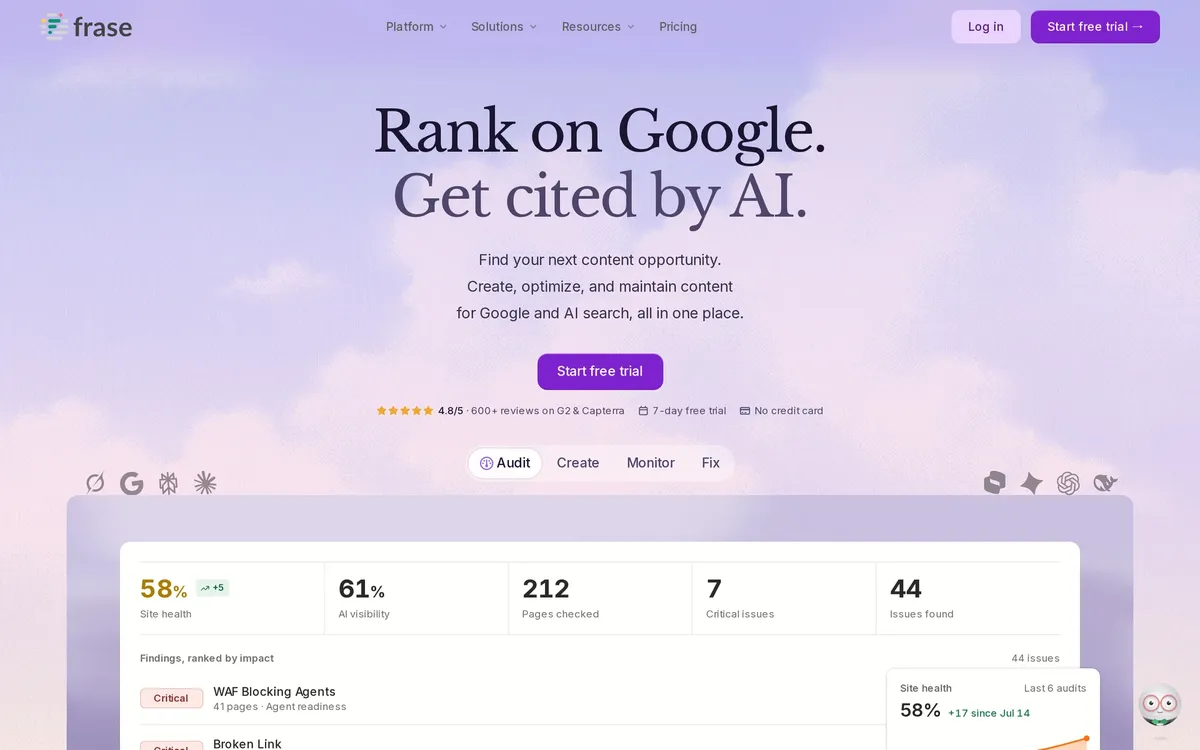
Frase tracks brand mentions, citations and competitors in AI answers, and connects visibility topics to research, drafting and publishing.
AI visibility monitoring
Its suggested prompts are grouped by awareness, consideration and decision, so you can choose questions that match the buying stage you want to monitor.
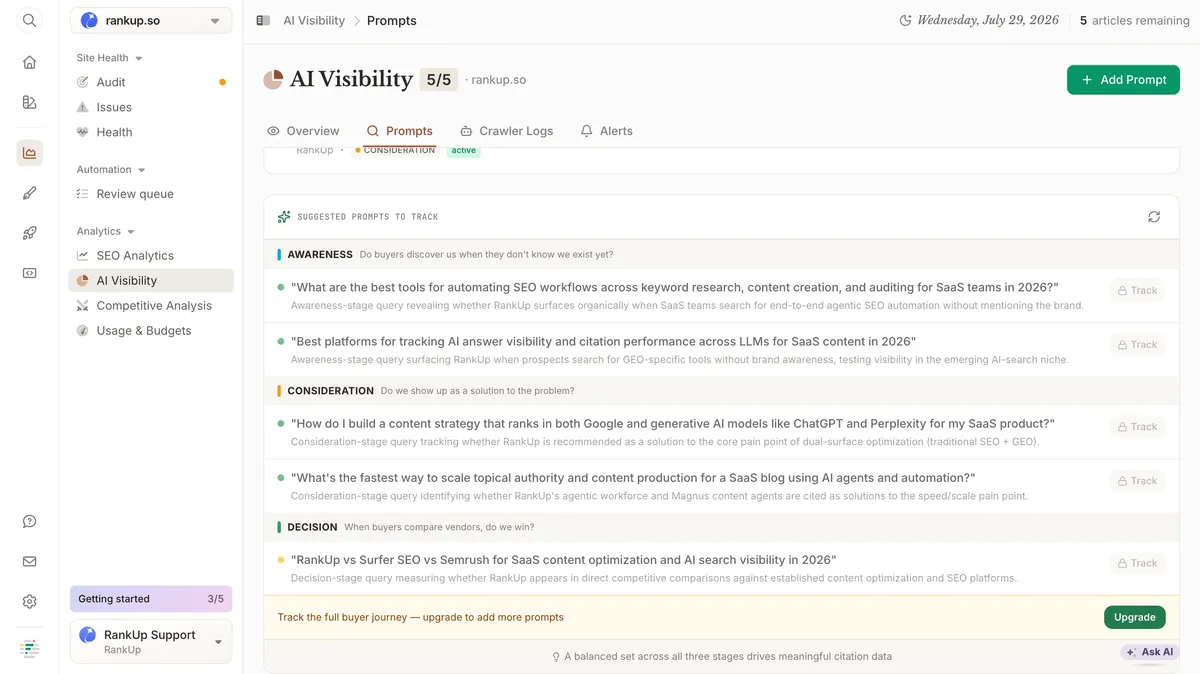
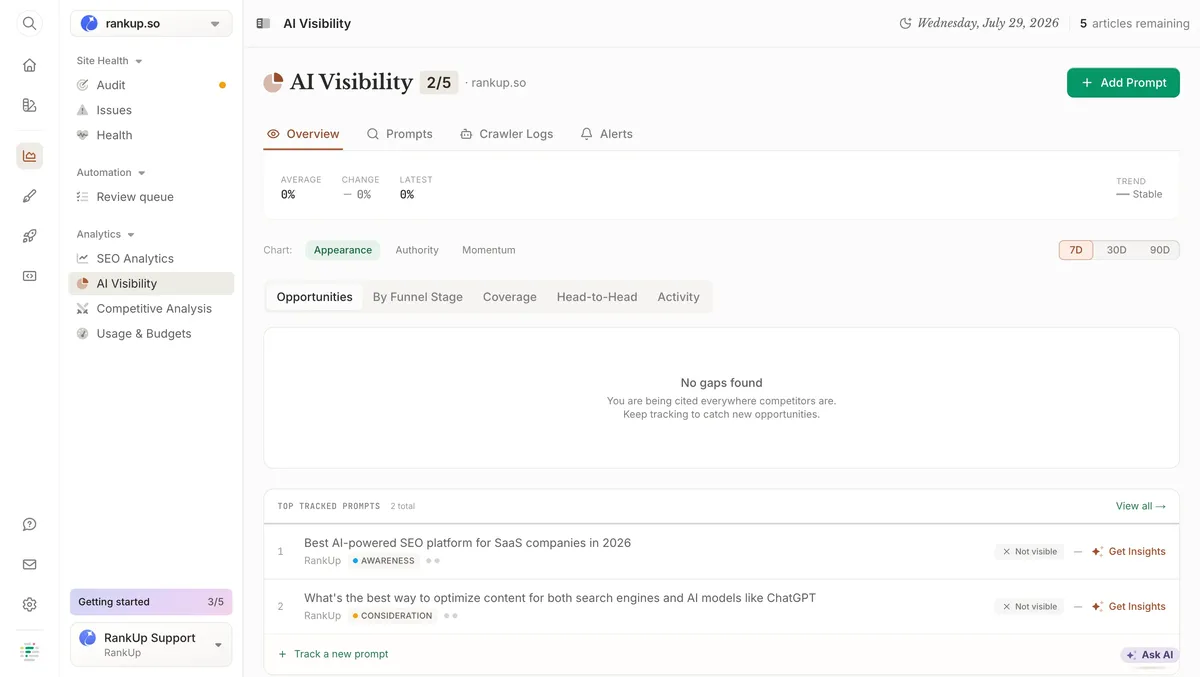
Every metric comes from the prompts you track. A new workspace started with two broad category prompts Frase wrote itself, and the overview reported 0% appearance while its Opportunities panel read "No gaps found", so the suggested buyer-stage prompts are worth adding before you read the numbers.
Research, briefs and drafting
Frase's assistant can start content from a selected visibility topic. Handed a writing task, it researched the topic and built a brief, then waited until I told it to write.
The brief and the draft both came back in Estonian because of a language default on the account, and nothing in the workflow flagged it first.
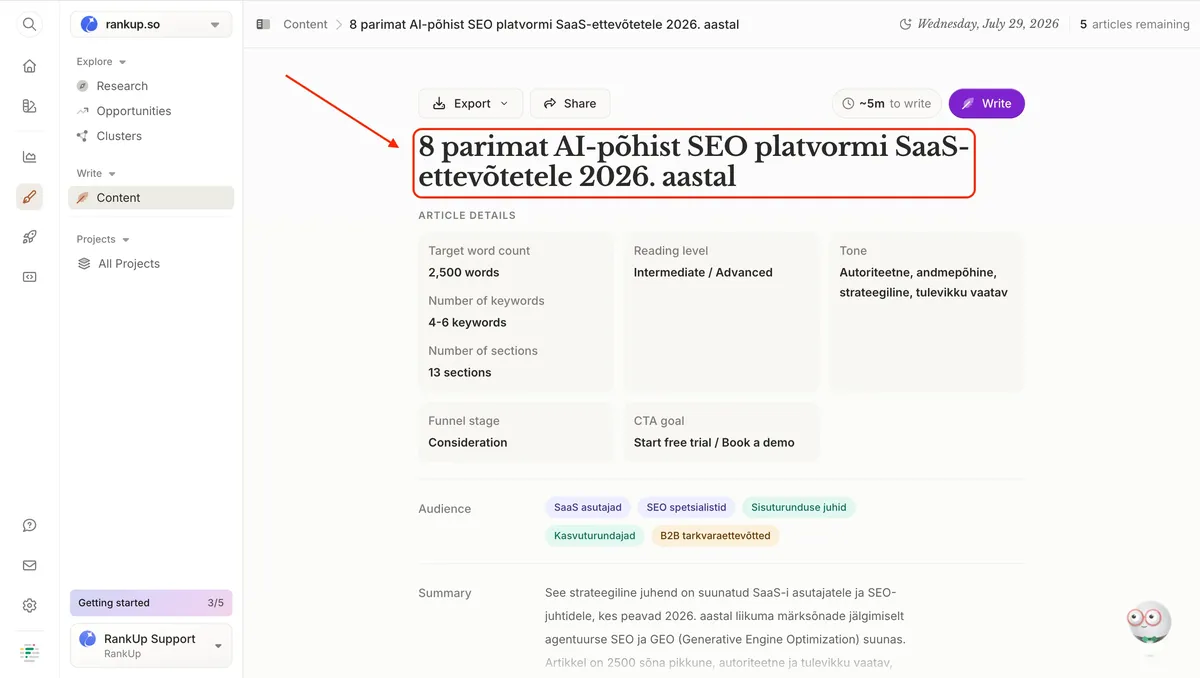
The draft needed more than a language fix. Frase flagged missing evidence and citations along with structural improvements, and making those changes fell to me.
An article evaluating a B2B product also needs to show the software, explain pricing and fit, weigh pros and cons, and include customer results where available.
Content Guard
Content Guard separately watches published pages for ranking and traffic declines and drafts fixes for approval. Frase says you can opt in to automatic application for selected low-risk fixes.
Pricing
Frase’s paid plans differ in prompt allowance and engine coverage:
Starter: About $49 per month, or $39 per month billed annually at $468 a year. It includes 20 prompts across ChatGPT and Google AI.
Professional: About $129 per month, or $103 per month billed annually at $1,236 a year. It includes 50 prompts and adds Perplexity.
Scale: About $299 per month, or $239 per month billed annually at $2,868 a year. It includes 75 prompts and adds Claude and Gemini.
Enterprise has custom pricing and prompt allowances, and adds Grok, Copilot and DeepSeek. Each prompt takes up a separate slot for each location. Additional seats on Professional and Scale cost about $29 per month each.
Best for
Frase fits if you want monitoring and content production in one workspace and can review drafts and make substantive corrections.
Pros and cons
Pros
Section-level comments let you discuss article changes with coworkers.
Professional and higher plans allow prompt CSV exports.
Suggested prompts are grouped by buyer stage, so you can select questions closer to a purchase decision.
Content Guard watches published pages for search declines and drafts fixes for approval.
Cons
My overview reported 0% appearance while its Opportunities panel said “No gaps found”.
The 180-day reporting view requires Scale or Enterprise. The 365-day view requires Enterprise.
Starter tracks ChatGPT and Google AI. Perplexity, Claude and Gemini require higher plans.
The brief and draft came back in Estonian because of my account's language setting, which I had to correct.
The draft Frase generated for me lacked evidence and needed structural improvements.
Compared with Peec AI
Frase connects monitoring to content production, while Peec AI organises work for your team. Their metrics and entry plans differ too:
Comparison | Frase | Peec AI |
|---|---|---|
Follow-up work | Research, drafting and publishing, with Content Guard fixes proposed for declining pages | Prioritised Actions for your team to carry out |
Starter monitoring | 20 prompts across ChatGPT and Google AI | 50 prompts on 3 models of your choice |
Starter price | About $49 a month | $95 a month |
Visibility measure | Answers that name or cite a brand | Answers that mention a brand |
Position measure | Average of the brand's rankings on Visibility and Share of Voice among tracked brands | Position within answers |
Frase fits a team that wants monitoring and drafting in one place and can edit drafts heavily. Peec AI fits a team that only needs monitoring and a task list, and writes elsewhere.
7. LLM Visibility by Search Atlas
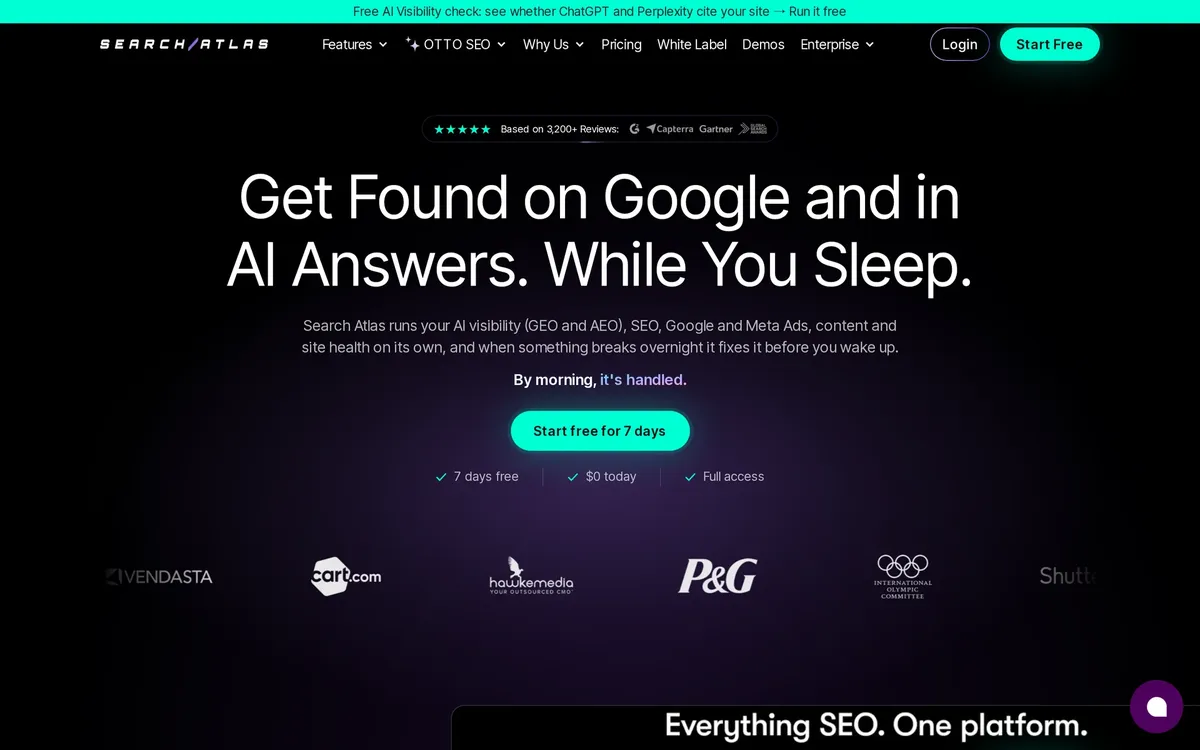
Search Atlas pairs AI visibility reporting with content tools, on-page playbooks and outreach research.
LLM Visibility reporting
LLM Visibility by Search Atlas tracks selected queries over time and reports visibility scores, average citations and sentiment by platform.
I could read the platform breakdown and topic table together, including visibility rank, citation share and search volume, though deciding what the data meant and what to do next stayed with me.
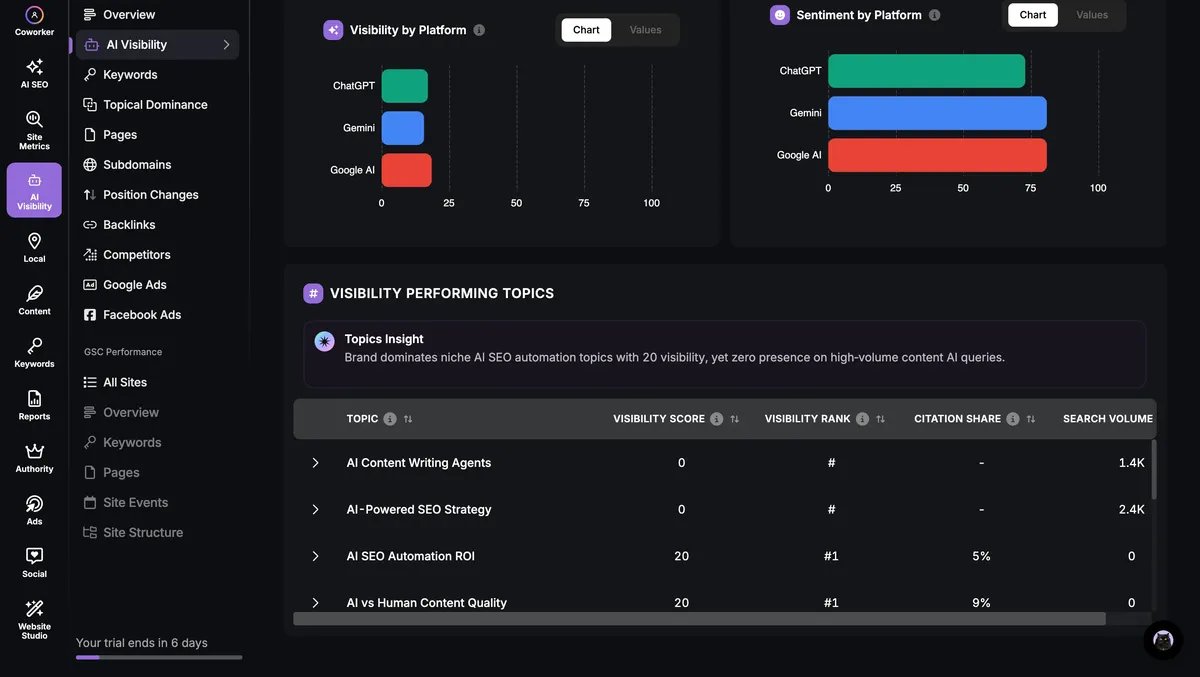
The Prompt Simulator lets you enter a question and compare brand mentions with competitors on ChatGPT and Gemini. A cited-sources view ranks the domains behind answers by citation count and share and lists the source URLs, which gives you specific pages to examine.
Search Atlas also proposes the topics and queries to monitor. Its agent suggested a full set for rankup.so, and I could approve or reject each one, or switch on auto-approval to skip the confirmations.
The wider Search Atlas platform organises repeatable work as playbooks for on-page fixes, competitor research, authority building and content.
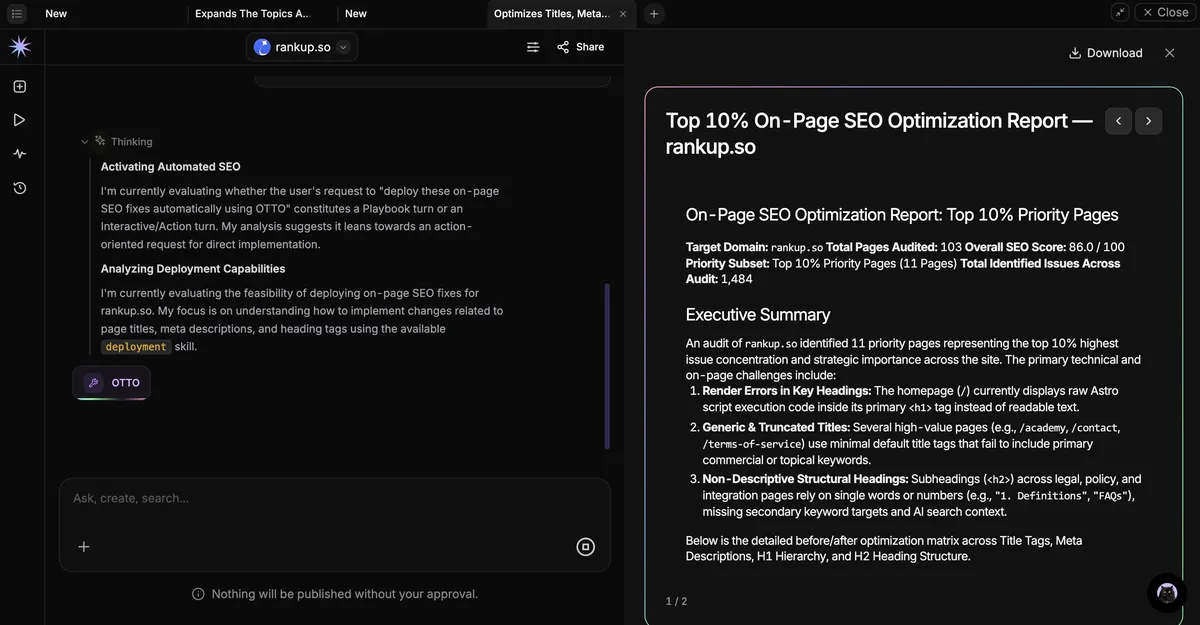
When I ran the On-Page SEO: Fix Critical Issues playbook on rankup.so, it produced a report that audited 103 pages and flagged 11 priority pages, mostly for heading structure and generic titles.
Technical checks and on-page hygiene were where the platform felt strongest, and once its pixel is installed, the Auto agent can apply changes such as H1 updates. In the Authority area, QUEST helps you find contributor contacts from AI-cited sources and create email or SMS campaigns.
Content creation
Content Genius takes a selected topic through research and drafting, then opens the article in an editor. Its Atlas Agent suggests follow-up changes, including metadata and internal links.
I used it to generate an article for rankup.so. The draft lacked distinctive insight, and when I asked for internal links, the agent found none even though related articles were in the content pool.
Pricing
These prices cover Search Atlas platform subscriptions, not standalone LLM Visibility:
Starter: $99 per month for one seat.
Growth: $199 per month for three seats.
Pro: $399 per month for five seats.
Agency: $999 per month for ten seats.
Best for
Search Atlas fits if you have an SEO specialist who can interpret the reports and direct the follow-up work. The broader platform also caters to local and service-business marketers.
Pros and cons
Pros
Prompt Simulator lets you test custom prompts against competitors on ChatGPT and Google Gemini, including in the United States market.
You can approve or reject proposed monitoring topics individually, or enable auto-approval.
The cited-sources view lists individual URLs alongside citation counts and share.
The on-page audit flags issues such as heading structure and generic titles.
Cons
When I asked for internal links, Search Atlas found none even though related articles were in the content pool.
Its competitor analysis selected similarly named domains and missed my main competitors.
Starter includes AI visibility tracking for one provider, with broader coverage on higher plans.
The on-page playbook I ran returned an audit report rather than a completed campaign.
The article Search Atlas generated for me was generic and lacked distinctive insight.
Compared with Peec AI
Peec AI turns monitoring findings into task steps. Search Atlas combines AI visibility reporting with a wider SEO platform:
Comparison | Search Atlas | Peec AI |
|---|---|---|
Monitoring | Visibility, citations and sentiment | Visibility monitoring and Actions |
Follow-up work | Playbooks, content tools and QUEST outreach research in the wider platform | Evidence, task steps and completion tracking |
Entry price and seats | Platform Starter: $99 a month for 1 seat | Starter: $95 a month with unlimited users |
Search Atlas fits a team looking for on-page audits and article creation alongside visibility reporting, though the article it generated for me needed substantial editing. Peec AI focuses the follow-up on evidence and task steps for the team to carry out.
8. Writesonic
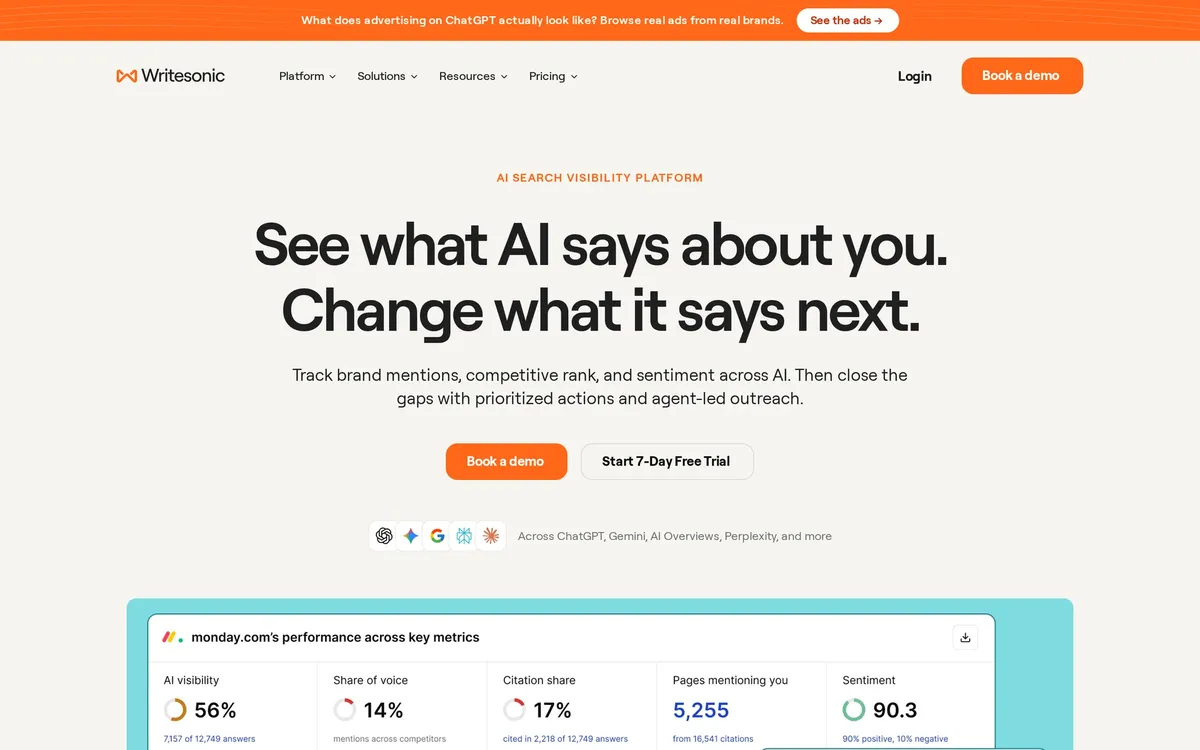
Writesonic combines AI search visibility monitoring with tools for creating articles and finding citation opportunities.
AI visibility and citations
After onboarding, its first report for rankup.so analysed 25 answers from 25 prompts across 3 AI platforms, and the Answers tab showed each prompt with the AI response, platform, topic and whether RankUp appeared.
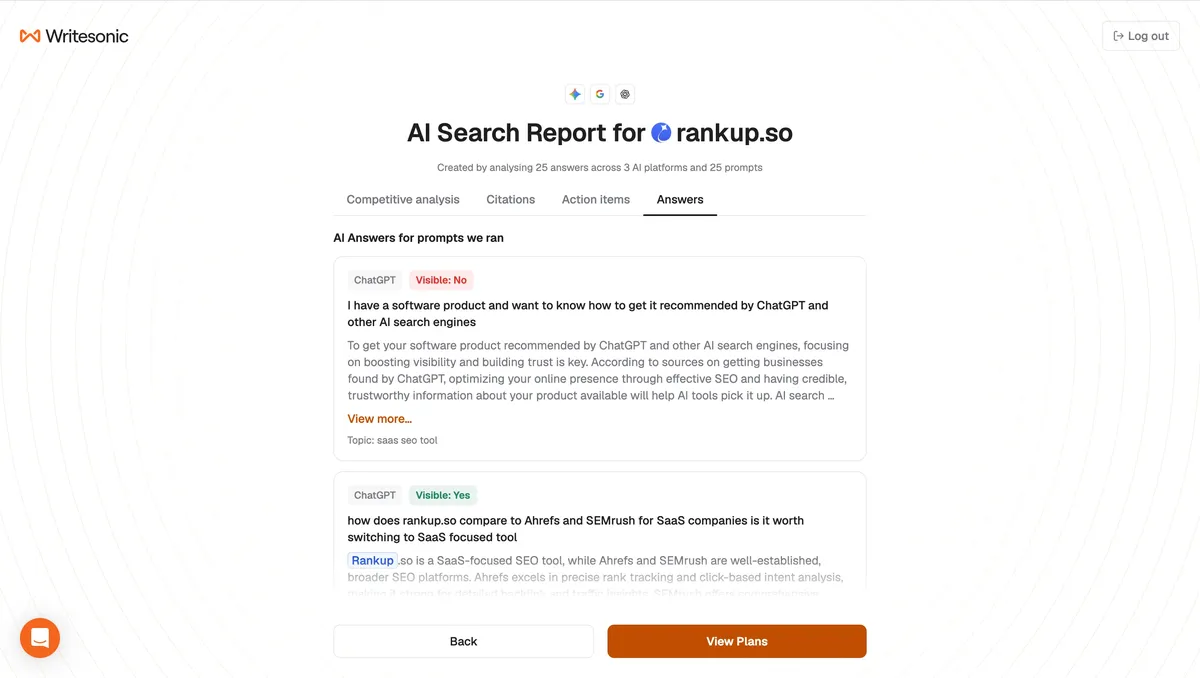
Its citation analysis shows the cited domain and page, the AI platform and the associated prompt or topic, so you can inspect the source behind a visibility gap.
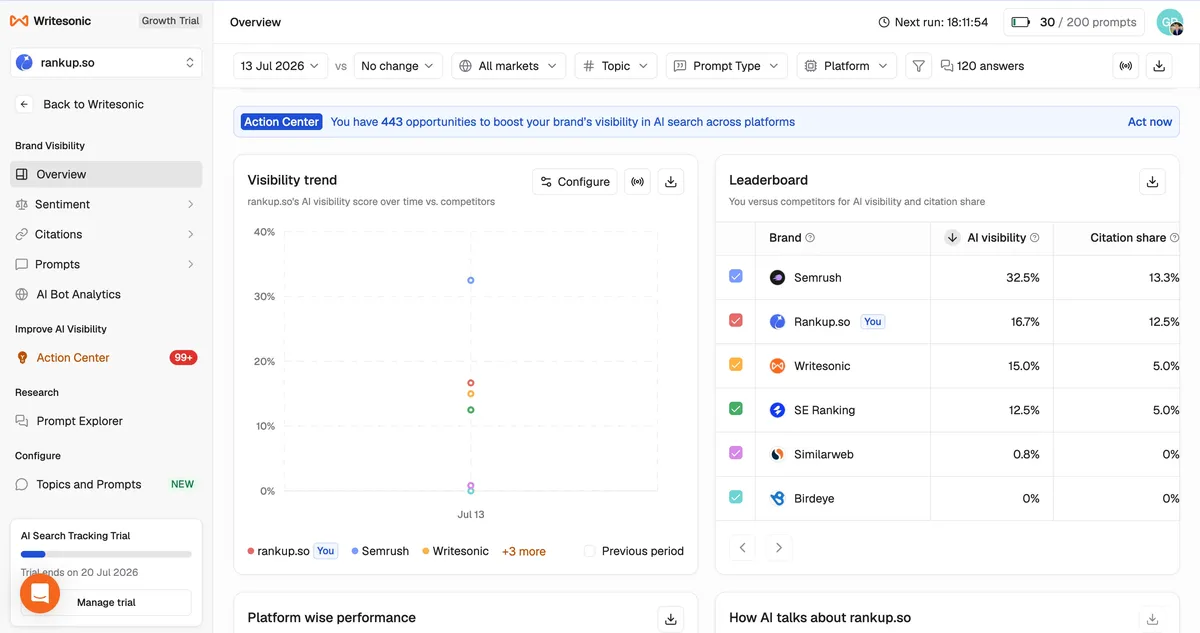
The leaderboard compares your AI visibility and citation share with the brands Writesonic picks for your niche.
For rankup.so it surfaced Birdeye, Similarweb, Semrush and SE Ranking, which are poor matches for its direct competitors, so the comparison is only as useful as the list you correct.
On plans with access to the relevant Action Center workflow, selecting Write on a citation-informed content opportunity opens Article Writer.
The Action Center groups recommendations into external mentions, content visibility and technical issues, with effort and impact ratings, and flags cited pages that mention competitors but leave out your brand. My workspace listed 443 recommendations, all still unresolved, because carrying them out stays with you.
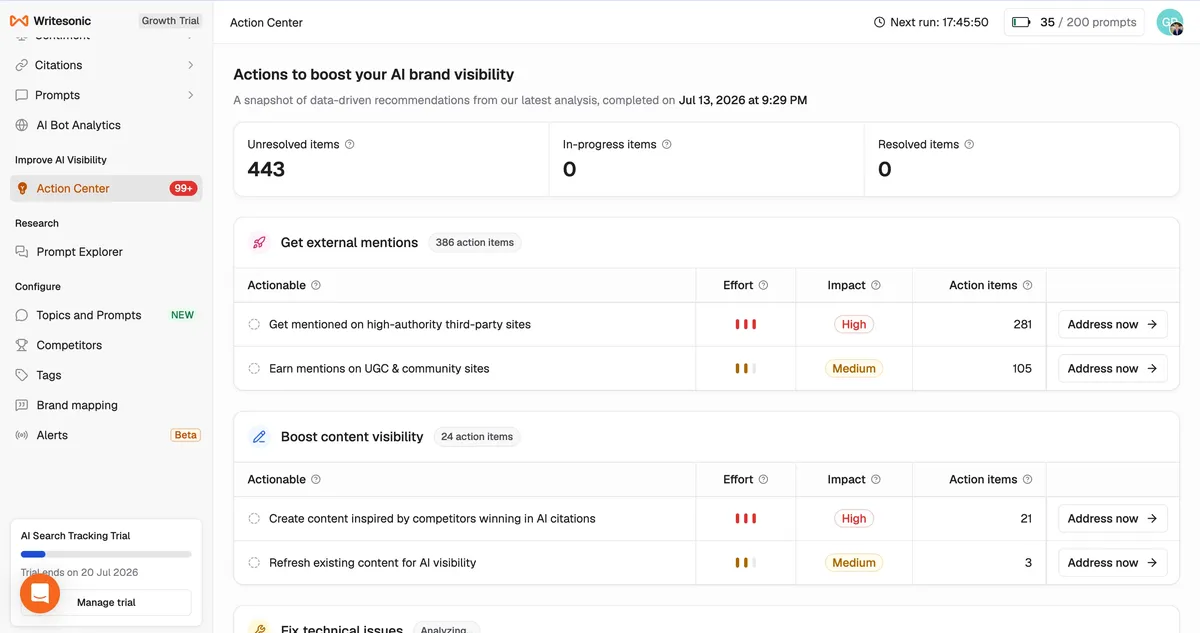
Growth includes a monthly trial of five on-page and five off-page actions, while full Action Center access requires Enterprise.
Article Writer
Before generating an article, I supplied a blog post and configured the writing context. The setup involved about 9 steps before generation, including selecting references, keywords and headings.
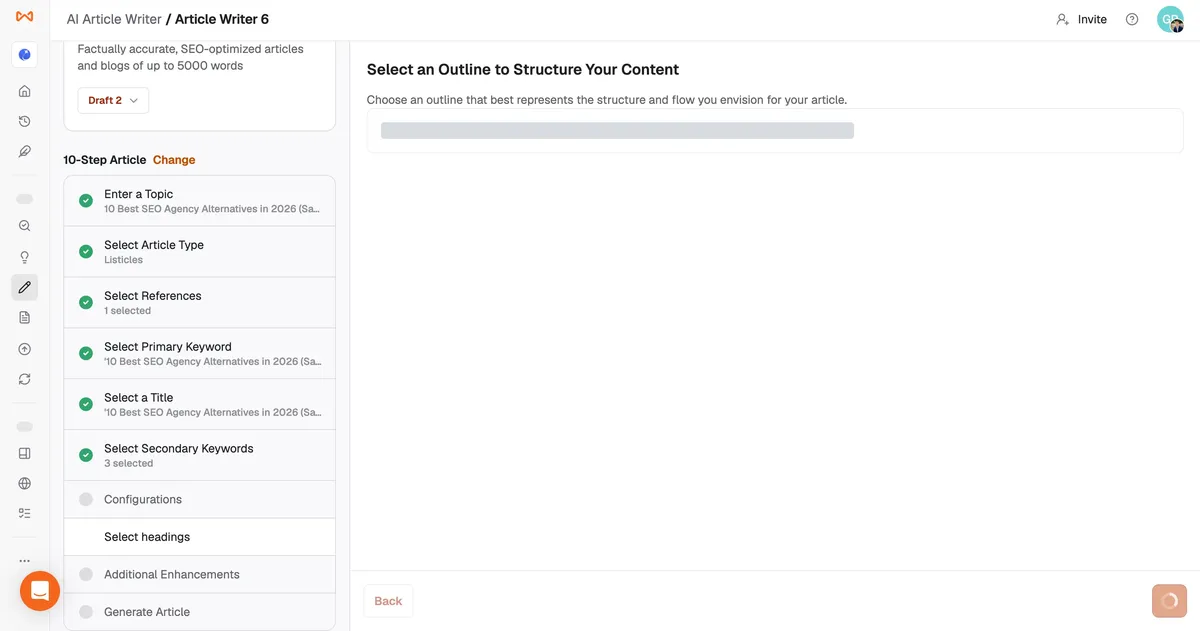
The resulting article lacked proprietary expertise, detailed implementation guidance and a distinct perspective. A product evaluation needs that material, along with the software’s pricing and fit, before publication.
Pricing
Writesonic’s listed plans include:
Starter: $79 per month, billed annually.
Growth: $399 per month, billed annually.
Enterprise: Custom pricing.
Self-service agentic workflows are limited to trial runs.
Best for
Writesonic fits if you want AI-answer monitoring connected to assisted article creation and can take on the writing setup and review. Starter, Basic and Growth each cover one market, which means one language-country combination.
Pros and cons
Pros
Answer inspection includes query fan-outs, so you can examine related searches alongside an AI answer.
Citation analysis identifies specific pages and topics, giving you a starting point for outreach.
The Action Center groups opportunities into external mentions, content and technical work.
Article Writer can turn an eligible content opportunity into a draft inside the platform.
Cons
Starter, Basic and Growth track ChatGPT, Gemini and Google AI Overviews, so you’ll need broader coverage if your buyers use other assistants.
Sentiment analysis requires Growth rather than Starter or Basic.
Growth includes a trial of 5 on-page and 5 off-page actions per month. Full Action Center access requires Enterprise.
Starter, Basic and Growth each cover one market, defined as a language-country combination.
The article I generated used unrelated blog thumbnails or statistics where product screenshots would have helped.
My generated article lacked proprietary expertise and detailed implementation guidance.
Writesonic's niche leaderboard suggested poor matches for my direct competitors.
My competitive-analysis table showed only rankup.so after I had added competitors.
Compared with Peec AI
Writesonic and Peec AI both surface visibility opportunities. Their monitoring coverage and follow-up work differ:
Comparison | Writesonic | Peec AI |
|---|---|---|
Engine coverage | Starter through Growth cover ChatGPT, Gemini and Google AI Overviews | 3 models of your choice on self-service plans |
Follow-up work | A citation-informed opportunity can open Article Writer on plans with the relevant workflow | Actions provide evidence, task steps and completion tracking |
Access to actions | Growth includes 5 on-page and 5 off-page trial actions monthly; full Action Center access requires Enterprise | Actions organise work for your team |
Writesonic fits a team that wants monitoring connected to assisted drafting and can put product knowledge and review into each draft. Peec AI fits a team that writes elsewhere and wants a task list beside its monitoring.
Which Peec AI alternative should you choose?
RankUp fits B2B SaaS founders and marketers who want visibility findings carried through to reviewed content and deals with cited sites.
The other alternatives suit different needs:
Profound fits enterprise teams that want AI visibility reporting alongside configurable marketing agents.
Semrush fits marketers who want AI visibility reporting alongside prompt research and an AI crawler audit.
SE Visible fits teams focused on inspecting AI answers and sharing visibility reports across projects.
AirOps fits teams that want to build and direct content workflows from AI search opportunities.
Frase fits teams that want AI visibility monitoring and assisted drafting in one workspace.
Search Atlas fits teams looking for AI visibility reporting within a broader SEO platform, including on-page audits and outreach research.
Writesonic fits teams that want to investigate citations and create articles in the same platform.
Check that your shortlist covers the assistants and buyer questions you need, then choose based on how much work your team has capacity to finish.
Why RankUp is the best fit for B2B SaaS
For B2B SaaS founders and marketers, being mentioned in an AI answer is a starting point.
Buyers also need pages that answer their questions, explain the product accurately and help them decide whether to sign up or book a demo.
SE Visible helps you inspect answers and find citation gaps, while Semrush adds prompt research and a crawler audit. Both inform the next decision, but Semrush's writing tools sit in a separate toolkit and SE Visible's agents are in beta.
Those approaches fit teams prepared to direct the work around their product.Profound's agents can draft pages and stage updates for approval. AirOps can turn opportunities into content workflows, with your team defining and refining how those workflows run.
Frase connects monitoring to drafting and proposed fixes for declining pages. Search Atlas adds on-page audits and outreach research, while Writesonic can turn citation opportunities into drafts on eligible plans. Writesonic reserves full Action Center access for Enterprise. Those approaches fit teams prepared to direct the work around their product.
RankUp brings that work together for B2B SaaS. Its agents use shared product knowledge in articles and page updates, and prepare deals with the sites AI answers cite. Search Console and PostHog add search and signup data alongside AI search monitoring, so you can assess what reaches buyers. You choose the actions and approve changes before publication.
Across these approaches, the buyer still needs to judge whether the content gives potential customers a useful understanding of the product.
RankUp brings that work together for B2B SaaS.
Its agents use shared product knowledge in articles and page updates, and prepare deals with the sites AI answers cite. Search Console and PostHog add search and signup data alongside AI search monitoring, so you can assess what reaches buyers.
You choose the actions and approve changes before publication.
To put that system to work on your site, start your 7-day free trial.
RankUp proposes a plan for your site first, and the trial gives you enough in-app balance to try the work that plan lists.

Author of the article
Georg Richard Aare
Georg is a B2B SaaS SEO specialist, an international keynote speaker on AI search and the co-founder of RankUp.
This article was created using: