

For SaaS and tech companies with English sites.
:quality(80))
9 Best B2B SEO Tools, Ranked by Use Case and ROI
:quality(80)) Georg Richard Aare
Georg Richard Aare For SaaS and tech companies with English sites.
After testing B2B SEO platforms on SaaS campaigns, I found that tool cost has little connection to finished output.
The useful question is what happens after the dashboard finds an opportunity. Some tools stop at data or recommendations, while others carry the work into briefs, drafts, publishing controls, or live-page improvements.
This guide ranks 9 B2B SEO tools by use case, workflow coverage, and likely ROI. You will see where each platform fits before you pay for another subscription.
P.S. Want the SEO content workflow handled in one place? Start your 7-day free trial. The trial is only available to SaaS and technology companies with English-language websites.
Quick picks by use case
The right B2B SEO tool depends on the job you need it to complete. These nine picks span connected content execution, broad SEO research, WordPress controls, focused competitor research, and content optimization.
Start with the workflow that creates the biggest bottleneck for your team. The table separates tools that produce research or guidance from those that handle publishing controls or carry content work through execution.
Primary B2B SEO use case | Quick pick | Why it is in this shortlist |
|---|---|---|
Content planning, writing, and updates for lean SaaS teams | RankUp | Turns keyword and competitor research into a prioritized plan, publish-ready articles, and written content updates. Your team supplies product expertise and reviews the work. |
All-in-one SEO platform for broad research and tracking | Semrush | Provides keyword data, competitive research, audits, reporting, and native AI visibility tracking. |
All-in-one SEO platform with backlink-led workflows | Ahrefs | Covers backlink research, keyword research, and rank tracking. |
All-in-one SEO platform for core SEO management | Moz Pro | Covers rank tracking, site audits, and link metrics. |
All-in-one SEO platform for teams needing broad coverage | SE Ranking | Combines rank tracking, competitor analysis, and reporting. |
WordPress SEO execution | AIOSEO | Manages meta tags, sitemaps, schema, and redirects inside WordPress. |
Focused keyword research for smaller teams | Mangools | Covers keyword research, rank tracking, SERP analysis, and backlinks. |
Competitive keyword and PPC research | SpyFu | Tracks competitor organic keywords, paid keywords, and ad history. |
Content briefing and optimization | Frase | Builds SERP-informed briefs and provides on-page guidance. |
What makes B2B SEO tools different?
B2B SEO tools are SEO platforms built for long sales cycles, multi-stakeholder buying journeys, high-intent niche keywords, and pipeline-focused measurement.
B2B buying groups are usually cross-functional. The CMO cares about pipeline impact; sales wants buying objections covered; technical reviewers look for integration details.
B2B pages need to match those buying roles across sales cycles that often last several months. A rank tracker alone cannot show which article influenced a demo request or opportunity.
Topical authority mapping: Uncover exactly what your site needs to cover to become a trusted resource.
Granular competitor breakdowns: Analyze page-level performance of your top competitors instead of relying on broad site-wide averages.
Qualitative LLM tracking: Analyze how ChatGPT and Claude mention your brand in relevant prompts rather than tracking thousands of irrelevant queries in bulk.
Measure B2B SEO performance by tracking commercial pipeline instead of traffic alone. Organic visits matter when analytics can connect the page to a demo request or sourced opportunity.
The organic conversion rate benchmark should be segmented by company size and sales motion, then checked against CRM data before an SEO tool gets credit.
B2B Difference | Why It Matters | Essential Capability |
|---|---|---|
Long sales cycles | Attribution takes several months | Multi-touch pipeline reporting |
Sophisticated buyers | Bulk AI content fails | Depth and brand alignment |
Niche keywords | Low traffic but high value | Long-tail search intent mapping |
Qualitative AI search | Bulk tracking is useless | Conversational mention audits |
How I evaluated these tools
I put every platform through the same test: does it fit the way a B2B team actually works, from the first keyword to the published page to the invoice at the end?
Workflow coverage: I checked whether each platform handles the full cycle from research to publishing.
Buyer journey intent: The software must map niche keywords to specific sales funnel stages.
Underlying data depth: Platforms need reliable database depth and Google Search Console integrations.
Actionable recommendations: The tool should generate a detailed SEO brief and prioritize your top three to five competitor URLs.
Total ownership cost: I counted subscription cost, per-seat pricing, and any extra software needed to publish content.
B2B SEO requires a connected workflow from keyword research to content optimization. The keyword set should include low-volume terms tied to buying research, such as integration pages and alternative pages.
I compiled these standards by testing the platforms in this shortlist. The table below shows what a useful tool should handle and where teams usually waste budget.
Priority | What Good Looks Like | Common Trap |
|---|---|---|
Workflow | Connects research to optimization | Buying separate point tools |
Intent fit | Maps keywords to funnels | Chasing meaningless traffic volume |
Data depth | Deep SERP and backlink data | Relying on shallow databases |
Actionability | Clear, automated briefs | Hard-to-read dashboards |
Cost | Fits lean team budgets | Hidden per-seat charges |
The 9 best B2B SEO tools
These nine tools cover the main B2B SEO jobs, from all-in-one research platforms to content briefing and WordPress execution. The sections below group them by workflow so you can compare tools that solve similar problems.
1. RankUp
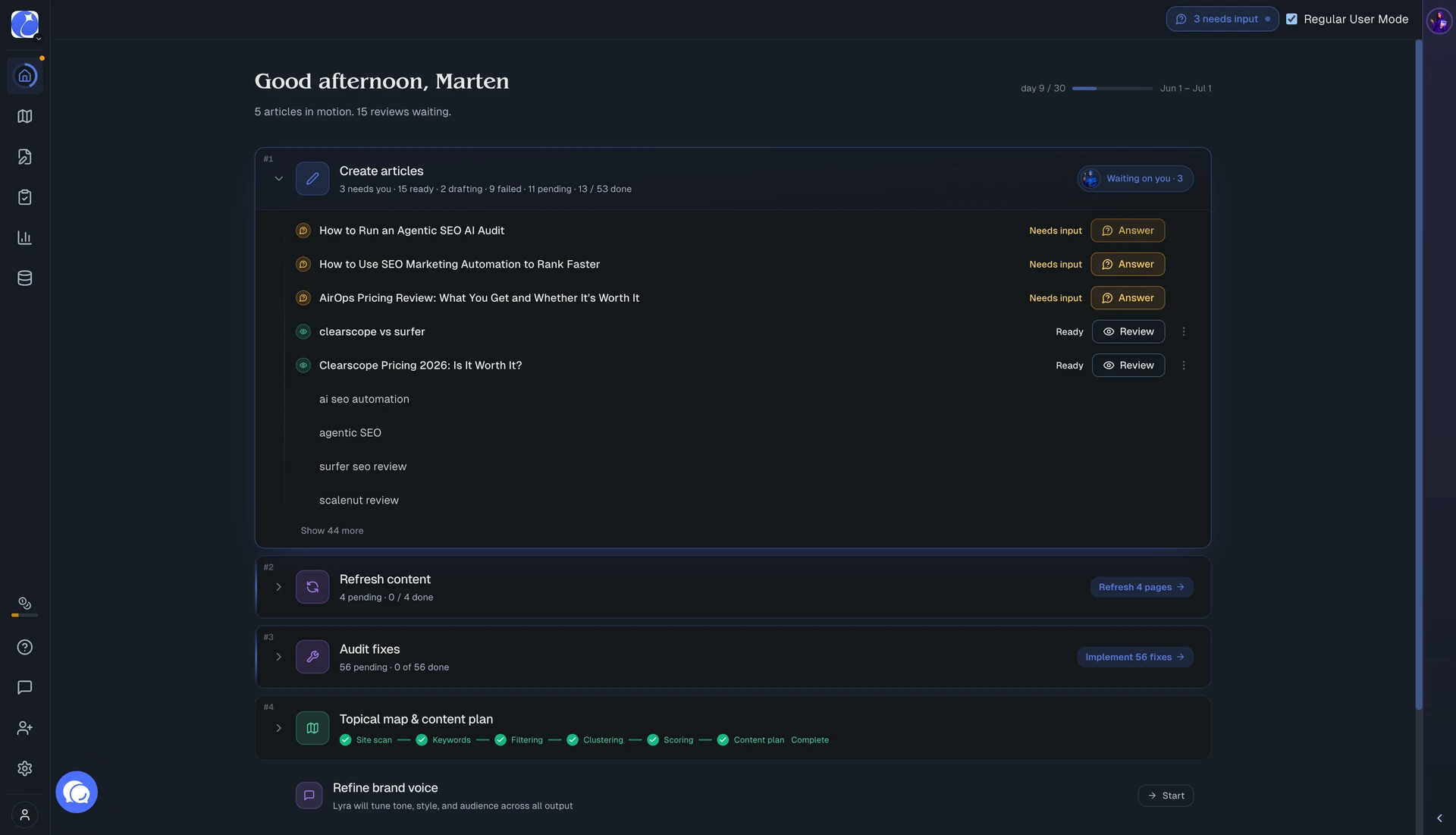
I built RankUp to solve a specific problem. SaaS teams want search visibility but lack the time or SEO expertise to run it.
RankUp carries the SEO and GEO work from strategy through content creation, site improvements, and performance analysis. You get the research and execution needed to make your product easier to find, understand, and consider during SaaS buyer research.
Agent | Job |
|---|---|
Magnus | Finds competitors, clusters keywords, and builds the content plan. |
Cedric | Drafts SEO articles from outlines using your brand voice and content brief. |
Lyra | Audits live pages, suggests updates, and sends approved work back into the writing queue. |
RankUp keeps keyword planning, article creation, and content improvements connected to the same product and market context. That gives you one reviewable workflow instead of rebuilding the brief at every handoff.
How the agentic content cycle works
The workflow starts with shared business context: your positioning, customer language, product knowledge, and style rules. That context informs the plan, draft, and later improvements.
Your knowledge base compounds as you review work and answer focused questions. Future articles can start with more of your product and market context already in place.
Phase 1: Opportunity discovery: Magnus identifies competitors, clusters keywords, and builds your prioritized content plan.
Phase 2: Asset creation: Cedric drafts the outline, prepares a content blueprint, and writes the article.
Phase 3: Editorial review: Your team reviews drafts, answers product questions, and approves the piece before publishing.
Phase 4: Library improvement: Lyra monitors performance, schedules updates, and routes new writing tasks back to Cedric.
Magnus: strategy, topical maps, and keyword research
Before drafting begins, RankUp researches high-intent demand, coverage gaps, and the topics worth publishing first. Magnus handles that strategy and planning work.
You get a prioritized topical map that shows which topics connect and what to publish next. The plan is built around buyer intent and your market context, not a raw keyword export.
Elena Daskalova, Senior SEO Consultant at Opullex, used Magnus to access thousands of relevant keywords and create clusters in minutes.
Sourav Prasad, SEO Project Lead at Boringmarketing.com, described the planning benefit this way:
"For SaaS businesses, this is a huge advantage. The tool takes the guesswork out of SEO planning and provides actionable insights in a fraction of the time."
Cedric: autonomous content production
Once a topic is chosen, RankUp researches the live search results, builds the outline and blueprint, and prepares a publish-ready draft in your voice. Cedric handles that writing flow, asking for your input only when missing expertise would materially improve the article.
Cedric drafts with 3 inputs:
Live search results for the target query
Your brand guidelines and style rules
Focused answers from your team when product knowledge is missing
You can see Cedric's writing workflow here:
Lyra: content audits and site-wide updates
For teams with content already live, RankUp finds pages that are slipping or outdated and turns the work into reviewable improvements. Lyra manages the update process and routes the writing work to Cedric.
You describe what needs changing in plain language. Lyra applies these updates across your site, turning audit items into reviewable edits.
See how Lyra manages content updates across a site:
Messaging refreshes: Update product descriptions or pricing details across dozens of pages at once.
Audit implementation: Convert static audit recommendations into written edits ready for approval.
Internal link optimization: Find new internal linking opportunities automatically based on newly published content.
Compounding context: a smarter knowledge base
Your product knowledge, customer language, style rules, and content history stay connected across the work. That gives every new plan, draft, and update a stronger starting point.
RankUp keeps a persistent knowledge base that expands as you add product expertise and review content. The context carries into future articles and site improvements.
As the database expands, future articles need fewer repeated explanations. The agents reuse your documented style rules and customer language.
Who RankUp fits best
RankUp fits SaaS founders and GTM, sales, and marketing leaders who want to improve search and AI visibility without becoming SEO or GEO specialists. It is especially useful when competitors appear in buyer research and you need a clear plan for earning qualified visibility.
Starting from scratch: You want AI tools and Google to surface your product during buyer research, but you do not know what to publish or which topics to prioritize.
Competitors get mentioned first: You see other SaaS products in category, comparison, or alternatives answers and need content that makes your product more eligible to be surfaced and understood.
Existing content needs attention: You have pages live, but they are not earning the rankings or qualified visibility you expected, and your team needs a practical update process.
RankUp is built for SaaS teams that want strategy and execution connected. If raw backlink data is your only need, a research suite may cover that narrower job.
RankUp is built for researched, context-rich content that your team can review before publishing. It fits teams that want the strategy, writing, and improvement loop handled in one place.
Want to see what RankUp can do on your site? Start your 7-day free trial to build your brand voice, knowledge base, and topical map, then put the system to work on an article or existing page.
All-in-one SEO platforms
All-in-one SEO platforms take a different approach. They bring keyword research, rank tracking, site audits, and competitor analysis into one subscription, starting with Semrush.
2. Semrush
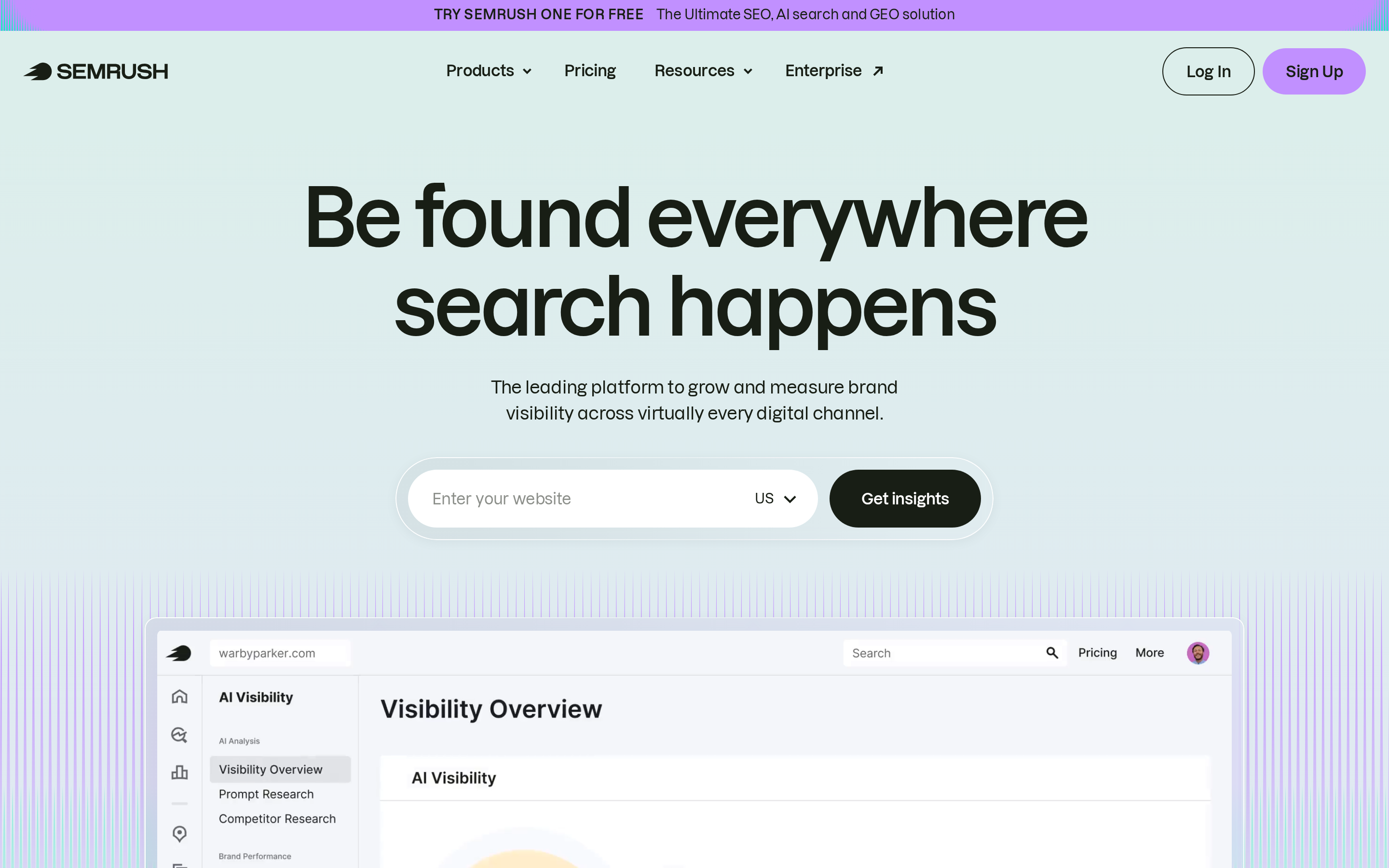
Semrush is a search marketing platform that combines SEO research, measurement, content optimization, and AI visibility tracking in one workspace.
Semrush is strongest as a research and measurement platform. Its AI visibility tools track custom prompts, AI sentiment, and brand performance across Google Search, ChatGPT, Perplexity, Gemini, and other supported AI results, while your team still owns the work that follows.
Strengths:
Auditing tools: Site Audit identifies technical and structural SEO issues that need manual follow-up.
Search and AI visibility: Organic keyword and PPC views help size a B2B market. Position Tracking, custom-prompt monitoring, AI visibility reports, and AI sentiment extend that research across conventional and AI search.
Where the workflow still needs ownership:
Human implementation: Semrush surfaces research, audit findings, and visibility signals, but a person or a separate execution process still has to decide priorities, write the changes, publish them, and handle technical fixes.
Plan limits and workflow complexity: AI visibility capacity scales by plan. Starter includes one AI brand-performance domain and 50 daily prompts, while Pro+ and Advanced increase daily prompt limits; the platform’s modules still require setup and interpretation.
Dimension | Semrush |
|---|---|
Core jobs | Keyword research, audits, rank tracking, competitor analysis, content optimization, AI visibility |
B2B relevance | Research and measurement across conventional and AI search |
Pricing signal | Starter, Pro+, and Advanced plans; capacity and add-ons vary |
3. Ahrefs

Ahrefs is an SEO suite built around competitive search data, especially backlinks and keyword research.
Ahrefs stands out here for backlink-led competitor research, with historical search data available on higher tiers.
What stood out in my review:
Backlink analysis: Site Explorer shows competitor backlink profiles and referring domains, which helps teams understand why competing pages are ranking.
Historical data: Advanced subscriptions include two years of historical search data for evaluating ranking movement over time.
Tradeoffs:
Tier restrictions: Entry-level plans limit historical data access to six months.
Research-heavy workflow: Ahrefs returns metrics and reports, then follow-up work still happens in briefs, tickets, or content updates outside the platform.
Dimension | Ahrefs |
|---|---|
Core modules | Site Explorer, Keywords Explorer, Site Audit, Rank Tracker, Content Explorer |
Primary use | Backlinks, keywords, audits, rankings, content discovery |
Pricing signal | $129/mo baseline in KB pricing snapshot |
4. Moz Pro
Moz Pro is an SEO suite for teams that want search metrics and technical tracking in one workspace.
Moz Pro centers its workflow on Domain Authority, keyword difficulty, crawl issues, and rank tracking.
Core signals:
Proprietary metrics: Domain Authority gives teams a directional view of link authority, but it should be read alongside traffic and conversion data.
Difficulty analysis: Teams can score keyword difficulty to evaluate B2B search terms.
Watchouts:
No guided execution: The software reports crawl issues, then the team still has to write tickets, update pages, or assign fixes.
Interface age: The navigation and reporting modules can feel dated during daily reporting work.
Dimension | Moz Pro |
|---|---|
Core jobs | Keyword research, audits, link analysis, rank tracking |
B2B relevance | Keyword difficulty, backlink analysis, marketing intelligence |
Pricing signal | Not provided in current inputs |
5. SE Ranking
SE Ranking is an SEO platform for teams that need rank tracking and reporting in one workspace.
SE Ranking puts rank tracking and reporting at the center of the product, with writing features available as a supporting layer.
Core uses:
Visibility monitoring: The system provides search rank tracking and broad tracking of organic search metrics.
Content support: Supplemental writing features help writers draft copy alongside primary ranking research.
Limitations:
Writing is secondary: The content features support drafting, while the platform's main depth remains tracking, audits, and research.
Analytical focus: The platform is built for SEO specialists who want reporting data and manual research workflows.
Dimension | SE Ranking |
|---|---|
Category placement | All-in-one SEO platform |
Source-backed scope | Tracking, audits, visibility monitoring, research workflows |
Pricing signal | Not provided in current inputs |
WordPress SEO execution
WordPress SEO execution covers the on-page work you handle inside the CMS. Plugins manage the meta tags, sitemaps, and schema that live with each post.
Tool category | Primary layer inside WordPress | Typical scope |
|---|---|---|
WordPress SEO execution | Plugin-level SEO controls | Meta data, sitemaps, schema, redirects, indexation settings |
6. AIOSEO
I put AIOSEO in the WordPress execution bucket because its work happens inside the CMS. The plugin manages technical on-page settings from the WordPress dashboard.
AIOSEO handles XML sitemaps, robots.txt settings, page-level schema, and URL redirects. Those controls are useful when WordPress is the source of truth for publishing.
Metadata control - Users can edit meta titles and descriptions directly inside the post editor.
Redirect management - The tool tracks broken links and sets up automated redirects for modified URLs.
Schema configuration - The plugin adds structured data to help search engines understand page content.
AIOSEO handles page-level settings inside WordPress. Site-wide content changes still require a separate workflow for deciding what to update and writing the revisions.
Strengths:
Native CMS integration - The plugin runs directly within the WordPress dashboard, so editors can adjust SEO settings while preparing a post.
Automated sitemaps - The system generates and updates XML sitemaps automatically as you publish content.
Schema markup - Users can implement structured data without writing custom code.
Weaknesses:
CMS limitation - The tool only works on WordPress sites and cannot support other platforms.
Manual scale - Changing metadata or content across hundreds of pages requires opening each post individually.
No keyword research - The plugin does not provide built-in competitor analysis or keyword tracking features.
Metric / Feature | AIOSEO Details |
|---|---|
Primary Use Case | Technical on-page SEO for WordPress |
Execution Model | Manual, page-by-page plugin settings |
Pricing | Multi-tier plans (details available on official site) |
Core Strengths | Sitemaps, redirects, schema, and meta tag controls |
Focused research tools
This group covers B2B SEO tools built mainly for keyword, competitor, and SERP research rather than full publishing workflows. The two entries below show the difference between a lighter keyword stack and a competitor-intelligence platform.
Tool | Primary research angle | Typical B2B use |
|---|---|---|
Mangools | Keyword discovery and SERP inspection | Long-tail topic validation and low-friction research |
SpyFu | Competitor keyword and ad intelligence | Rival monitoring and gap analysis |
7. Mangools
I treat Mangools as the lighter research stack in this list. It covers keyword discovery and rank tracking without the heavier interface found in broad SEO platforms.
The platform splits its features into five dedicated tools, including KWFinder and SERPChecker. These tools help teams find search terms and check competitor rankings.
KWFinder - Used to find and validate long-tail keywords with low search difficulty.
SERPChecker - Used to inspect page-level competition and search result structure.
SERPWatcher - Tracks daily organic keyword rankings for your tracked domains.
LinkMiner - Analyzes the backlink profiles of competing websites.
The monthly subscription tiers range from $29 to $129 per month. Choosing annual billing provides a 35% discount on these plans.
Strengths:
Affordable entry point - The starting price of $29 per month makes it accessible for small teams.
Low-friction interface - KWFinder and SERPChecker keep the main research actions visible, which shortens the learning curve for non-specialist teams.
Unified limits - API requests and standard lookups share a single usage pool, keeping the billing straightforward.
Weaknesses:
No content optimization - The suite lacks native tools for writing, auditing, or optimizing articles.
No automated workflows - Marketers must export research data manually to build briefs or content briefs.
Strict limits - High-volume research teams can consume their monthly lookup limits quickly.
Metric / Feature | Mangools Details |
|---|---|
Primary Use Case | Lightweight keyword and SERP research |
Monthly Pricing | $29 to $129 per month (35% off annually) |
Core Components | KWFinder, SERPChecker, SERPWatcher, LinkMiner |
Workflow Scope | Research-first, not full-cycle execution |
8. SpyFu
SpyFu is the competitor-intelligence tool I’d use to understand what rival domains have been buying and ranking for over time. Its workflow starts with a domain, then moves into organic keywords, paid keywords, and ad history.
Users can track a competitor's ranking history over years to see which rankings they maintain. This helps teams identify stable keyword opportunities rather than chasing temporary trends.
PPC ad history - Displays the exact ad copies and paid keywords competitors have bought.
Keyword gaps - Identifies search terms that multiple competitors rank for, but your site misses.
Backlink tracking - Pinpoints specific links that help competitors rank for commercial queries.
Strengths:
Historical data - Shows organic ranking movement and paid ad activity over time, which helps teams separate durable opportunities from short-term spikes.
PPC insights - Helps B2B teams discover commercial keywords by analyzing competitor ad spend.
Unlimited searches - Many plans offer unlimited data downloads and searches without strict credit caps.
Weaknesses:
No editor - Lacks on-page optimization tools or content briefing workspaces.
Narrow focus - Primarily useful for competitive intelligence rather than daily content management.
Data lag - Competitor ranking updates can sometimes lag behind real-time search engine results.
Metric / Feature | SpyFu Details |
|---|---|
Primary Use Case | Competitor search and PPC intelligence |
Monthly Pricing | Multi-tier plans (details available on official site) |
Core Strengths | Domain tracking, ranking history, and ad copy analysis |
Workflow Scope | Research and intelligence, not content publishing |
Content briefing and optimization
This category turns SERP research into usable outlines, briefs, and on-page recommendations. Frase is the entry here because its workflow centers on brief creation and content guidance, not broader SEO operations.
Tool | Primary focus | Typical output |
|---|---|---|
Frase | Content briefing and optimization | SERP-informed briefs and on-page guidance |
9. Frase
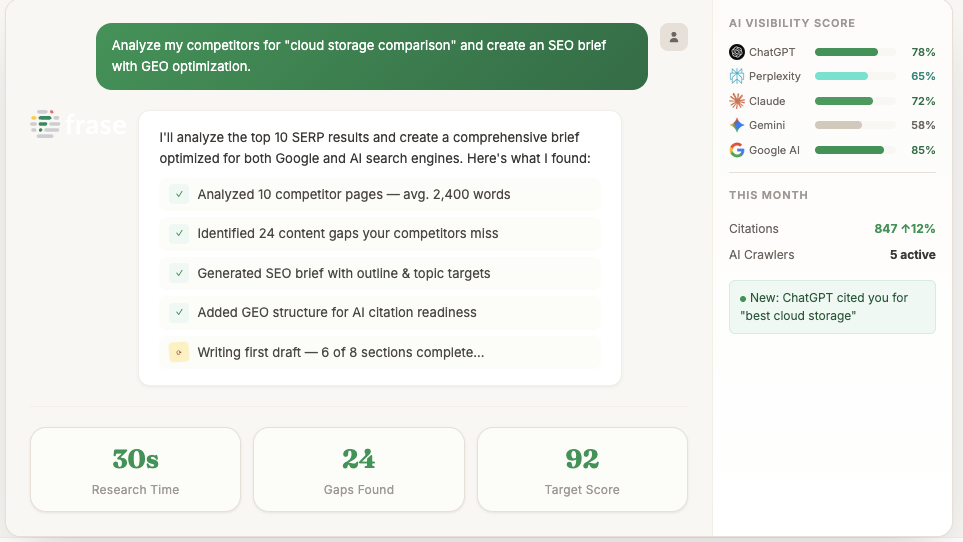
I classify Frase as a briefing and optimization tool because its best work happens before and during the draft. It reviews top search results, pulls common topics, and turns that research into outline guidance.
It generates briefs that prescribe semantic terms, target word counts, and keyword density. This helps writers align their drafts with existing search patterns.
Semantic recommendations - Pinpoints related terms and entities that should appear in the text.
Question discovery - Extracts questions from People Also Ask and forums to address search intent.
GEO optimization score - Evaluates how well content is optimized for citations in AI search engines.
While competitors like Surfer SEO focus on real-time recommendations, Frase emphasizes upfront brief creation. The tool is designed to speed up the pre-writing phase.
In my scoring, Frase loses ground when the job moves from one article to a full content program. Site-wide audits, refresh planning, and brand-specific enforcement are limited compared with tools built for ongoing content operations.
Strengths:
Fast brief creation - Automates the collection of competitor headers and user questions into structured outlines.
AI search tracking - Includes analytics that monitor brand visibility across Generative Engine Optimization models.
All-in-one editor - Integrates brief guidelines directly alongside the writing document.
Weaknesses:
Basic auditing - Does not offer deep, site-wide content refresh workflows for outdated pages.
Brief-heavy - The interface is tailored for teams that use rigid outlines rather than flexible writing styles.
No brand context - Lacks advanced tools to upload and enforce deep brand-specific guidelines in drafts.
Metric / Feature | Frase Details |
|---|---|
Primary Use Case | SERP-informed content briefing and optimization |
Core Outputs | Outlines, semantic terms, and question gaps |
Specialized Feature | GEO scoring and AI search visibility tracking |
Workflow Scope | Focuses on individual article creation and editing |
Comparison table: use case, data depth, pricing, and AI readiness
This table compares each tool's main use case, data depth, pricing, and AI readiness. Use it to check the broad fit before comparing the detailed entries above.
Tool | Primary B2B SEO use case | Data depth | Pricing | AI readiness |
|---|---|---|---|---|
RankUp | Strategy, content creation, and live-site improvements | Keyword, content, and performance context | 7-day free trial; custom ongoing plan | Content workflow built for Google and AI search |
Semrush | Keyword research, rank tracking, audits, optimization, and AI visibility | Broad SEO and AI-search performance data | Starter, Pro+, and Advanced plans; limits scale by plan | Native AI visibility across supported AI results, with prompt and domain limits |
Ahrefs | Keyword discovery, backlink auditing, and competitor analysis | Backlink and keyword data | From $129/month | AI-related features vary by plan |
Moz Pro | Domain Authority tracking and technical audits | Rankings and link-profile data | Pricing varies by plan | AI-related features vary by plan |
SE Ranking | Rank tracking and competitor keyword analysis | Keyword data and site audits | Pricing varies by plan | AI-related features vary by plan |
AIOSEO | On-page SEO and WordPress configuration | On-page structures and schema | Paid plugin plans | On-page AI features vary by plan |
Mangools | Keyword research and SERP tracking | Keyword and domain metrics | Paid monthly plans | Traditional search metrics |
SpyFu | Competitor organic and paid keyword research | Historical organic and Google Ads data | Paid monthly plans | Traditional search metrics |
Frase | Content briefing, structuring, and optimization | SERP-based outline data | From $49/month | AI-assisted drafting and optimization |
How to choose the right stack for your team
Evaluating B2B tools requires looking past simple feature lists. The right stack matches your team size, workflow complexity, system integration needs, and acquisition economics.
1. Workflow coverage
Building your stack starts with mapping your workflow from keyword discovery to content refreshes. You must decide which steps to run manually and which to automate with software.
While basic teams rely on simple CMS plugins, scaling your SEO operations eventually requires connecting tools through middleware like Zapier or n8n.
2. B2B data depth
B2B purchasing journeys are long and complex, requiring precise data targeting.
Two data capabilities matter most:
Niche search query mapping: Surfacing low-volume, high-intent keywords that match specific B2B buyer problems.
Programmatic structure scaling: Managing variable datasets and repeatable templates with internal linking structures to index pages at scale.
3. Actionable outcomes
Data is useless if your team does not know how to execute on it. A quality tool must translate search metrics into immediate actions.
Look for two execution assets:
Action-oriented audits: Reporting that links every identified issue to the exact page, the specific fix, and the business reason it matters.
Structured briefs: Outlines that compile target keywords, search intent, headings, on-page instructions, competitor data, and internal linking suggestions.
4. System integration
Your tools must fit together, not sit in isolated browser tabs.
Enterprise teams lean on tools like Semrush or Ahrefs that offer API access to ranking data. That lets you pull rankings automatically and pipe them into a dashboard like Looker Studio instead of exporting spreadsheets by hand.
5. Real cost of the stack
Tool costs vary by plan and usage. The total cost includes subscriptions plus the time your team spends turning reports into briefs, drafts, and updates.
The average B2B SaaS customer acquisition cost sits around $728. Your tool stack only earns its keep if it lowers that number or brings in more qualified pipeline.
Criterion | What good looks like | Common trap |
|---|---|---|
Workflow coverage | Software automates tedious steps while you focus on brand expertise. | Buying three overlapping subscriptions that still leave execution gaps. |
Data depth | Surfaces niche, low-volume commercial keywords with clear search intent. | Paying for broad dashboards that offer zero actionable B2B insight. |
Actionability | Provides clear briefs and page-level fixes that are ready to implement. | Receiving generic reports that require manual interpretation. |
Integrations | Data flows cleanly into Google Search Console, CRMs, or automation middleware. | Discovering complex API setups or OAuth blocks that halt your workflow. |
Total cost | The total monthly software spend actively lowers your customer acquisition cost. | Evaluating individual tool licenses instead of the true cost of managing multiple systems. |
Which tools overlap, and which should you pair?
Understanding tool overlap prevents you from wasting budget on duplicate features. True efficiency comes from pairing a data-rich foundational platform with specialized execution tools.
1. High-overlap categories
All-in-one platforms like Semrush, Ahrefs, Moz Pro, and SE Ranking share substantial feature overlap. They all crawl websites, track rankings, and maintain extensive keyword databases.
Stacking multiple broad suites together wastes your software budget. Instead, keep a single data-rich platform as your foundation and pair it with specialized systems for execution.
2. Strategic tool pairings
The right integration fills gaps in your data and workflows, turning raw metrics into clear strategic direction.
Three pairings that tend to work:
Analytics and search console: Combine Google Analytics with Google Search Console to map actual user behavior against organic search metrics.
On-page specialists and dashboards: Pair optimization tools like Surfer SEO with analytics platforms to measure how content updates impact traffic.
Research suites and execution systems: Use one broad suite for keyword, competitor, and visibility research. Add an execution system when you need those priorities turned into content and live-page improvements.
3. Transitioning to end-to-end automation
An end-to-end content system reduces the handoffs between research, writing, optimization, and publishing. The practical test is how much finished work reaches your review queue.
RankUp carries keyword planning, outline creation, blueprinting, drafting, and live-site improvements through a connected workflow. It uses the research context to produce work your team can review rather than leaving the next steps as reports and recommendations.
Your team reviews the output and steps in when missing brand expertise or factual verification would materially improve the article.
The SEO content team that does the work: RankUp
B2B SEO gets easier when your plan and content share the same product and market context. RankUp turns that into execution, so you can build better rankings and stronger AI-search visibility while your SaaS buyers research their options.
RankUp gives you a coordinated SEO and GEO content team that carries the work from strategy through creation, updates, and performance analysis:
Magnus plans clusters.
Cedric writes drafts.
Lyra keeps published pages updated.
The knowledge base keeps your style guide, product context, and customer language connected across the work. That means new drafts and site improvements start with what RankUp has already learned about your business.
I would replace the handoff-heavy setup with this workflow:
Traditional setup: Keyword research, briefs, and drafting live in separate places, so context gets rewritten at each handoff.
RankUp setup: Specialized agents carry the plan from keyword cluster to publish-ready draft, using the same saved brand context.
If your team is juggling five tools, I would start with a roadmap before adding another subscription.
Guardian Home ran that agent-led setup instead of stitching separate tools together. Co-founder Alonso Solis says RankUp produced about 55 blogs and landing pages for them in roughly three months.
Leads started arriving around the first month, and he now counts organic search as one of Guardian Home's main pipeline channels.
Ready to turn that plan into work on your site? Start your 7-day free trial. Your onboarding builds a brand voice, knowledge base, and topical map from your site.
FAQs
How much should I budget for B2B SEO tools?
I would budget by workflow stage, not by a fixed monthly range. A lean stack covers tracking and research, while enterprise suites often use sales-led pricing.
For a B2B team, I separate subscription cost from editing cost. A cheaper tool still gets expensive when someone turns exports into briefs and updates by hand.
Budget path | Typical budget | What you get | When it makes sense |
|---|---|---|---|
Research only | About $50 with RankUp, or $29 to $129 per month for a budget research tool | In RankUp, the keyword research and content strategy workflow costs $35, with roughly $15 more for an agent-assisted strategy iteration. | Choose this path when you only need the research and are willing to handle briefs, writing, publishing, and updates yourself. |
Content creation | $300 to $400 with RankUp | Keyword research, content strategy, and finished content creation. | Choose this range when your priority is producing new content and you have little existing content to audit or refresh. |
Content creation, audits, and refreshes | $400 to $500+ with RankUp | New content plus auditing and refreshing a larger set of published pages. | Choose this range when RankUp needs to maintain more of your existing content alongside creating new pages. |
Enterprise SEO infrastructure | $2,500+ | Large datasets, custom APIs, governance controls, and advanced technical SEO capabilities. | Choose this path when an enterprise team needs infrastructure and oversight across complex sites, regions, or business units. |
Are B2B SEO tools suitable for small businesses?
Yes. I would start small when the tool matches your team's writing capacity and publishing rhythm.
In my experience, a small B2B team gets more from one tool someone actually uses than from a stack no one maintains.
Evaluation Factor | Suitable Path | Unsuitable Path |
|---|---|---|
Budget | Affordable, focused tools like Mangools ($29/mo). | Multiple premium subscriptions that cost hundreds monthly. |
Team Capacity | Beginner-friendly platforms requiring minimal training. | Complex databases requiring a full-time SEO specialist. |
Execution | Automated workflows that generate blueprints quickly. | Heavy manual optimization that leads to founder burnout. |
Can B2B SEO tools integrate with other marketing platforms?
Yes, but I would check the specific integrations before you buy. Useful connections move SEO data into the places your team already works.
The connections I look for remove manual copy-paste between:
Google Search Console or GA4
The CMS or doc workspace
The CRM or reporting dashboard
Integration Category | Common Endpoints | Operational Benefit |
|---|---|---|
Analytics & Reporting | Google Analytics (GA4), Google Search Console (GSC), Looker Studio | Automatically maps rankings and organic traffic to dashboards. |
CRM & Automation | HubSpot, Salesforce, ActiveCampaign, Slack | Alerts sales teams to high-intent leads and triggers follow-ups. |
CMS & Publishing | WordPress, Contentful, Google Docs | Exports optimized drafts directly to your content management system. |
Middleware | Zapier, custom Connect APIs | Syncs SEO platforms with custom internal marketing databases. |
How do B2B SEO tools help with content strategy?
B2B SEO tools help content strategy when they turn search data into a publishing plan. That is the workflow I care about.
In RankUp, Magnus handles the planning layer:
Clusters related queries by intent
Maps topics into a topical authority plan
Turns the plan into a Content Blueprint
Strategy Phase | How SEO Tools Help | Agentic Automation (Magnus) |
|---|---|---|
Topic Research | Grouping keywords by search intent. | Automatically clusters queries and maps topical authority. |
Prioritization | Identifying high-value keywords first. | Calculates priority scoring based on intent and commercial value. |
Brief Creation | Building outlines with target keywords. | Instantly drafts a comprehensive Content Blueprint for writers. |
Execution | Tracking production status across stages. | Schedules content runs and manages the editorial queue. |
:quality(80))
Author of the article
Georg Richard Aare
Georg is the co-founder of RankUp and an SEO nerd who spends (almost) every waking minute refining his craft and sharing his learnings. When he’s not behind his computer, which is rare, you’ll find him in the gym doing bench (never legs) to clear his mind.
This article was created using: