

For SaaS and tech companies with English sites.
:quality(80))
SaaS SEO Strategy: Rank, Get Recommended, Drive Pipeline
:quality(80)) Georg Richard Aare
Georg Richard Aare For SaaS and tech companies with English sites.
You can publish consistently and still watch competitors own high-intent Google results and appear in ChatGPT answers.
A volume-led SaaS SEO strategy pushes commercial queries and AI-search demand down the backlog. A useful strategy instead ties each topic to commercial intent, qualified pipeline, and revenue.
This guide shows how to find, prioritize, publish, and improve pages for Google and AI discovery.
What makes SaaS SEO different?
SaaS SEO focuses on qualified pipeline and recurring revenue across a subscription software buying journey that often spans several visits.
That changes how you plan and measure content. A buyer may discover a guide, return through a comparison, search your brand later, and request a demo without converting during the first visit.
:quality(80))
Attribution spans multiple visits: Sessions alone cannot show SEO's contribution when buyers encounter organic content across several touchpoints before becoming an opportunity.
Evaluation content carries commercial weight: Comparisons and use-case pages help buyers judge fit, while proprietary product data and benchmarks make those pages harder to copy.
Product architecture creates indexing risk: JavaScript rendering and headless content systems can hide important content when search bots cannot access the complete page.
The SaaS SEO strategy framework
A SaaS SEO strategy links buyer demand to pipeline. It guides content choices using commercial intent, product relevance, and revenue impact.
Use five connected principles: identify the buyer decision, test its commercial value, add defensible evidence, build broader authority, then measure and maintain the result.
:quality(80))
Align content with the buyer journey. Assign educational, navigational, and transactional queries distinct roles across the software evaluation process.
Prioritize commercial opportunity. Lead with buyer value and product relevance, using competitor evidence and keyword difficulty as context rather than letting search volume or difficulty scores drive the plan.
Create defensible content. Add product knowledge, original analysis, or firsthand evidence that gives the reader something unavailable in a generic summary of ranking pages.
Build authority across Google and AI discovery. Cover the product's category with enough depth and credible support for search engines and AI systems to understand where the company belongs.
Connect publishing to pipeline and maintenance. Define the business outcome each content group supports, then revisit pages as demand, rankings, and product positioning change.
How to find high-intent keyword opportunities
Finding high-intent keyword opportunities starts with buyer language. Filter each query for SERP intent and product relevance.
Use this four-step research sequence:
:quality(80))
Collect the buyer's words. Search a product problem in Google, then record autocomplete and People Also Ask phrasing. Keep modifiers that reveal use cases or objections.
Add prompt language. Seed ChatGPT, Claude, or Perplexity with phrases from sales calls, then test category, alternatives, comparison, and use-case prompts. Record recurring entities and follow-up questions, not one answer as demand proof.
Check the SERP. Search each candidate and inspect the ranking formats and tasks resolved. Comparison-heavy results suggest evaluation intent, while product or signup pages often signal transactional intent.
Test product relevance. Keep queries your SaaS can credibly solve or belong in. Then confirm demand through Search Console impressions, keyword estimates, autocomplete, paid-search evidence, sales-call frequency, or competitor coverage.
For a support SaaS, “reduce ticket backlog” might become “best AI ticket-routing software.” Keep it if the SERP favors comparisons and the product automates routing; reject it if results address staffing instead.
Map the buyer journey stages
Map the buyer journey by prioritizing commercial and transactional searches where your SaaS should be recommended. Use discovery and evaluation labels only when the label changes the page you create.
Classify each query by the decision the searcher is making, including branded searches that help existing prospects continue their evaluation:
Commercial evaluation: Queries containing “best,” “alternatives,” “vs,” “reviews,” or feature requirements usually need a comparison, alternatives page, or product-led guide.
Transactional action: Searches for pricing, a demo, a trial, or a named integration usually belong on a product, pricing, or integration page.
Branded navigation and switching: Searches for “[Product] pricing,” reviews, alternatives, comparisons, login, documentation, or integrations should lead directly to the relevant evaluation or destination page.
Problem discovery: “How to” questions and People Also Ask queries can support authority, but keep them close to a problem your product solves.
The label earns its place only when it guides execution. “Best customer support software for SaaS” calls for a commercial comparison, while “how to reduce support ticket backlog” calls for an educational page with a relevant product path.
Record the intended page type and next action beside the query. Leave scoring for the backlog review, where demand and business value can be compared across clusters.
Organize keywords into topical clusters
Organize keywords into topical clusters by grouping queries that share a buyer problem, SERP intent, and product capability under one commercial pillar.
Start with a pillar tied to a capability you sell. Split a keyword when its dominant format, buyer task, conversion path, or ranking URLs differ materially from the rest of the cluster.
For a customer-support SaaS, one cluster could be:
Pillar: “AI customer support software,” a commercial category page
Comparison: “AI chatbot vs live chat,” an evaluation page
Use case: “automate support ticket routing,” a product-led guide
Integration: “customer support software for Slack,” an integration page
Assign one primary query and supporting variants to each URL to prevent cannibalization. Link pages wherever the next buyer question continues, including between supporting pages, rather than sending every path only to the pillar.
How to prioritize your content backlog
Prioritize your content backlog by pipeline contribution and fit with your product. Use current performance as evidence, and use keyword difficulty only as an effort check or tie-breaker.
Treat each backlog item as one page decision. Use sales-call frequency, conversion proximity, capability fit, assisted conversions, impressions, and cluster dependencies as evidence across these four passes:
:quality(80))
Start with pipeline impact. Move evaluation and purchase questions above topics with a weak connection to revenue.
Check product and topical relevance. Favor pages where your expertise belongs and where the topic closes an important cluster gap.
Use current performance as evidence. Existing impressions, rankings, links, or visible decay can make a refresh more urgent than a new page.
Assign the page action. Mark each item as consolidate, refresh, create, or defer before setting the final order.
Magnus turns planning inputs into an ordered AI-built content plan aligned with demand and product direction, with each topic's priority and status visible.
Build an opportunity scoring table
An opportunity scoring table compares each backlog item’s business, topical, and search value. The highest score leads unless a dependency, launch, or product priority justifies an override.
Pipeline impact receives double weight so high-volume, weak-fit topics cannot dominate. A direct-evaluation topic scoring 3, 3, 2, 1, and 3 totals 15 out of 18 after weighting.
Field | Weight | Score 1 | Score 2 | Score 3 |
|---|---|---|---|---|
Expected pipeline impact | 2x | Weak buying connection | Assists product evaluation | Direct evaluation or purchase intent |
Product relevance | 1x | Adjacent to product | Product supports part | Product directly solves need |
Cluster coverage | 1x | Isolated supporting topic | Fills a coverage gap | Core page or cluster connector |
Current performance | 1x | No page or search signal | Existing page with weak signal | Clear rankings, impressions, or decay |
Recommendation fit | 1x | Product mention feels forced | Product fits part of answer | Product belongs among recommendations |
Multiply the pipeline score by two, then add the remaining scores for a total out of 18. Break ties by pipeline impact, followed by recommendation fit.
Keep search volume beside the score as demand context. Use keyword difficulty only after setting priority, when you estimate effort and sequence items with similar business value.
Page consolidation vs. new page creation
Page consolidation merges overlapping content into one stronger URL. Refresh an existing page when it matches intent, and create a new page only for an uncovered intent.
Apply the decision in this order:
Consolidate: Two URLs satisfy the same intent. Keep the better intent match, conversion history, links, ranking stability, or URL; merge unique material, update internal links, and redirect the weaker URL.
Refresh: One URL already matches the intent and has recoverable signals such as rankings or impressions, but the answer is stale or losing visibility.
Create new: The searcher needs a distinct answer that no current page provides. The new page should close a cluster gap and link naturally to the related pillar or supporting page.
Defer: The topic has weak pipeline impact, limited product relevance, and no clear role in a priority cluster.
Handle consolidation or refresh work first when it protects existing value or prevents competing URLs. After consolidation, confirm the retained page is indexed, internal links point to it, and the old URL redirects correctly.
Before the trial, RankUp analyzes your site and proposes a plan tailored to your priorities. Start your 7-day free trial to execute it through content creation and refreshes.
(For SaaS and tech companies with English-language sites only.)
How to create and structure SaaS content
SaaS content creation starts by deciding which commercial queries and AI prompts should recommend your product. Use the live SERP and independent intent analysis to choose the page type and next action.
Build each page in four steps. The sequence separates SERP evidence from your own intent judgment, so ranking formats do not dictate the page by default:
:quality(80))
Define the target decision. Name the search or prompt where your product should appear, such as a category comparison or use-case recommendation.
Inspect the live SERP. Record the page formats that rank and the task each result resolves.
Check the intent yourself. Decide what the searcher needs to learn, compare, or do instead of copying the ranking pages blindly.
Design the page and conversion path. Cover the direct answer, evaluation criteria, product evidence, conditions, relevant alternatives, and next action. For SaaS, include screenshots, integrations, pricing conditions, security, implementation, and fit where relevant.
Suppose listicles rank for an automation query, but buyers need implementation detail. Use the comparison evidence, then add a workflow, integration requirements, limitations, and a trial or demo path instead of copying the list format.
Need to hand those decisions to a writer? Writer-ready SEO briefs preserve intent, evidence, and conversion requirements.
Match page types to search intent
Match page types to search intent by pairing the searcher’s task with the format that resolves it. Treat the SERP as evidence, then use your own judgment when the ranking formats do not fully fit the query.
Searcher’s task | Best starting format | What the page must prove |
|---|---|---|
Learn a process | Blog post or guide | Clear steps and expert judgment |
Compare category options | Comparison or list page | Decision criteria and material differences |
Compare named products | Head-to-head page | Evidence for each tradeoff |
Solve a specific use case | Use-case page | Relevant workflow and product fit |
Understand one capability | Feature page | How the capability works |
Buy or start now | Landing or pricing page | Offer, fit, and next step |
Once the format is clear, structure the page around five requirements:
Direct answer: Resolve the main question near the top before adding context.
Original product evidence: Back each product claim with the exact screenshot, video, or documented workflow that proves it. A general dashboard cannot support a narrow feature claim.
Expert insight: Add a founder or subject-matter expert’s judgment where the searcher needs interpretation.
Internal links: Connect the page to supporting topics and the product page that continues the decision.
Next logical action: Give the visitor one step that matches the decision the page just helped them make.
Map CTAs to the buyer journey
Choose the initial CTA from the decision a visitor can make after reaching the page. Then validate that choice with page behavior and conversion evidence, changing it when visitors consistently take another path.
ChatGPT, Claude, Perplexity, and Google AI Overviews can answer simple informational questions without directing the searcher to a source page.
Use conditional CTA paths instead:
The visitor is ready to act: Send a pricing or purchase-intent search to a trial for self-serve products, or to a demo or pricing conversation for sales-led products.
The visitor is still evaluating: Move a comparison visitor to the use-case or product page that resolves the next fit question.
The visitor is learning: Move an educational-guide visitor to a product explainer when a purchase ask would be premature.
The answer happens in AI search: Treat a recommendation or citation as a potential discovery touchpoint. Call it assisted influence only when referral or later journey data supports the connection.
Judge CTA fit from observed behavior on each page rather than borrowed benchmarks. A page can influence a later conversion even when the original organic visit receives no last-click credit.
Funnel labels can document the path after evidence exists. They should remain secondary to the searches and prompts where your product needs to be recommended.
How to build authority and AI citations
Build authority and AI citations by earning relevant third-party mentions, publishing original evidence, and creating concise sourceable answers to buyer questions.
Authority grows when an outside publisher has a specific claim it can check and cite. A documented methodology turns proprietary product or customer data into evidence beyond the company's product copy.
:quality(80))
Distribution and page structure
Partner directories and editorial coverage build external authority. On your pages, concise answers improve sourceability only when differentiated evidence, credible support, and topical relevance make the underlying claim worth citing.
Use each method for a distinct evidence gap:
Original research: Publish a specific finding with a defined dataset, collection period, methodology, and terms that publishers can verify on a stable page.
Partner and integration listings: Earn accurate product references on partner directories, marketplaces, and integration pages.
Listicle outreach: Target comparison pages where the product genuinely fits, then supply verifiable positioning and evidence instead of requesting placement indiscriminately.
Guest contributions and digital PR: Pitch expert commentary, company data, or a timely story that earns editorial coverage rather than a copied product description.
Broken-link outreach: Use this selectively when a relevant publisher has lost a source and your live resource directly replaces its evidence.
Concise direct answers: Open important sections with a complete answer, then support it with evidence and context. Extraction-friendly wording cannot substitute for authority.
How to measure SaaS SEO success
SaaS SEO measurement connects search and AI visibility to qualified conversions, assisted pipeline, and revenue. Page health provides an early warning when visibility or conversions begin to decay.
Use this hierarchy to connect early visibility signals to business outcomes:
Level | What to measure | What it tells you |
|---|---|---|
Search visibility | Queries, impressions, clicks, average position | Whether demand and rankings are moving |
AI visibility | Recommendations, citations, cited pages | Whether AI answers surface your brand |
Qualified conversion | Demo, trial, or signup with fit signals | Whether content attracts potential buyers |
Assisted pipeline | Content touches before opportunities and revenue | Whether organic influenced later conversion |
Page health | Traffic decline, query mix, intent match | Which pages need investigation |
:quality(80))
Assisted-pipeline reporting usually requires defined conversion events, consistent source handling, an attribution window, and identity stitching between analytics and the CRM. Document these rules before interpreting content influence.
Use a fixed buyer-prompt set across the same models and repeat the checks. Record brand mentions and cited URLs separately from AI referrals, then treat repeated observations as trends rather than stable rankings.
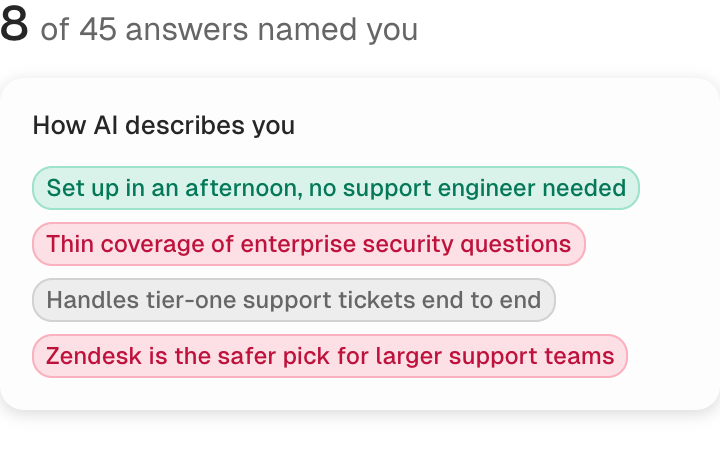
A shared dashboard helps compare search visibility, AI-referral traffic, conversions, and page-health changes without treating those measures as interchangeable:
:quality(80))
Visibility is an early indicator. Qualified pipeline and revenue determine whether the strategy is attracting buyers who can become customers.
Track pipeline and assisted conversions
Track pipeline by defining the conversion events that matter. Then record qualification signals and content touches before an opportunity, matching each definition to your funnel and ideal customer profile.
Qualification signals can come from three points in the journey:
Form details: A demo request can capture the buyer's company and stated need.
Website or domain: The submitted site can reveal the business model and company fit.
Product conversion: A trial or signup records intent, while your account data determines whether the lead qualifies.
RankUp asks for one website field because a submitted domain can indicate SaaS fit. Capture the smallest field that reliably identifies fit, and align form collection, analytics, and retention with your privacy requirements.
Keep direct and assisted attribution separate:
Attribution view | What receives credit |
|---|---|
Direct conversion | Organic visit converts in the tracked session |
Assisted conversion | Content is viewed before a later conversion elsewhere |
A buyer may discover an article through Google and request a demo later through another channel. Report organic-sourced conversions, organic-assisted opportunities, qualification status, and pipeline value when CRM data supports it.
Audit for content decay and intent drift
Audit for content decay when a page loses search visibility or stops matching the intent behind its queries. Start with the decline, then determine whether demand, rankings, or the SERP itself changed.
Use this four-step review:
Flag the decline. Compare clicks or impressions with the page's normal variation over the same reporting period. Account for seasonality and separate sitewide demand changes from page-specific losses.
Inspect the query mix. Compare the queries that lost impressions or clicks with the terms still bringing visibility.
Check current SERPs. Review the ranking page formats and questions answered to see whether search intent now favors a different response.
Validate the update. Compare impressions, clicks, average position, and qualified conversions against the pre-update baseline.
Before rewriting, check indexing, canonicals, redirects, rendering, internal-link changes, and accidental noindex rules. Intent drift exists when the page answers an older question, uses the wrong format, or lacks the depth current results provide.
Match the action to the cause: refresh stale evidence, restructure for changed intent, consolidate overlapping URLs, fix access or indexing failures, and reset expectations when category demand has declined.
Conversion recovery depends on traffic quality and the page's role in the funnel. Judge the update against the qualified-conversion and assisted-pipeline definitions from the preceding section.
Where manual SEO playbooks break down
Manual SEO playbooks are fragmented, labor-intensive workflows that slow SaaS teams as content volume, data, and coordination needs grow.
Manual work can produce excellent SaaS content. The strain appears when each stage of the SEO playbook lives in a disconnected system.
Planning drift: Product positioning or campaign priorities change while spreadsheet briefs remain untouched, leaving writers with outdated instructions.
Editor-to-CMS handoffs: Moving approved comparison, integration, or use-case pages from an external editor introduces formatting errors, missed changes, and publishing delays.
Incomplete attribution: Long SaaS sales cycles hide organic influence from last-click reports, while privacy filtering leaves part of the query journey unreported.
Quality loss at scale: Faster publishing creates more review work, so stale product evidence, thin pages, duplicate sections, and formatting problems can pass through unchecked.
A connected system keeps priorities current, carries approved content into publishing, preserves quality checks, and links performance evidence to page updates while editors retain final judgment.
Execute your strategy faster with RankUp's agentic SEO team
RankUp connects strategy, content creation, page management, and performance learning in one SEO and GEO system. Magnus plans, Cedric creates, and Lyra measures, prioritizes, and coordinates improvements to published pages.
Meet RankUp's agent team, which carries the work across the SEO process without disconnected handoffs:
Strategy and planning, handled by Magnus: He turns business context and keyword opportunities into a prioritized publishing plan. This demo shows him expanding and balancing that plan.
Strategy and planning, handled by Magnus: He turns business context and keyword opportunities into a prioritized publishing plan. This demo shows him expanding and balancing that plan.
The prioritized plan gives Cedric a defined starting point for drafting.
Content creation, handled by Cedric: The AI content writer takes a selected keyword from live SERP research through outline, blueprint, interview, drafting, review, internal linking, and CMS-ready handoff:
Builds the outline and blueprint from search results and business context.
Asks a focused interview question only when the draft needs missing expertise.
Writes and reviews the draft against the article's rules and brand guidance.
Adds internal links and prepares the finished article for a connected CMS.
With a supported CMS connected, Cedric sends the reviewed article into the CMS workflow without a separate export.
Measurement and page improvement, managed by Lyra: Lyra analyzes performance, prioritizes page work, frames the changes, and routes deeper writing edits to Cedric for review.
:quality(80))
Lyra turns plain-language requests, audit findings, and performance signals into targeted changes. Cedric writes deeper edits, while each implementation remains visible for customer review.
Alonso Solis, Guardian Home's co-founder, reported a pilot booking within a few weeks of publishing its first RankUp content. He also said organic search became a main, growing pipeline channel for the company.
Before the trial, RankUp learns your business and brand context, analyzes your site, runs a light AI-search audit, identifies topics and next actions, and proposes a tailored plan.
During the trial, you use that plan to create content and refresh existing pages.
Put your SaaS SEO strategy into practice when you start your 7-day free trial.
(For SaaS and tech companies with English-language sites only.)
SaaS SEO FAQs
What technical SEO foundations matter for SaaS?
SaaS sites need crawlable, indexable pages that Google can render and understand. Check canonicals, duplicate URLs, XML sitemaps, robots controls, internal architecture, JavaScript rendering, page experience, and structured data.
Access and structure: Keep important routes crawlable, canonicals accurate, sitemaps current, and product and content pages connected through internal links.
Rendering and page quality: Ensure Google can render essential JavaScript. Core Web Vitals measure page experience, while structured data clarifies page meaning and rich-result eligibility.
Which tools support SaaS SEO?
Use tools for recurring SEO audits to compare reporting clarity, technical depth, scheduling, and follow-through before choosing a stack.
Do SaaS startups need a different SEO strategy?
Yes. SaaS startups need more emphasis on category, alternatives, comparison, pricing, integration, and use-case demand. Longer attribution paths, qualified conversions, and product evidence matter more than raw traffic alone.
:quality(80))
Author of the article
Georg Richard Aare
Georg is the co-founder of RankUp and an SEO nerd who spends (almost) every waking minute refining his craft and sharing his learnings. When he’s not behind his computer, which is rare, you’ll find him in the gym doing bench (never legs) to clear his mind.
This article was created using: