

For SaaS and tech companies with English sites.
:quality(80))
SaaS SEO: A Repeatable 9-Step System for More Pipeline
:quality(80)) Georg Richard Aare
Georg Richard Aare For SaaS and tech companies with English sites.
Your competitors can appear in Google and AI answers while your SaaS remains invisible. Even when your pages attract clicks, that traffic is worthless if it never becomes qualified pipeline.
Buyers move between Google, ChatGPT, Claude, Perplexity, and product pages before building a shortlist. You need a system that connects visibility across those surfaces to evaluation and conversion.
This guide gives you a practical nine-step system for turning search demand into qualified trials, demos, and customers. It covers what to prioritize, how to execute, what to measure, and how to improve the pages that influence revenue.
What makes SaaS SEO different?
SaaS SEO is search optimization for subscription software businesses, where success depends on recurring revenue rather than traffic alone. Every page needs a clear role in helping the right buyer discover, evaluate, or adopt the product.
:quality(80))
That commercial lens changes the work:
Revenue over raw traffic: Track qualified trials, demos, customers, and revenue influenced by organic search. A high-volume query has little value when its visitors have no reason to evaluate the product.
Intent by buyer segment: Enterprise buyers may need security and integration details, while smaller teams may care more about setup and pricing clarity. The keyword map and page evidence should reflect those priorities.
Scalable pages with distinct value: Integration, comparison, and use-case pages can capture precise demand at scale. Each page still needs accurate product details and an answer tailored to its query.
Visibility across search experiences: Buyers can discover software through Google results or AI-generated answers. Clear product facts and consistent positioning help both systems understand when the product is relevant.
Generic SEO can stop at rankings and sessions. SaaS SEO must connect visibility to buying intent, product understanding, and recurring revenue.
For example, 1,000 visits from a broad definition query may produce less pipeline than 50 visits to a comparison page used by buyers evaluating vendors. The useful number is not traffic alone, but qualified movement toward the product.
How do you build a SaaS SEO system?
A SaaS SEO system is a repeatable workflow for validating channel fit, mapping customer demand to pages, producing and improving content, maintaining technical quality, and measuring organic search against business outcomes.
:quality(80))
The nine steps run on four shared operating layers:
Customer evidence: Use sales calls and interviews to capture buyer language, objections, and research habits.
Demand and page map: Connect qualified searches to existing pages or planned pages, with one clear purpose for each URL.
Publishing infrastructure: Assign ownership, use repeatable CMS templates, and plan internal links before pages go live.
Measurement: Track search visibility and on-site behavior alongside the business action each page should support.
Set the review rhythm around the work and the buying cycle. Check production as content moves, evaluate search signals after pages have collected enough data, and judge business impact across a complete sales cycle.
If programmatic SEO is part of the plan, apply the page-mapping and technical checks in Steps 5 and 7 before scaling. Every template needs useful data, a distinct answer, and crawlable internal links.
1. Check channel fit and growth motion
Check channel fit by comparing buyer search behavior with your growth motion, whether sales-led, product-led, founder-led, or another route to market. Search demand alone does not make SEO the right investment.
:quality(80))
Use this diagnostic before committing budget:
Trace buyer behavior. Review sales calls and customer interviews to learn where prospects discovered the category and which sources they consulted before buying.
Size relevant demand. Build a query set from customer wording, then compare demand for commercial searches and problem-aware searches with the size of your niche.
Compare competing channels. Compare SEO with social, communities, referrals, and outbound using qualified conversations, sustained execution cost, time to feedback, and fit with the buying cycle.
Estimate conversion potential. Choose the business action an organic visitor should take, then use your own site and sales data to judge whether that path can produce customers.
Test your runway. Budget for production and maintenance across a period that includes your buying cycle, so SEO is not judged before revenue can appear.
Fund SEO when buyer research produces a credible query set: searches tied to real customer problems, supported by live results, and connected to pages that can lead to a business action. You also need enough runway to cover the buying cycle.
Run a limited pilot when demand exists but conversion evidence is thin. Deprioritize SEO when customer evidence consistently points elsewhere or the commercial query set is too sparse to justify ongoing production.
2. Define conversions and success metrics
Define SEO success around the company’s existing funnel. Organic search brings qualified visitors to the offer; the funnel determines which visitor actions matter and how those actions connect to revenue.
:quality(80))
Document four decisions before reporting on performance:
Primary conversion: The first meaningful action, such as a demo request, trial, signup, or contact form.
Qualification event: The point where that action becomes an activated account, qualified lead, or another recognized stage.
Commercial outcome: The pipeline or revenue that organic content sourced or influenced under your agreed attribution model.
Diagnostic metrics: The search and on-site signals that explain movement between visits, qualification, and revenue.
For a product-led SaaS, the measurement path might be: organic landing page → trial start → activated account → qualified opportunity → attributed revenue.
Google Search Console tracks clicks, impressions, click-through rate, and average position. Segment those measures by query, landing page, device, country, date, or search appearance when you need to diagnose a change.
Pair search data with the funnel measures your company already trusts, such as landing-page conversion rate, qualified-conversion rate, pipeline, or revenue. The agreed attribution rule keeps a long, multi-touch SaaS buying journey from producing competing SEO reports.
3. Collect customer evidence
Collect customer evidence from the conversations where buyers describe their problems, goals, objections, and alternatives in their own words. Those phrases give content specific claims and examples instead of internal marketing language.
:quality(80))
Review the sources your company already has:
Sales-call recordings and notes
Support tickets, chats, and community discussions
Customer interviews and research sessions
Product or company reviews
Survey responses
Win-loss notes
For each useful interaction, capture:
Exact wording: Preserve the customer’s phrase rather than translating it into company terminology.
Problem and desired outcome: Record what triggered the search and what success would look like.
Context: Tag the customer segment, role, product, and use case so unrelated buyers are not grouped together.
Decision evidence: Note the alternatives considered, objections raised, and reason for choosing or rejecting the product.
Validate a theme by weighing two factors together: how often the idea appears and how important the underlying problem is to the product and buyer. A fixed mention threshold can bury a rare objection that decides a high-value sale.
Keep each theme linked to the original customer language. That trail lets a writer support a page with recurring pain points, credible objections, and the terms buyers already use.
A phrase such as “I can see the data, but I still don't know what to fix” can become a query theme, a section heading, and an objection the page answers. If segments disagree, keep their evidence separate instead of forcing one message across different buyers.
Remove personal details and confidential account information before storing excerpts. Keep only the context a writer needs to use the evidence accurately.
4. Build a demand map
A demand map groups validated search topics by product area, buyer awareness, and search intent. It records how pillar and supporting pages connect without deciding the production order.
Build the map in three passes:
Validate demand. Keep a term when search data and the live SERP support it. Check volume and difficulty, review seasonality, and expand seed terms with autocomplete, People Also Ask, and related searches.
RankUp's keyword opportunity view supports this validation before clustering and page assignment:
Filter through the business. Remove terms that do not connect to a product area, feature, service, or problem the product solves. RankUp applies the site's business context and relevant competitors to the opportunity set:
:quality(80))
Create product-aligned clusters. Group related terms under a primary topic, assign primary and secondary keywords, then label each cluster by buyer awareness and search intent.
Buyer awareness: unaware, problem aware, solution aware, or product aware
Search intent: educational, navigational, or transactional
A keyword list records terms. A demand map connects validated demand to products, buyers, intent, and page relationships. The topical map visualizes that hierarchy, while the content plan later decides what enters production first.
A topical map should make the central product topic, supporting pages, and internal links visible. RankUp visualizes that hierarchy so each planned page has a clear role:
Record pillar-to-cluster links and links to relevant product pages now. Step 6 decides which page enters production first.
5. Match queries to pages
Match queries to pages by comparing search intent and SERP overlap. Related terms belong on one URL when Google returns substantially the same sources; divergent results signal separate pages.
Label the dominant search intent first, then record the page format the live results favor:
Intent: informational, navigational, commercial, or transactional.
Page format: guide, comparison, feature, use-case, integration, alternatives, or support page.
Keep feature, use-case, integration, and competitor terms distinct inside those labels. Each query type can imply a different page format even when the terms mention the same product.
For uncertain pairs, compare repeated ranking domains and URLs, the page formats, the dominant intent, and whether one answer would satisfy both searches. Shared sources are evidence to inspect, not an automatic merge rule.
Use one page when the intent, ranking sources, format, and required answer substantially overlap.
Use separate pages when the intent or answer diverges, even if the wording looks related.
Expand an existing page when its purpose already matches the query group.
Use a template family only when each variation has distinct data that changes the answer.
Assign an existing URL when its purpose already matches the query group and the added coverage fits naturally. Flag competing URLs for consolidation under the page that best satisfies the shared intent.
Use a scalable template family only when every generated URL answers its variation with genuinely useful data. A reusable layout alone does not justify pages whose substance is near-duplicate.
Finish the page-query map with:
The query group and intent
The owning URL or new-page placeholder
The page action: keep, create, consolidate, or template
The parent cluster and required internal links
Leave production priority out of the map. Step 6 owns backlog ordering.
6. Prioritize the backlog
Prioritizing the backlog means ranking SEO work by demand, product relevance, performance potential, internal-link value, and workflow status. The result is an ordered queue rather than an unfiltered keyword list.
Treat the score as a decision aid. Compare each opportunity across five signals:
Demand: Validate that people search for the topic, and check whether seasonality affects when it should publish.
Product relevance: Move clusters tied to core features and customer problems ahead of loosely related traffic opportunities.
Performance potential: Favor topics where current rankings, traffic opportunity, or an existing page’s decline suggests a realistic gain.
Internal-link value: Sequence supporting pages when they can strengthen an important existing page or complete a useful cluster.
Workflow status: Account for work already outlined, in editing, blocked, or published so the queue does not create duplicate assignments.
RankUp brings relevance, priority, search intent, and production status into the content plan, so the team can compare opportunities in one place.
The queue should make the next owner and action clear, while RankUp keeps the score calculation within the system.
For example, a lower-volume comparison topic can outrank a broad educational topic in the queue when it maps to a core product, supports a revenue page, and reaches buyers already evaluating options. The score guides that tradeoff rather than replacing judgment.
Want RankUp to turn your search demand into a prioritized content plan? See how the RankUp SEO Strategist handles keyword research, market coverage, and planning.
7. Create, refresh, or consolidate
Creating, refreshing, or consolidating means assigning each opportunity to a new page, an update, or a merge. Redirect and remove decisions handle URLs that should no longer remain separate.
Start by checking whether a live page already satisfies the query’s intent. Create only when the demand is distinct and no suitable page exists; otherwise, evaluate the page’s performance and continued relevance.
RankUp’s content audit uses Search Console and connected CMS data to assess live pages. It considers rankings, unrealized traffic, commercial importance, search-intent alignment, and freshness before recommending an action and priority:
:quality(80))
For a refresh or rewrite, RankUp presents the recommendation, priority, reasoning, and supporting evidence. Cedric prepares reviewable changes, but an editor approves the content, links, redirects, removals, and CMS handoff before the site changes.
Consolidation is appropriate when a manual review shows that two pages answer the same information need and their SERPs substantially overlap. Shared top-ranking URLs are a signal to inspect intent, not a replacement for that review.
Redirect and remove decisions need a human check before implementation. A redirect needs a relevant surviving destination; removal fits content with no continuing purpose and no suitable page to absorb its value.
8. Build clusters and briefs
Build each cluster around a product area, then turn its priority topics into intent-led outlines and Content Blueprints. The finished workflow should give a writer enough direction to produce a publish-ready draft.
Start with the pillar page for the product area. Supporting topics should answer adjacent questions, follow a deliberate publishing order, and link back to that central page.
Stage | What happens |
|---|---|
1. Select the cluster | Group related queries around a product, feature, or service and choose the pillar page. |
2. Shape the outline | Read the live SERP, match search intent, and find coverage gaps that create a useful angle. |
3. Build the Content Blueprint | Map research, brand context, section guidance, and internal-link opportunities to the outline. |
4. Fill knowledge gaps | Ask for focused input only when missing product knowledge or expert perspective would weaken a section. |
5. Draft and review | Write the article, run a quality review, and apply the highest-impact fixes. |
6. Add internal links | Compare the draft with existing pages, review proposed links, and insert the approved suggestions before handoff. |
An outline defines the argument and order. RankUp's Content Blueprint adds section-level purpose, research, product context, source material, and internal-link opportunities before writing begins.
When the available context cannot support a claim, Cedric asks a focused question such as, “What objection most often stops buyers at this stage?” instead of running a generic interview.
The result is a reviewed draft with an intent-led structure and approved internal links. The team still controls the knowledge it contributes and the links that enter the article.
You can hand the research, outline, blueprint, interview, drafting, review, and internal-link proposals to Cedric. See how the RankUp Content Writer takes an article from topic to CMS-ready handoff.
9. Review performance and improve
Review new pages lightly during the first month, then set the cadence by publishing volume, traffic, business importance, active experiments, and market speed. Every review should produce either a tested update or a clearer publishing priority.
Timing | Review cadence | What to check |
|---|---|---|
First month | Basic spot checks | Confirm indexing, watch ranking positions, and note whether impressions or traffic are starting to move. |
After the first month | Monthly review | Compare page movement, inspect query and landing-page data, and investigate clear gains or declines. |
Once enough performance exists | Weekly or more frequent review | Track ranking movement, conversion behavior, and AI mentions where those signals are available. |
RankUp's monthly analysis classifies pages as improved, declined, or unchanged, then connects meaningful movement to a page-level recommendation and priority.
:quality(80))
When a page moves, diagnose the signal before editing:
Indexing and rankings: Check whether the page is indexed, which queries changed, and whether the movement is isolated or shared across related pages.
Impressions and traffic: Separate stronger visibility from stronger click-through behavior before deciding that the content itself needs work.
Conversion behavior: Where analytics or session recordings are available, check how blog visitors move toward product pages or demo requests.
- **AI mentions:** Track new or lost mentions in ChatGPT and other monitored answer engines using AEO tracking software, while treating attribution as directional evidence.
Turn each change into a test with a stated reason, such as closing a coverage gap or improving the page's alignment with the query. Review the result before applying the same change elsewhere.
If impressions rise while clicks stay flat, test the title and search-result alignment before rewriting the page. If clicks rise but qualified conversions do not, inspect the offer, audience fit, and route to the product instead.
The next cycle should reflect what the review found. Expand topics that are gaining traction, route underperforming pages into focused updates, and adjust upcoming SEO content briefs with the evidence from both groups.
Which technical issues matter most?
The two priorities are making every valuable page easy to discover and render, then keeping scaled page sets distinct enough to deserve separate URLs. Fix crawlability before increasing page volume.
:quality(80))
Crawlable site architecture
Crawlable site architecture is a logical page hierarchy with accessible links, indexable rendering, and clear routes to every valuable URL.
Check the route from an indexed page to every URL you expect search engines to find:
Keep the hierarchy clear: Use predictable parent and child pages, and avoid burying valuable URLs behind long click paths.
Prevent orphan pages: Give each valuable URL at least one deliberate internal link from a relevant, crawlable page.
Add navigation paths: Breadcrumbs clarify hierarchy, while an HTML sitemap gives crawlers another route to deeper pages.
Expose critical content in HTML: Confirm that page copy and links are available to crawlers instead of appearing only after client-side JavaScript runs.
Choose rendering by need: Use server-side rendering or static generation when client-side rendering keeps important content out of the initial HTML.
Internal links should use descriptive anchor text and point where the relationship helps a visitor continue. Topic-cluster planning belongs elsewhere; the technical requirement is a crawl path that search engines can follow.
For SaaS sites, also check accidental noindex rules, conflicting canonicals, redirect chains, broken internal links, XML sitemap quality, and incorrect metadata produced by shared templates. Prioritize issues affecting integration, comparison, use-case, documentation, and programmatic page sets.
Scalable pages without duplication
Scalable SaaS pages are template-based URLs with distinct search intent, unique evidence, and enough variation to avoid duplicate or thin content.
Use these controls before publishing a template-based page set:
Start with unique data: Each URL needs data points that change the answer, rather than a swapped product name or location.
Separate search intent: Create a standalone page only when the query calls for a distinct answer.
Set template requirements: Require useful page copy, a descriptive H1, and schema that matches the visible content.
Handle overlap deliberately: Consolidate redundant variants or use a canonical tag when duplicate URLs must remain accessible.
Review samples by hand: Check facts and readability before launch, then audit the collection as new pages are generated.
Thin pages can struggle to earn indexing or rankings because they add little beyond another URL. Human checks catch weak inputs and broken templates before the same flaw spreads across the collection.
How do you build authority?
Build SaaS authority by connecting related content internally, publishing original proof, and earning relevant third-party citations through partners and distribution.
:quality(80))
Internal links and topic clusters
Build topic clusters by publishing a pillar page first, creating related supporting pages, and linking those pages to relevant pillar and revenue pages.
Use the topical map as a publishing and linking order:
Publish the pillar page first. The pillar establishes the broad subject and gives every supporting page a clear destination.
Add narrower supporting pages. Prioritize subtopics that deepen the pillar and connect naturally to content already on the site.
Link toward business value. Each supporting page should point to its pillar and, when relevant, the product, feature, comparison, or use-case page that helps the reader take the next step.
Redistribute existing authority. Add contextual links from established pages that already earn backlinks or organic traffic to newer pages that need discovery and authority.
Internal linking is an editorial system, not a quota. Add a link when the destination explains the current point, completes the reader's journey, or passes authority to a strategically important page.
That approach produces clear clusters while directing accumulated authority toward the pages tied to signups, demos, and product adoption.
Partners, proof, and distribution
Build external authority by publishing original evidence, earning relevant links through partners and outreach, and distributing expert insights through credible third-party channels.
A linkable asset gives another publisher evidence they can use, quote, or challenge. Package the method and source context with the finding so the citation remains credible outside your article.
Build and distribute that proof through channels that fit the evidence:
Original research: Publish surveys or recent industry-trend analysis with the methodology and relevant sample context.
Product data: Turn aggregated, anonymized usage patterns into benchmarks or trend reports, with clear definitions for each measure.
Partner surfaces: Claim accurate listings in integration marketplaces, partner directories, and ecosystem pages where buyers already compare compatible products.
Credible outreach: Pitch a specific finding to relevant trade publications, podcasts, or newsletters instead of sending a generic backlink request.
Earned and contributed media: Use expert commentary, guest articles, and useful replacements for broken resources to bring the evidence into an existing conversation.
Mention reclamation: Find unlinked brand mentions and ask the publisher to link to the original research, product page, or integration page that supports the reference.
Distribution works better when each pitch leads with the evidence and explains why that publication's audience needs it. The backlink follows from a useful source, rather than acting as the entire request.
For example, aggregated product usage can become a benchmark report, while integration data can support a joint partner study. Use original research when you own the evidence, partner distribution when the insight spans ecosystems, and mention reclamation when credible coverage already exists.
How does AI search fit in?
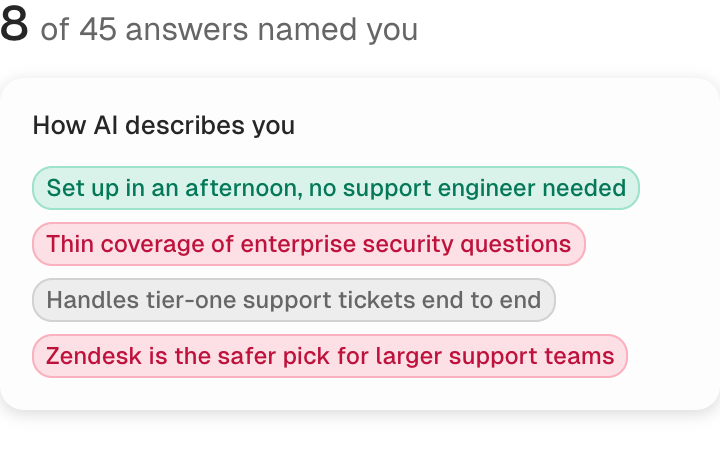
AI search is an additional discovery surface where SaaS buyers encounter cited sources, brand recommendations, and referral links. Its role depends on both third-party selection and content signals a team can influence.
:quality(80))
Recommendations, citations, and referrals
AI search visibility is a brand appearing in generated recommendations, source citations, or links that send researchers to its website.
ChatGPT, Perplexity, and Google AI Overviews can surface a SaaS brand in three distinct ways:
Brand mention: The company is named, but not necessarily presented as an option.
Recommendation: The product is named as a suitable option for the buyer's request.
Citation: A page is used as a source for part of the generated answer.
Referral: Someone follows a link from the AI platform to the site.
A citation can appear without producing a visit. A referral can come from a cited source even when the answer does not recommend the brand.
Track each outcome separately alongside Google rankings, organic clicks, and conversions. AI search expands the SaaS discovery journey; it does not replace traditional search.
Choose monitoring prompts from sales calls, comparison searches, category questions, and recurring objections. Run spot checks on a consistent prompt set and record the model and result, but treat each observation as directional because generated answers can vary between runs.
Content signals you can control
Controllable AI-search signals are clear, conversational, authoritative content with original evidence and structured answers to buyer questions.
Write pages so a buyer and an AI system can identify the answer, verify the product details, and distinguish your evidence from generic summaries:
Direct answers: Answer the buyer's question in the opening sentences, then add the detail and caveats needed to support it.
Conversational language: Use the terms buyers use in prompts and sales calls, including natural synonyms, instead of repeating one exact keyword.
Clear product facts: State who the product is for, what it does, and where its limits apply without vague claims.
Structured comparisons: Use descriptive headings, bullets, or tables so pricing, use cases, and tradeoffs are easy to locate.
First-hand evidence: Add documented tests, product screenshots, customer examples, or expert commentary that shows where a claim came from.
Proprietary data: Publish internal benchmarks, usage patterns, or original research when the methodology and scope can be explained.
Consistent entity context: Keep the company name, product category, audience, and core capabilities consistent across product pages, articles, and profiles.
These signals are controllable inputs, not guaranteed outcomes. The AI platform decides which brands to recommend, which sources to cite, and which links to include.
How should SaaS teams measure SEO?
Measure SaaS SEO from qualified pipeline and revenue backward. Conversion efficiency explains funnel quality, while visibility and page signals diagnose why commercial performance is changing.
:quality(80))
Read the funnel in three layers: qualified pipeline and revenue show commercial impact; conversions and acquisition efficiency show funnel quality; visibility and page performance explain where the movement began.
Business and conversion metrics
This section interprets the measurement contract you defined in Step 2. Start with qualified pipeline and revenue, then work backward to determine whether a change came from visibility, click-through, conversion, or qualification.
Demo request
Trial start or account signup
Contact request
Product-qualified action
Sales-qualified lead
Use the same event definitions in analytics, the CRM, and revenue reporting. Otherwise, a “conversion” can mean one action in Search Console reporting and another in the sales pipeline.
Judge conversion efficiency against your own baseline. Compare results by:
Landing page
Query group
Funnel stage
A high visit-to-signup rate means little if those signups rarely become qualified opportunities. Compare related content groups as well as individual pages, and report sourced revenue separately from revenue that organic content influenced later in the journey.
Calculate organic CAC with a simple formula: accepted SEO costs ÷ new organic-attributed customers. Document whether the numerator includes tools, staff time, agencies, production, development, and distribution before comparing it with fully loaded paid acquisition.
Revenue attribution should also use one documented model across reporting periods. First-touch, last-touch, and multi-touch views answer different questions, so changing models can create movement that SEO did not cause.
Leading indicators and review cadence
Leading indicators show whether pages are being discovered and gaining search visibility before enough pipeline data exists. Use them to investigate progress, not as substitutes for qualified pipeline or revenue.
Start with indexing status and initial impressions for new or changed pages. Once a page has enough activity, review clicks, click-through rate, query position, and conversion rate by page and query group.
When aggregate Search Console data hides a change, segment the trend by:
Query and landing page
Device
Country
Search appearance
A decline limited to one page or device needs a narrower diagnosis than a sitewide decline.
Once the program has enough data, use this operating cadence across the portfolio. It complements the page-level checks in Step 9 rather than replacing them.
Review level | Primary focus |
|---|---|
Weekly | Page and query movement, technical anomalies, publishing status |
Monthly | Clicks, impressions, conversions, content refresh priorities |
Quarterly | Organic pipeline, revenue attribution, CAC, and strategic priorities |
What happens when execution stalls?
Execution stalls when a priority page gets stuck between research, writing, approval, and publication. Limited content capacity and slow approvals are common blockers, while the right owner depends on the queue.
Trace the oldest unfinished page through each handoff. A vague “content is delayed” problem usually becomes a specific queue: incomplete research, no writer, CMS friction, developer dependency, or an approver holding the draft.
Assign one accountable owner and one next action to every blocker:
Placeholder | Value |
|---|---|
Not applicable | Not applicable |
Use a weekly recovery loop until work moves predictably again:
Measure backlog age: Record how long each item has waited in research, drafting, approval, CMS, or development. Start with the oldest blocked item.
Measure publishing throughput: Count pages published or refreshed during the review period, then compare completed work with the ready backlog.
Measure technical resolution: Track each dependency from ticket creation to completion, including its owner and next checkpoint.
Evaluate commercial impact after throughput recovers: Once published work has enough data, review qualified conversions alongside Search Console trends. Diagnose visibility first, then judge contribution to business outcomes.
If throughput stays flat, revisit capacity and approvals. If pages ship but visibility or conversions do not improve, return to query fit, content quality, and technical health instead of pushing more drafts into the queue.
Get a dedicated SEO and GEO content team with RankUp
The nine-step system works, but a lean SaaS team still has to research, plan, write, approve, measure, and improve every page.
RankUp is a self-improving SEO and GEO agent system that turns that workload into planned, reviewable execution.
:quality(80))
RankUp keeps your business context and performance data with the work. Approved articles, audit decisions, and knowledge updates inform the next cycle, so the team starts with an informed view of your company.
Agent | Role in the system |
|---|---|
Magnus, SEO Strategist | Owns keyword research, market coverage, content planning, and the supporting organization of knowledge used for strategy. |
Cedric, Content Writer | Owns live SERP research, outlines, blueprints, focused interviews, writing, review, internal-link proposals, and the CMS-ready handoff. |
Lyra, Content Manager | Handles performance analysis, audits, updates, site-wide changes, internal-linking initiatives, creative-brief edits, and knowledge updates. Lyra routes writing work to Cedric. |
Those roles become useful through the handoffs. One content cycle moves from a prioritized opportunity to a reviewed article, then returns with performance evidence for the next update:
Plan: Magnus maps demand, coverage gaps, and priorities against your business context.
Execute: Cedric researches the live SERP, builds the outline and blueprint, asks focused questions where expertise is missing, writes the article, reviews it, and proposes internal links.
Approve: Your team reviews the draft, link proposals, and CMS-ready handoff before anything changes on the site.
Improve: Lyra reads performance and audit findings, prioritizes updates, and routes required writing back to Cedric for another reviewable edit.
RankUp keeps Google performance and AI visibility separate, so the next action rests on the relevant evidence:
Google performance: RankUp uses Search Console data to track clicks, impressions, ranking movement, and page-level changes. Lyra uses those signals to decide what needs attention next.
AI referral traffic: The PostHog integration can identify sessions referred by AI assistants and measure configured conversions without storing raw events.
AI mentions and citations: These still require direct spot checks until RankUp's AI Search Monitoring ships. A single appearance can vary by model and run, so RankUp never treats it as guaranteed placement.
Alonso Solis, co-founder of Guardian Home, said the team produced about 55 blogs and landing pages in roughly three months. Leads began around the first month, and organic search became one of Guardian Home's main pipeline channels.
RankUp first learns your business and brand context, analyzes the site, runs a light AI-search audit, finds topics and next actions, and proposes a tailored plan. The 7-day trial follows that work.
During the trial, you execute the plan through content creation and refreshes. start your 7-day free trial to turn your site's next priorities into reviewed, publish-ready work.
(For SaaS and tech companies with English-language sites only.)
FAQs
What tools do SaaS teams need for SEO?
Add SEO tool categories as the workflow creates a real need. Each category supplies data or production support, but your team still owns the decision and follow-through:
Search analytics: Use Google Search Console for queries and indexing reports, then connect Google Analytics when you need to tie organic visits to conversions.
Keyword and backlink data: Add Ahrefs or Semrush when you need competitive research, rank tracking, or backlink monitoring.
Technical crawling: Use Screaming Frog when indexing reports cannot explain site architecture or duplicate-page problems.
Content workflows: Add briefing, optimization, or AI-assisted production tools when research, drafting, internal linking, and updates become a repeatable bottleneck. The tool should move work forward, not merely produce another score.
When should a SaaS team hire an SEO agency?
Hire an SEO agency when you have a defined organic opportunity but lack execution capacity or specialist technical expertise. Check technical complexity, internal ownership, feedback speed, access to product experts, and whether the agency can retain enough context to improve work across cycles.
Do not outsource an undefined channel problem. The team still needs an accountable internal owner, timely approvals, and a measurement window long enough to judge the work.
How can a SaaS blog support product adoption?
A SaaS blog supports product adoption when educational content teaches a real workflow, resolves an implementation objection, and connects the reader to the relevant product capability.
An update guide can demonstrate the manual process, show where the product handles it, and link to the matching feature or use-case page. The same approach can reduce onboarding friction, answer setup objections, and help existing users discover an underused capability.
How long does SaaS SEO take to work?
SaaS SEO does not have one universal timeline. Technical fixes can affect discovery first, ranking movement follows as pages earn relevance and authority, and qualified pipeline appears only when the traffic reaches the right offer across the buying cycle.
Does SEO work for early-stage SaaS companies?
SEO can work for an early-stage SaaS when buyers already search for the problem or category and the site can support a conversion path. If demand is unclear or direct conversations are still defining the market, customer research and sales should come first.
What is the difference between SEO and GEO for SaaS?
SEO helps SaaS pages rank in traditional search results. GEO helps the brand become understandable and citable in generated answers, but both depend on clear, authoritative content and should run as one discovery program.
Which pages should a SaaS company create first?
Create the pages with the strongest combination of validated demand, product relevance, and conversion value. Use-case and comparison pages often qualify, but an existing page may need an update before the site needs another URL.
How should a SaaS company measure SEO success?
Measure SEO primarily through qualified organic conversions, pipeline, and revenue under a consistent attribution model. Use rankings, impressions, AI citations, and AI referrals as diagnostic signals that explain how buyers discovered and evaluated the product.
:quality(80))
Author of the article
Georg Richard Aare
Georg is the co-founder of RankUp and an SEO nerd who spends (almost) every waking minute refining his craft and sharing his learnings. When he’s not behind his computer, which is rare, you’ll find him in the gym doing bench (never legs) to clear his mind.
This article was created using: